Showing posts with label Jorge Luis Borges. Show all posts

Monday, July 9, 2012

Borges . . .the unalterable / sum of moments granted you by fate. . .

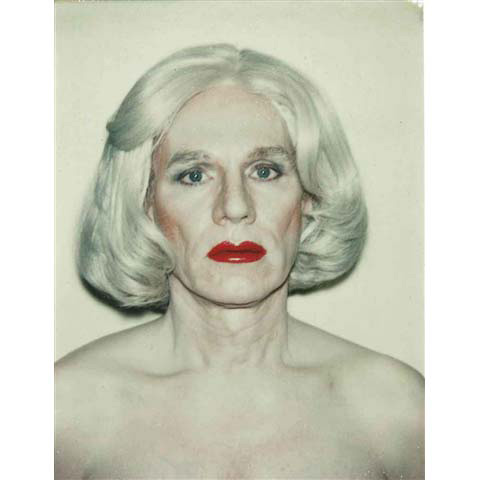
Andy Warhol Self-portrait in drag
(Monroe wig)
I am back to Borges.  


I needed an antidote. Saw an ad this morning for a major chemical corporation, the name of which resonates from the time of the Vietnam War and the occasion of death by formula made product.


Seeing the death star's new slogan was too much. No need to be specific. No need for proper nouns locating actions more improper than the imagination can create.  


Lately I've been remembering the truism: You aren't responsible for your first thought but you are for the thoughts which follow.  


So I'm being responsible. "We live discovering and forgetting / that sweet familiarity of the night." Offering a chance to suck your breath in and marvel. This poem is translated by A.S. Kline. 

(The Andy Warhol self-portrait kinda turns the table on the adoration here. Well, maybe it doesn't turn tables so much as expand the possibilities. More expansion, ahead.)


The Sum

The silent friendliness of the moon
(misquoting Virgil) accompanies you
since that one night or evening lost
in time now, on which your restless
eyes first deciphered her forever
in a garden or patio turned to dust.
Forever? I know someone, someday
will be able to tell you truthfully:
‘You’ll never see the bright moon again,
You’ve now achieved the unalterable
sum of moments granted you by fate.
Useless to open every window
in the world. Too late. You’ll not find her.’
We live discovering and forgetting
that sweet familiarity of the night.
Take a long look. It might be the last.
 _____
Jorge Luis Borges,  tr. by A.S. Kline, @2008

Sunday, January 22, 2012

What will the indecipherable future dream? ... Borges (Still missing Etta & Johnny)

Ric Nagualero*
It doesn't feel quite right to move on from the deaths of Etta James and Johnny Otis so soon (my previous post), but their lives and impact are being sung in so many publications, including the L.A. Times and the Guardian, which I regularly read, and beautifully so, in articles, photos, appreciations.

Every so often I'm proud of the human race. We don't have much capacity to identify stupidity, but sometimes we do know genius.

Tonight I'm going to post another selection from Poems of the Night, a gathering of work from several of Jorge Luis Borges' collections. I want, for myself, his easy passage into dream and back, his understanding of depth, process and transparency of the collective unconsciousness, of the momentous occasion of its existence, and a personal access through myth and dream (and good fortune). Borges gives me hope as an artist and as a believer (in many things).

Each sentence below is a meditation.

Someone Will Dream

What will the indecipherable future dream?  A dream that Alonso Quijano can be Don Quixote without leaving his village and his books.  A dream that the eve of Ulysses can be more prodigious than the poem that recounts his hardships. Dreaming human generations that will not recognize the name of Ulysses. Dreaming dreams more precise than today's wakefulness. A dream that we will be able to do miracles and that we won't do them, because it will be more real to imagine them. Dreaming worlds so intense that the voice of one bird could kill you. Dreaming that to forget and to remember can be voluntary actions, not aggressions or gifts of chance. A dream that we shall see with our whole body, as Milton wished from the shadow of those tender orbs, his eyes.  Dreaming a world without machines and without that afflicted machine, the body. Life is not a dream, Novalis writes, but can become a dream.

Suzanne Jill Levine tr.

_____________
Borges, Waiting for the Night, Poems of the Night (Penguin).

*Painting by Ric Nagualero: www.nagualero.com / Facebook.com/nagualero

Sunday, January 1, 2012

Borges, my last of '11, my first of '12. "Someone," a poem

It seems the right thing, to remember the last poem I read in 2011, and to make it my first in 2012. It's from one of my bedside collections the past few months, Poems of the Night, a selection from three of Borges' books.

"Someone" ("Alguien" in Spanish) is from A Gift of Blindness, 1958-1977.

Like someone, I live with "reasons more terrible than a tiger." Please note and admire how Jorge Luis Borges defines our crouched fears as impossibly muscular.

This morning I jimmied a flyer for an Occupy Language event that will be held on January 26, 5-7:30, at the Bowery Poetry Club, and in hunting for a quote looked no further than James Baldwin. Every legend, moreover, contains its residium of truth, and the root function of language is to control the universe by describing it.

"...to control..." the universe seems too colonial, but "describing it," is just the ticket, a ticket I buy. Borges describes.

Someone

A man worn down by time,
a man who does not even expect death
(the proofs of death are statistics
and everyone runs the risk
of being the first immortal),
a man who has learned to express thanks
for the days' modest alms:
sleep, routine, the taste of water,
an unsuspected etymology,
a Latin or Saxon verse,
the memory of a woman who left him
thirty years ago now
whom he can call to mind without bitterness,
a man who is aware that the present
is both future and oblivion,
a man who has betrayed
and has been betrayed,
may feel suddenly, when crossing the street,
a mysterious happiness
not coming from the side of hope
but from an ancient innocence,
from his own roots or from some diffused god.

He knows better than to look at it closely,
for there are reasons more terrible than tigers
which will prove to him
that wretchedness is his duty,
but he accepts humbly
this felicity, this glimmer.
____________
Jorge Luis Borges, A Gift of Blindness, 1958-1977, in Poems of the Night, Penguin, 2010. (Many translators are listed.)

Wednesday, November 24, 2010

Spinoza and Borges: Someone is building God in a dark cup

Today is Baruch Spinoza's birthday. Of Spinoza, Patrick Kurp in his blog Anecdotal Evidence wrote, "His thought seems inhumanly subtle and demanding, yet Spinoza is among the most humanly compelling, even lovable of great philosophers, excommunicated from the Portuguese-Jewish community of Amsterdam at the age of 23."

Jorge Luis Borges and Spinoza represent a destined pairing of imagination with capacity. Demand and reward. Here are two sonnets by Borges, both translated by Willis Barnstone.

Links to poems by me are at the end of this posting.* Benedictus de Spinoza, November 24, 1632 to February 21, 1677.  "No one / Is granted such prodigious love as he: /The love that has no hope of being loved." [Borges]


Baruch Spinoza

A haze of gold, the Occident lights up
The window. Now, the assiduous manuscript
Is waiting, weighed down with the infinite.
Someone is building God in a dark cup.
A man engenders God. He is a Jew
With saddened eyes and lemon-colored skin;
Time carries him the way a leaf, dropped in
A river, is borne off by waters to
Its end. No matter. The magician moved
Carves out his God with fine geometry;
From his disease, from nothing, he’s begun
To construct God, using the word. No one
Is granted such prodigious love as he:
The love that has no hope of being loved.

tr. by Willis Barnstone


Spinoza

Here in the twilight the translucent hands
Of the Jew polishing the crystal glass.
The dying afternoon is cold with bands
Of fear. Each day the afternoons all pass
The same. The hands and space of hyacinth
Paling in the confines of the ghetto walls
Barely exists for the quiet man who stalls
There, dreaming up a brilliant labyrinth.
Fame doesn’t trouble him (that reflection of
Dreams in the dream of another mirror), nor love,
The timid love women. Gone the bars,
He’s free, from metaphor and myth, to sit
Polishing a stubborn lens: the infinite
Map of the One who now is all His Stars.

tr. by Willis Barnstone

Two related My 3,000 Loving Arms posts:
Today No One Is Your Friend
Experiential Philosophy