Showing posts with label Sufi. Show all posts

Thursday, June 2, 2011

Religion Switching . . .a mist that appears for a little while and then vanishes. . .

***
Maybe I've said this before, but when I was in my early twenties, I decided I needed limits.

I was at the Bodhi Tree, a bookstore of mysticism, religion and of course a little tripe east, west and in the middle.  The sun was setting, maybe I was looking out a window or onto a courtyard, hard to be specific some thirty years later but there was sun and however many miles I stood from its thousand hot tongues I was close enough to its Pacific reflections to feel the distant yet present love of the universe.

Classically inclined, I'd been working my way through writings of the saints west and east. Dope-smoking and contemporary I read Be Here Now (Baba Ram Das) and other books which were great reads at the time and maybe still are.  I was always reading.

But at that moment, that point in flowing time which has no one point in point-of-fact and perhaps no point other than its own silky flow, I knew I needed restraining. I could go anywhere and did, mentally and spiritually and psychically.

You will stay in the west, I said. (I was you.)  That means Christianity, Judaism, Islam.

Note that I was not limiting my reading. Reading cannot be limited. I was limiting my joining. I can't quite say if this transpired before or after my two-year once-a-week training at the Healing Light Center (Rosalyn Bruyere is a real deal aura reader, per the UCLA Dept. of Kinesiology and she just is) or other interests and ventures. It was definitely years before I taught at a Catholic high school.

I'd been trucked over to the Annie Besant Center in high school by my Christian Science mom, though I can't say why, exactly. It might have had something to do with guitar lessons. My Jewish father believed, to his credit, but didn't quite have the gene for spirituality qua place-in-the-heart to hobby I did, my mom did, two of my three sisters did.  (The third sister would not allow so much as a Thanks, You! before a big meal, which reveals a ungene to be respected.)

Hopefully some reader or other is tracking this posting because I cannot figure out where I am right now (in the writing, not my body).  But lifetime-wise, I did stay within Sarah-proscribed guidelines, which were, I admit, partly a matter of style--I dreaded seeing those super serious westerners being so obviously devotee-like when it came to all things Buddhist. That sort of public demonstration of faith has been discredited by luminaries such as Hafiz, Rumi, Jesus, and every single religious person of serious intent. And my intent is serious. God help me.

But also I believed it to be a good idea and though I've had regrets, as a married person regrets her or his beautiful choice when there are so many gorgeous choices, I stayed on track.

Thus here I am, writing this because someone urged a short-lived discussion on a poetry listserv about Buddhist poetry, one of my madeleines (I buy them by them by the dozens) and it got my mind a'wandering. See the problem?

What is your life? You are a mist that appears for a little while and then vanishes. (James 4: 14; not sure which tr.)
***painting by Richard Bizley

Monday, May 23, 2011

My Mind is not a Database

Over the past three months I have researched and entered well over 100,000 facts, pieces of information, data related to medical advertising, medical editing, scientific research and good restaurants for take-out, into my brain.

When, two Saturdays ago, I attended a lecture on one school of Sufi thinking, I luxuriated in the possibility of overriding some of the nesting and organized details of Pub Med (see previous posting) and academic honors with more beautiful facts. Having been shown gorgeous slides of Sufi shrines and tombs to Sufi teachers I felt a possibility of peace and a cleaner, less encumbered mind.

One teaching numbed me in an exciting way. A sage had urged Muslims should pray for all Muslims. I hear parallel versions of that in churches--praying for all Christians--but I never gave it much thought before.  (And parallel, also, in synagogue, to include the third of my personal triad.) Seemed like a standard issue preaching from the pulpit. At the time I thought that if I generalize Islam, reduce it to its most mystical branch, praying for all Muslims is a joy.  However:

If I reduce Christianity, reduce it to its mystics and decent faithful believers who really try to do good, help the poor, and get enough inspiration to keep going, blanket prayers are also easy. But my mind instantly went to Christians I dislike: the hateful rightwingers; "pro-lifers" who kill in the name of pro-life; the well-fed aristocracy of clerics all religions have now and in history which commit abuses including sexual abuse and, by refusing to allow use of condoms, are responsible for millions and millions of deaths by AIDS, well, then my praying is challenged.

You won't believe it, but I thought I was leading up to writing about poet W.G. Sebald's After Nature, which was my subway book last week.  It's part of my database mind reaction. I'll tell you about that tomorrow.  For today, I hope (and pray) for everyone's highest angels to elevate us all. It's the best I can do; may it be doable for our higher angels.

Sunday, February 20, 2011

Cihan Okuyucu on Rumi, his piety hiding in divine love

 
Cihan Okuyui, author of
Rumi, Biography and Message
"Rents . . . increased excessively..." That statement strikes dread in the hearts of New Yorkers.  Fortunately the rents referenced were in Baghdad in the early 1200s. That's when Rumi and family fled Balkh in northern Afghanistan. Mongols descended as Mongols were want and destroyed Balkh and other cities, hence a westward migration to Baghdad, hence a spike in rentals. Rumi's family caravaned to Hejaz, which might have been cheaper than Baghdad, but who knows, a city's a city.

His father and relatives were scholars and religionists, and he was well educated well into his adult years. A teacher, Burhanaddin, stepped in after his father's death and sent him to Aleppo and Damascus to perfect disciplines of learning, culture, art, Koranic study, mysticism over a period of nine years; then insisted on three 40-day ascetic retreats after which Rumi's heart was "awakened to divine secrets."* I don't doubt it.

Barhanaddin left Kayseri where he died. His tomb is still the most-visited n the city. I can't tell you where Kayseri is, but I will visit the tomb of Rumi's teacher in meditations. Students visited Rumi.  He had "divine love in him but his love was hidden in his piety."*  Later, "his piety would hide in his love."*

*I'm reading Rumi, Biography and Message (The Light, 2007) by Cihan Okuyucu, who teaches Turkish lit at Fatih University.

Wednesday, December 8, 2010

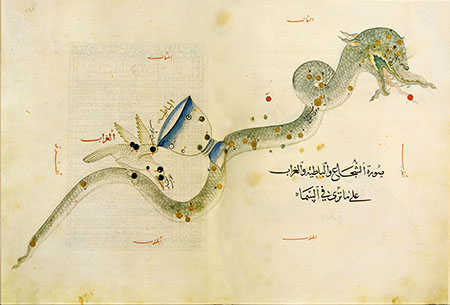
Hafiz: a ghazal; Andromeda as "A Little Cloud" [Abd al-Rahman al-Sufi]

from al-Sufi's The Book of Fixed Stars
...amazing...
My keen mental preparation for yesterday's posting about Hafiz was spurred by D., who'd told me it was Hafiz's birthday.

Keen mental preparation in my world consists of, more or less, me thinking, Huh; Hafiz; can't wait.

It turns out D.'d seen this in a Parabola Magazine newsletter:


Abd al-Rahman al-Sufi (December 7, 903 – May 25, 986) was a Persian astronomer. . . [who] published his famous Book of Fixed Stars in 964, describing much of his work, both in textual descriptions and pictures.
Hafiz the poet was a Sufi (a Sufi of Sufis of Sufis among Sufis) and Persian. I would think Al-Sufi was a Sufi by his name, but that conclusion could merely highlight my western ignorance. He was Persian, wrote in Arabic and according to http://www.worldlingo.com/ma/enwiki/en/Book_of_Fixed_Stars synthesized the work of earlier astronomers (Ptolemy) in his Book of Fixed Stars, complete with exquisite illustrations, as above. He called the Andromeda Galaxy "A Little Cloud;" sounds like poetry to me.

In another lifetime I studied Ptolemy, and retain vestigial interest. But I'm posting more of the great lover, Hafiz, again translated by Elizabeth T. Gray Jr in The Green Sea of Heaven, an amazing collection of ghazals.

Ghazal 22

Remember the day of union with the friends.
Remember those times, remember.

From bitter sorrow my mouth became like poison.
Remember the revelers’ cry of “Drink!”

The friends are free of the memory of me
although I remember them a thousand times.

I was overtaken in these bonds of calamity.
Remember the efforts of those who serve the truth.

Although there are always a hundred rivers in my eye
remember the Zindehrud, and those who plant gardens.

After this Hafiz’s secret will remain unspoken.
Alas, remember those who keep the secrets.

__
Hafiz
I found the illustration at Galileo: Images of the Universe from Antiquity to the Telescope
http://brunelleschi.imss.fi.it/galileopalazzostrozzi/object/AbdAlRahmanAlSufiBookOfTheConstellationsAndFixedStar.html

Monday, September 28, 2009

Ekphrasis, Yom Kippur, Christ Consciousness, St. Sarai

El Greco's
St. Bartholomew
I am at odds on Yom Kippur. I was raised a Protestant. My father was Jewish. I am a half-Jewish, Sufi-esque, Swedenborgian Christian who doesn't who doesn't go to church but spends time in churches when the congregation is elsewhere occupied. In New York many stunning churches are open during the day so I can sit and think on the confusing mess of our warring loving natures; ours and mine.

Museums serve a similar purpose, not to discount art for art's sake. Looking at art for looking at art's sake.

It feels good to post this poem here today. Once I learned the Jewish holiday / observance cycle -- and I was in my late thirties by then --  my internal clock a.k.a. voice within opened to its holiness.

The first draft happened at the Met as I was looking at a Flemish painting (pictured), "St. Christopher Carrying the Infant Christ Child" by a Follower of Dieric Bouts This poem was published in The Mississippi Review, a journal which, alas, has folded, and is included in my collection, The Future Is Happy. It was a "best of the web." 


St. Sarah Sarai Carrying the Infant Christ Child

Creeping, is what a saffron sun is doing,
creeping out from a past it will soon revisit.

I hike my blood-red tunic to my thighs
with one hand while the other, well,
in my arms, well, always a child,
always delivered to us in indrawn-
infant stillness, as if creation
holds its breath because, really,
all this is over so much too soon.

Isn’t making art remembering
what we knew? Why not, then, salvation?

The water over rocks cold on granite—
quartz and orthoclase—and slick moss.
I’m the last person who should be entrusted
to carry Him, me of the angry sinner school.

And I would forswear sainthood and irony,
I would, for this one, held against my heart.
_______
Sarah Sarai. Mississippi Review, The Ekphrasis Issue, Volume 14, Number 4 (2008)
Editor Jane Armstrong