Showing posts with label Wallace Stevens. Show all posts

Wednesday, February 15, 2023

Blackbird v Blackbird: Stevens v Sarai: Two Poems

"The End of November: The Birds That Didn't Learn How to Fly" by Thornton Dial2007. The Metropolitan Museum of Art, N.Y.

I am close to embarrassed, but what would be the point. I already know that I am not Wallace Stevens, and he is not Sarah Sarai. That being established may I say I had Stevens poem in mind as I wrote Another Way of Looking. I was responding to Stevens. Saying, Click a prism and you will see different perspectives with each time. But now that I see my poem adjacent to the great Wallace Stevens’ poem, “Thirteen Ways...” Well. Yikes and all that. Sigh. I plow on. First my poem. Then his. Thanks to the editor of Prelude, Stu Watson.


Another Way of Looking
by Sarah Sarai

The poem on the page
remains on the page

the page with the poem is
the page with the poem it

may lift it self (up)

or snack and nap


but there it is on the page

in all its theory


in all its wisdom which

is not all wisdom


hey, a blackbird knows wisdom

just one blackbird


no need to cast shade over

the whole of them


from Prelude Journal, Stu Watson, ed.


Thirteen Ways of Looking at a Blackbird
by Wallace Stevens

I
Among twenty snowy mountains,   
The only moving thing   
Was the eye of the blackbird.   

II
I was of three minds,   
Like a tree   
In which there are three blackbirds.   

III
The blackbird whirled in the autumn winds.   
It was a small part of the pantomime.   

IV
A man and a woman   
Are one.   
A man and a woman and a blackbird   
Are one.   

V
I do not know which to prefer,   
The beauty of inflections   
Or the beauty of innuendoes,   
The blackbird whistling   
Or just after.   

VI
Icicles filled the long window   
With barbaric glass.   
The shadow of the blackbird   
Crossed it, to and fro.   
The mood   
Traced in the shadow   
An indecipherable cause.   

VII
O thin men of Haddam,   
Why do you imagine golden birds?   
Do you not see how the blackbird   
Walks around the feet   
Of the women about you?  


VIII
I know noble accents   
And lucid, inescapable rhythms;   
But I know, too,   
That the blackbird is involved   
In what I know.   

IX
When the blackbird flew out of sight,   
It marked the edge   
Of one of many circles.   

X
At the sight of blackbirds   
Flying in a green light,   
Even the bawds of euphony   
Would cry out sharply.   

XI
He rode over Connecticut   
In a glass coach.   
Once, a fear pierced him,   
In that he mistook   
The shadow of his equipage   
For blackbirds.   

XII
The river is moving.   
The blackbird must be flying.   

XIII
It was evening all afternoon.   
It was snowing   
And it was going to snow.   
The blackbird sat   
In the cedar-limbs.

from the Poetry Foundation website.

Thursday, July 23, 2015

Tattoo - by Wallace Stevens


I'm at Byrdcliffe in Woodstock. One of the rooms has Wallace Stevens' name on it.  
He stayed here. His "Tattoo" is eerie, light equated to a spider to crawling, to 
spreading webs, fastening. I haven't seen stars in a long time. Disconected thoughts.

Tattoo

The light is like a spider.
It crawls over the water.
It crawls over the edges of the snow.
It crawls under your eyelids
And spreads its webs there--
Its two webs.

The webs of your eyes
Are fastened
To the flesh and bones of you
As to rafters or grass.

There are filaments of your eyes
On the surface of the water
And in the edges of the snow.
_____
Wallace Stevens, from U of V.

Friday, December 13, 2013

Wallace Stevens: ...of the two dreams, night and day... "Hymn From a Watermelon Pavilion"


Something's wrong lately. I'm in a deprivation mode. I am become especially inept at the balancing act between work and all-I-love. So before I left for work this morning I told myself to read a poem. There are no windows of opportunity in my mornings. There is a half-hour of bathing, brushing, the luxury of coffee and I'm off. My life is "obscured by sleep."

But this morning I stalled and opened my new Wallace Stevens collection which I bought at the Strand on Sunday to replace my old Wallace Stevens collection. It had finally crumpled like a beautiful ghost in an Alfonso Cuarón movie. A Hayao Miyazaki animated film.

Sunday, I'd asked a nimble Strand clerk to climb the stepladder, which he ably did. Well and good. But as he handed me two books he indicated one and said, "Here's a good place to begin." Grrrr. I held my tongue and paged but couldn't hold it in, turned to his perusing self at the other end of the poetry section. "I'm not beginning." He grinned.

What an ego I have! And what a lie. Of course I'm a beginner.

Someone must have come before me to my new collection as it fell open to:

Hymn From a Watermelon Pavilion

You dweller in the dark cabin,
To whom the watermelon is always purple,
Whose garden is wind and moon,

Of the two dreams, night and day,
What lover, what dreamer, would choose
The one obscured by sleep?

Here is the plantain by your door
And the best cock of red feather
That crew before the clocks.

A feme may come, leaf-green,
Whose coming may give revel
Beyond revelries of sleep,

Yes, and the blackbird spread its tail,
So that the sun may speckle,
While it creaks hail.

You dweller in the dark cabin,
Rise, since rising will not waken,
And hail, cry hail, cry hail.
__________
Wallace Stevens, The Collected Poems of Wallace Stevens (1982)

Thursday, October 4, 2012

Wallace Stevens. "Farewell to Florida" in my Chakras.

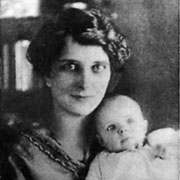
Elise Stevens & child (Holly?)
I answered a call to read Wallace Stevens' "Farewell to Florida" out loud, and a good choice it was, an exemplary way to positively reward my recent push to say Yes! to opportunity.

It was Bob Quatrone who put out the call. An established (as they say) poet in the New York open mic scene, with no small level of erudition when it comes to poetry and poets, Bob curates the Four Horsemen reading at the Cornelia Street Cafe in the Village.

He was specific in asking for a reader for this poem. I didn't remember having read it. Maybe I did, maybe I didn't. My edition of Stevens' poems crumbled with age last year and I still haven't replaced it.

"Farewell to Florida" isn't necessarily elegaic, though it is, Bob told me, written after Stevens wife died.  What made this such a wonderful poem to read out loud several times before the reading--on the subway platform, while walking crosstown on Bleecker, while on my building's stoop--was its subtlety. Which is subtle. On first read it is, as Harold Bloom has written, Shelleyan and Spenser-like (paraphrase), and that slight formality, that almost clever rhyming surprised me, and not happily.

Cleverness is something to be fought, in poetry.  Any poet worth her lines is enormously clever. Clever is easy, a cheap trick. It was the rhyming that seemed too easy, although I don't encounter rhyme much in poetry I read, unless it is slight as a functional braincell in a Tea Partier's brain. So when I read, "Her mind had bound me round. The palms were hot / As if I lived in ashen ground, as if / The leaves in which the wind kept up its sound. . . " I wasn't won over.

Dissection isn't the necessary ticket to embrace, it turns out.  (Read that sentence both ways.)  The poem itself, in its being, won me over, the poem in my head, heard through the mic, off subway walls and track. The poem feeling its way through my body, blood, organs, weaving through chakras, from sexual to celestial and back again.  The silk of it, the tongue-teasing rhythms like the swaying palms Stevens has written of. I suggest you read this poem out loud several times, and tell me if you agree. Also tell me what you think Stevens means by "I am free." Don't be glib.

Farewell To Florida

I
Go on, high ship, since now, upon the shore,
The snake has left its skin upon the floor.
Key West sank downward under massive clouds
And silvers and greens spread over the sea. The moon
Is at the mast-head and the past is dead.
Her mind will never speak to me again.
I am free. High above the mast the moon
Rides clear of her mind and the waves make a refrain
Of this: that the snake has shed its skin upon
The floor. Go on through the darkness. The waves fly back


II
Her mind had bound me round. The palms were hot
As if I lived in ashen ground, as if
The leaves in which the wind kept up its sound
From my North of cold whistled in a sepulchral South,
Her South of pine and coral and coraline sea,
Her home, not mine, in the ever-freshened Keys,
Her days, her oceanic nights, calling
For music, for whisperings from the reefs.
How content I shall be in the North to which I sail
And to feel sure and to forget the bleaching sand ...


III
I hated the weathery yawl from which the pools
Disclosed the sea floor and the wilderness
Of waving weeds. I hated the vivid blooms
Curled over the shadowless hut, the rust and bones,
The trees likes bones and the leaves half sand, half sun.
To stand here on the deck in the dark and say
Farewell and to know that that land is forever gone
And that she will not follow in any word
Or look, nor ever again in thought, except
That I loved her once ... Farewell. Go on, high ship.


IV
My North is leafless and lies in a wintry slime
Both of men and clouds, a slime of men in crowds.
The men are moving as the water moves,
This darkened water cloven by sullen swells
Against your sides, then shoving and slithering,
The darkness shattered, turbulent with foam.
To be free again, to return to the violent mind
That is their mind, these men, and that will bind
Me round, carry me, misty deck, carry me
To the cold, go on, high ship, go on, plunge on.
____________
by (1879-1955) Wallace Stevens

Tuesday, April 26, 2011

Wallace Stevens; Susan "My Emily Dickinson" Howe, Wallace Stevens

On that space for religion?  The enlightened write:  Wallace Stevens.

Poet Susan "My Emily Dickinson" Howe and Wallace Stevens scholar Joan Richardson so worship, and tonight hit the pulpit at the Philactetes Center on East 82nd. They said this and that. Read some Stevens. Preached the word.

Being a group of western civ-central white people (sigh) there was alot of talk about categories. We white people like our categories. Is it a [Stevens'd work]  poem? Can it be music? Rembrandt?  Plato, of course, was mentioned. We white people like the Greeks.

Your intrepid reporter cum slightly sarcastic Stevens lover suggested that's why many poets create collages--music on words next to doilies next to a road map superimposed on Plato.

Catallus was the Platonic dialog referenced (though I jotted Cratallus).  I didn't care about careful notes so I can't tell you which poem submits itself to Socratic questioning.

Susan "My Emily Dickinson" Howe talked about the opacity of "Final Soliloquy of the Interior Paramour" and how one of the lines (I can't read my notes!) (I'm so tired!) has lo and behold a word she looked up in the OED. Its fourteenth meaning was a bingo and she wondered if she was "the one reader" (equalling all readers) Stevens has written about. If he chose that word for her.  He did!

Am I making sense?

Final jotted note:  Peter Quince took a bite out of himself and winced.  That's me.  Rest assured that not even exhausted Sarah Sarai can ruin Stevens.  Why?  SHE LOVES STEVENS. She also loves the feeling of rearrangement signaling new work soon to appear. Howe and Richardson are lovely, by the way.

Night night.

Final Soliloquy of the Interior Paramour

Light the first light of evening, as in a room
In which we rest and, for small reason, think
The world imagined is the ultimate good.

This is, therefore, the intensest rendezvous.
It is in that thought that we collect ourselves,
Out of all the indifferences, into one thing:

Within a single thing, a single shawl
Wrapped tightly round us, since we are poor, a warmth,
A light, a power, the miraculous influence.

Here, now, we forget each other and ourselves.
We feel the obscurity of an order, a whole,
A knowledge, that which arranged the rendezvous.

Within its vital boundary, in the mind.
We say God and the imagination are one...
How high that highest candle lights the dark.

Out of this same light, out of the central mind,
We make a dwelling in the evening air,
In which being there together is enough.

________________
by Wallace Stevens, a great American poet