Saturday, October 10, 2009

Obama's Nobel Peace Prize Is Good News for Poets

American poets may be luckier than I thought. Bearing in mind a Czeslaw Milosz quote that's been nagging at me for a few weeks, "the privilege of coming from strange lands, where it is difficult to escape history," a version of the Chinese, May you live in difficult times, I previously worried I was, as an American, too privileged to write poetry that mattered. Me, or any of us.

But the Nobel Peace Prize committee has made me aware of just how challenging my times, here in America, have been. The prize wasn't awarded to Obama for specific actions. After all, the Oslo decision was made, as I understand it, shortly after Obama's inauguration, when he was still forming his cabinet and choosing drapes.

I woke up around 3 a.m. last night with the realization that America has been far worse off than I ever understood. America, with our dishonestly (first term) elected President Bush, with our dishonest war, our uncared-for children, our illiteracy, our obesity, our quest for continued global domination without any thought for the actual globe we are trying to dominate - and - very importantly - and - our influence - the fact we are a superpower - the dominant economy, even now - has been on its deathbed, writhing, for years.

And ready and able to take down many countries along with us.

So although Obama clearly didn't have much chance to prove himself in his second week in office, or even in his first nine months in office, the Nobel committee felt the stir of something new. Spring. Hope. Change. Buzzwords that weren't lies, even if: Obama didn't help the people of Gaza. Even if: the war in Afghanistan shows no sign of ending. Even if: even if: even it.

The Nobel people and much of the world saw just how sick America has become but unlike terror cells, haters, they have been cheering for us to get well.

WE DO LIVE IN INTERESTING TIMES, Americans. I want my poetry to mean something to my readers (and I know I don't have many, but I have a few). The more it's wrought of sweat (craft: drafts: reading of other poets) and the experience of living in a world that makes little sense (hey, I've done copyediting and proofreading for financial institutions where 10Ks (government filings) 'explain' why fabulously wealthy people should remain fabulously wealthy; I've worked for educational publishing concerns that grew in the wake of the No Child Left Behind act - a lot of teaching for the test - little read education - a lot of teaching-for-the-test books SOLD; hey, I've worked in advertising (enough said?); and on; and on).

It took the awarding of the Nobel Peace Prize for 2009 to assure me I and we and you have a chance at writing poetry that can effect its own style of hope and change. The global community needs that from all poets. America is an innotive and generous country; Oslo knows that. I feel the love.


Tuesday, October 6, 2009

The Book of Practical Pussies: poetry in a bustier

The Book of Practical Pussies is a dream to review but for the prospect of some businessman at the next table at my little coffee house/office observing me study ink drawings of pussies in bustiers or spreading them as if for Hustler.

Sure, I can tell the businessman, The poetry is really good. And he can argue with equal validity, So are the articles in Playboy.

But, dear poetry-lovers, cat-idolaters, pussy-strokers, sensuous kinkoids, crotch-shot admirers, the poetry and prose in The Book of Practical Pussies is worth a read. Consider: Co-publisher is Lee Ann Brown's Tender Buttons press, and Lee Ann Brown wrote Polyverse, one of the more remarkable - original joyful and true - books of poetry I've read of late. As the friend who recommended Polyverse understated, You really should take a look. She's done something, there.

She's done something here, in conjunction with KRUPSKAYA Press. Nine writers, plus a scary good artist Michelle Rollman, marries lithesome, whimsical, weird and sexy line drawings of cats and kitties and pussies in states of dishabille, of silk dress, and sluttish undress, with word.

Writers are Camille Roy, D-L Alvarez, Yedda Morrison, Scott Macleod, Jocelyn Saidenberg, Kevin Killian, Robert Gluck (with an umlaut over the "u"), Dodie Bellamy and Lee Ann Brown. From Yedda Morrison's "Harryetta the Slum Puss," a persona piece, a bit of a dramatic monologue midway in the book, Harryetta tellin' it like it is, sister.

"Toms are always leaving parts of themselves inside me so when I purr 'OK, Tommy, turn over' and you respond, just by raising your middle, 'No please, I'm an ass cat, do it there, just a hair bit higher,' I do." I say, you don't have to be a cat to be a cat.

So there's that. It takes brass to address sex, its confusions, power and sloppy joys, to flaunt sexuality. The Book of Practical Pussies is brassy. Flaunty.

Camille Roy's "History of the Slut in my Relationship" hints at the feline, works on the issue: "The problem with sex is that it fires the harder life." As the first poem and opening volley of this book, "History..." leaves the animal issue ambiguous. A "spreading butt" is a spreading butt. It's a strong somewhat solemn poem. Opposite is a drawing of a kitty licking her rear; she is all kitty but for one raised leg in a silk stocking with a seam, and a Chita Rivera high heel. You can get things done on heels like that.

Elsewhere is "Cat Scan," one of a series of poems by Kevin Killian. A little silly, that title, but not the whole. "You lie on your back, flimsy gown of paper, / and a cat walks down your body, / your forehead, your throat, sternum, stomach / and so forth, til the tiptoeing creature stares / back at you over his shoulder. / Kevin, you are going to die."

Robert Gluck's (umlaut over "u") smart dialog between Mr. Fox and Miss Kitty began long before Tender Buttons Press stitched itself to his slacks, as "Chapter XXIV," the title of his contribution, suggests. We've met Fox and Kitty before, right?, in an English frolic. This tradition of dressing up the creatures is old, magical and, in Gluck's ("u" + umlaut), piece, well referenced (in the sense of a jazz solo referencing a few bars of the songbook or Schubert). Fox and Kitty are civilized as two Oscar Wilde drawing room snipers. "'The trees and dirt path darkened as your head slid down the front of his pants!' Miss Kitty sat as stiff as a basalt pharaoh. Mr. Fox sniffed the air.' Are you smoking with him?'"

If one of Dodie Bellamy's older aunts, a parent, an incontinent, farting, demanding, selfish soul, needs care, Bellamy has been schooled by living with -or for- her cats for many years. Hers is the kind of sexing loving eating living that is nonstop as life; "Blanch and Stanley" is a three-page single paragraph of cats licking, butting, stroking, demanding. "Fur fur fur fur everywhere and always the stench of urine he kneads my lap he kneads my tit, he rubs his face against my tit and drools."

One last story, Scott MacLeod’s “Pussy in Hollywood,” a series of cat porn stage directions. “Showing us a close-up of her nice breasts as she has sex with a tom doggy-style.” “Having sex with a tom against a sink in a bathroom and then stopping to talk for a bit showing us her breasts." More writers, surprises, drawings.


The Practical Book of Pussies. KRUPSKAYA / Tender Buttons (a collaboration). 79 pages. Paperback. $15. Go to http://www.krupskayabooks.com/bopp.htm for information on where, how, to buy (now).

A Vote for Ross Perot: from my novella

The Interview

“Leave now,” the receptionist on 11 warned Princess. “Run, go, get out of here, don’t turn back.”

“He’s coming down?” Princess already knew this lawyer could be tough. Already she knew. She needed work. Already Princess knew: This lawyer broke rules—good; screamed—not good. Two wives, she already knew; she knew a fiancé called the office one day to cancel as wife three. So she already knew: He was single. Also known: So was Princess. What in a lawyer who might be her boss could be overlooked? Or a husband? What in her life could Princess make happen? This lawyer was Jewish—it was a Jewish law firm, Princess was applying for work at a Jewish law firm. That’s what she was doing. She was applying to work for a Jewish lawyer—he was single. Princess could see herself married to a Jewish man who was wealthier than her Jewish dad, non-legal, was. Princess saw him two inches taller than her short dad, and thin, with a less confused biography than hers. But sympathetic to Princess’ life experience. Princess needed work.

Forget marriage. Princess needed work. Who was Princess? A woman needing work! Forget single, Princess. Get the job. Work, Princess.

In Princess’ life there were no small plates, platters only, and those platters were large. Those platters were full. Princess had big full platters this lifetime. No husband, Princess had no husband. But Princess needed work; that’s what she really needed. Life expanded, life changed; if in those shifts there could be located a line, at the bottom, a bottom line, that bottom line for Princess these days, here, in New York, famous New York City was: gotta find work. Gotta pay the rent, the famous New York City rent.

“Get in that elevator,” the receptionist on 11 repeated. She called Arnie Sharaga’s office. “Where are you?” the receptionist barked into the phone. “This guy is too much,” she spat to Princess. “He thought we were supposed to announce you’d shown up.” Raised her eyes to heaven, or Human Resources, on 24. “H.R. told you to be here at 10:30, Arnie.” She dabbed at her lips. To Princess: “They told him you’d be here at 10:30, but oh no, he needs a reminder.”

Princess’ watch: 11:00 a.m. “I’m worried I gotta get back to my job.”

“Who does he think he is.” This was not a question. It was a statement, a growl from the receptionist on 11, and it was inciting Princess. Just who was this Arnie Sharaga, anyway, to keep her waiting? She would get docked. This wasn’t going to pan out. Princess was fuming. She was thinking, “Just who,” as worked up as the receptionist on 11, “is Arnie Sharaga.”
He arrived.

The receptionist on 11 was Pig Pen, but it was not dust around her. It was, Who does he think he is. puffing here, puffing there.

Puffing here, puffing there, that was a good description of him, Arnie Sharaga, the attorney who was here to interview Princess. He would puff, “I collect art.” Then, “I’m flying to Florence for a week.” He would mouth “Florence” like he started the Renaissance, Princess would think.

Princess straightened her shoulders. “They told me the interview was at 10:30.” See why Princess didn’t have a job? See why Princess didn’t have a husband?

Arnie led her to a small caucus room on a floor of conference and caucus rooms, of corridors and doors, closed clicked shut; of carpeting and parquet floors. The next foot she put out was Princess’ best. “Oh how very nice.” She meant the caucus room. Arnie Sharaga was better looking than she’d heard he was, so well-dressed, and that had her disappointed. He was nicer looking than she was, two inches shorter, notwithstanding; wiry, bearded. A shark in wolf’s clothing. So boss only, not a husband. Can’t marry a man nicer looking than you are. Well.

She’d keep an open mind.

“I thought they’d call me!” Arnie was astonished. He’d been at his desk, drumming the fingers of his right hand against the fingers of his left hand, waiting for the receptionist’s call. For a half-hour, all of it billable, he’d timpani-ed his fingers, checked his watch, fumed to himself, “How dare the receptionist on 11 not call me to remind me I have an appointment at 10:30! How dare she assume I will simply arrive. I am important, a Partner. She should know that. She does know that and still she refuses to remind me, me whose time is so dear. How dare anyone make assumptions about I, Arnie Sharaga.”

No one needed to make assumptions. Everyone knew.

Princess sat straight, and hoped her golden brown hair with auburn streaks, short and as close to a bob as curly-headed, mousse-aplenty woman could get, looked good: smooth yet bouncy and please, God, shiny. She hadn’t had time to check it. Or she’d thought time was scarce. If Sharaga had made it clear he’d be late, she’d have checked; she’d look and feel better. Look and feel better.

He shifted to the side, his arms slightly shielding his midriff. He wasn’t shot; hadn’t past life regressed to a Civil War battlefield—his posture wasn’t that extreme. But Princess didn’t miss it. He was protecting something.
“Did Human Resources tell you anything about me?”

A pyrotechnic display in Princess’ eyes she couldn’t stop. Arnie didn’t miss it. But it wasn’t Human Resources which shared information. Not exactly. To Princess directly, Human Resources said, “I have an interview for you with Arnie Sharaga.” At 10:30, not 11.


The beginning of A Vote for Ross Perot. A Vote... is the second of two related novellas (From the One Side of Heaven), both with the same protagonist, forty years and 3,000 miles apart. The first chapter was originally published in Ampersand/Fordham University.

Friday, October 2, 2009

On Houston, pronounced How-ston

When I walk home from downtown I usually opt for sidestreets with some illusion of an older New York, the New York of my father - who claimed he walked from NYU through Central Park every day of his three years there; of my grandfather and uncles who ran a wholesale business on lower Broadway.

But today, instead of heading uptown on Elizabeth - which from Houston to 1st - Elizabeth's last leg or little toe - isn't all that interesting, with its corrugated door to a greasy garage and other miscellania, I walked east on Houston - the north side - to Bowery. Thought I might drop in on the Bowery Poetry Club. See if a mysterious coffee-drinkin' poem had my name on it.
I stopped short at looming yellows, blues, greens, too many to move on from, definitely not too much color to soak in or want to keep soaking in up down through. There's a new mural there by a tag team (literally), from from Sao Paulo, Brazil, identical twins, Otavio and Gustavo Pandolfo, also known as Os Gemeos (The Twins).
Os Gemeos tell stories submerged in folklore, mthology and hue. There's rhythm and song in the mural, movement, shadow, promise, magic, enchantment. Keith Haring's mural that was, I believe, on the same corner for a month in the early eighties - until it was painted over - and later reproduced by the Deitch gallery is more than well-served.

Public art - art that's accessible in the most democratic sense - to all passersby. Although it's launched and sometimes eroded long before a passage of time yields a verdict on its esthetic durability, its success is measured in velocity and amplitude of immediate reaction.

The images above are from Google image.

Thursday, October 1, 2009

SPD recommends my book: yay

Zowie.

The Future Is Happy is on a list.

Small Press Distribution, the people who serve as a conduit between independent bookstores and independent publishers, included The Future Is Happy in their twice-monthly newsletter of recommended books.

You can get the full list here: http://www.spdbooks.org/Products/List/53/Lister.aspx and of course your independent bookseller -or- independent you can order my book from them. Independence. How American is that?

I independently urge you to BUY THIS BOOK. Poems about Billy-Bob Thornton, Moses, Cain, Jodie Foster, and more more more.
Thanks. My SPD page:

[I, Afterlife]: a response to Kristin Prevallet

Sometime - not that long ago - I couldn't sleep. I'd wander streets of Manhattan and try to figure it out. I knew what I needed. It was everywhere.
This is about poetry.

Not sleeping affected work, affected play, disaffected me. I wanted joy. Insomnia is anti-joy. I'd learned that taking an antidepressant soothed my insomnia. Was a happy morning bugle after a good night's sleep.

Still about poetry.
Sometime not that long ago I didn't have health insurance. In a country that is medicated, overmedicated, unscrupulously and wickedly medicated, I couldn't get a 50 mg-a-day pill. So as I walked this city - which does sleep - don't believe the hype. I felt I was in a glass booth. I felt insane. People who could take a pill were everywhere. Pills were all around. But I lived in glass.

Hang on, poetry.

I understand antidepressants treat depression and that insomnia is a signal of same. I understand more than I am going to say here. Because this is:

About poetry. This is about I, Afterlife, by Kristin Prevallet, a 60-page essay, in handy paperback format that slips into a pocket, slips out of a pocket for worthy meditation on the text.

Prevallet's father killed himself. He was medicated, questionably so, on Paxil. Not long after starting the pills, he started his car, drove to a parking lot, used his gun.

Her grief, this essay, is about the unspeakable; the unbearable. In attaching words to sorrow, this essay is a vessel into which we can pour memory. Why does this essay receive my endless nights, and not other parts of my story? My insomnia lies in the distances of grief, the spaces between suffering. Prevallet understands distances which create the sense of glass. "Language fills in the desire to alter time," she writes. That'll have to do for a reason.

Prevallet writes, "If the body of the text has suffering as its root, then language will take a fragmented, torn-apart form as if it too is suffering. Poetry that seeks this kind of engagement with language is positioned to absorb the brokenness with grief."

And so there are parts to this essay. Poems. The fractured nature of poetic language allows equivalencies of Prevallet's fracture. Drawings. Plain, gray squares, as if by Rothko, age six. Young but still Rothko. Captions are from the police report. "I responded and took photos and evidence (after coroner arrived)." Prose. The flow of language is useful for the elders who need to instruct through storytelling. Prevallet, an elder, tells us a story about a man and a mountain and a dream. That kind of story. "This story, about a man who meets the ghost of who he wants to be, has already been told, over and over." That's good news.

Elegy. "The elegiac burden is the poem expressing, through the form is takes on the page, the broken minds which have shaped it." Sums it up, doesn't it. The parts of this essay. The shapes of grieving. The acclimation to loss.

I finally got my pills. Slowly came to earth, a good place to be on, not over, not under. Life with its many distances is good. Good. I'm always some distance, close or apart, from events, the usual, childhood, which collude to trigger my unsleeping state; it's been a battle that's shaped my life: insomnia; childhood; all that. Prevallet is likely to remain at an unguessable distance from her sadness.

"As a political position, I hold onto my grief." As a political position, hold onto this book.


[I, Afterlife] [Essay in Mourning Times] by Kristin Prevallet, Essay Press. http://www.essaypress.org/
photo: The Conveyer Belt (theconveyerbelt.com) : A Fashion and Lifestyle Journal

Tuesday, September 29, 2009

Tips for Success!

A discussion arose (like a wind from the east, etc. etc.), as such discussions will, on how to get published - first book, second book, poem in journal, story online . . . It happened on a listserv, I, to which, belong. I posted my first book blog from just down the way (scroll down the way), but also wrote (and now in a pique of self-adoration I quote my very words):

"Advice, after a while, can sound like a Cosmo cover:

*Ten Ways to Get Your Book Published!
*Seven Tips on How to Please Your Publisher!

Maybe we could try for Prevention:

*Lose Five Bad Poems by Thanksgiving!
*Walk Your Book to the Publisher in Thirty Days!
*What Your Doctor Won't Tell You About Poetry! (A lot!)"

So Susan Rich, she who has authored The Cartographer's Tongue, Cures Include Travel, and The Alchemist's Kitchen (forthcoming), responded with these three crispy nuggets:

*How to Tell If Your Publisher is the Faithful Kind (Before the Contract is Signed)
*What Your Mother Didn't Tell You About Being a Poet
*How to Believe in Your Own Book (Ten Tips on a More Confident, Lyrical, You)

If you have a handy tip, please share it in a comment. And remember:

*You Too Can Be A Successful Writer! Aim For The Stars And You'll Be All Sparkly!


photo of Edwin Hubble. Title of page: Tips for Success in Observational Astronomy

Monday, September 28, 2009

Ekphrasis, Yom Kippur, Christ Consciousness, St. Sarai

El Greco's
St. Bartholomew
I am at odds on Yom Kippur. I was raised a Protestant. My father was Jewish. I am a half-Jewish, Sufi-esque, Swedenborgian Christian who doesn't who doesn't go to church but spends time in churches when the congregation is elsewhere occupied. In New York many stunning churches are open during the day so I can sit and think on the confusing mess of our warring loving natures; ours and mine.

Museums serve a similar purpose, not to discount art for art's sake. Looking at art for looking at art's sake.

It feels good to post this poem here today. Once I learned the Jewish holiday / observance cycle -- and I was in my late thirties by then --  my internal clock a.k.a. voice within opened to its holiness.

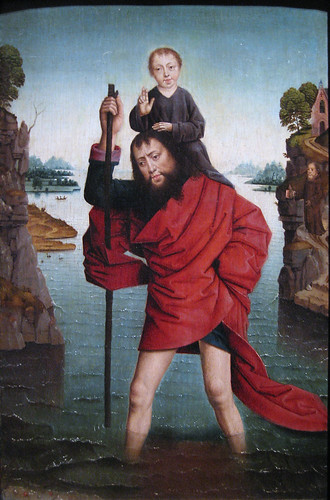
The first draft happened at the Met as I was looking at a Flemish painting (pictured), "St. Christopher Carrying the Infant Christ Child" by a Follower of Dieric Bouts This poem was published in The Mississippi Review, a journal which, alas, has folded, and is included in my collection, The Future Is Happy. It was a "best of the web." 


St. Sarah Sarai Carrying the Infant Christ Child

Creeping, is what a saffron sun is doing,
creeping out from a past it will soon revisit.

I hike my blood-red tunic to my thighs
with one hand while the other, well,
in my arms, well, always a child,
always delivered to us in indrawn-
infant stillness, as if creation
holds its breath because, really,
all this is over so much too soon.

Isn’t making art remembering
what we knew? Why not, then, salvation?

The water over rocks cold on granite—
quartz and orthoclase—and slick moss.
I’m the last person who should be entrusted
to carry Him, me of the angry sinner school.

And I would forswear sainthood and irony,
I would, for this one, held against my heart.
_______
Sarah Sarai. Mississippi Review, The Ekphrasis Issue, Volume 14, Number 4 (2008)
Editor Jane Armstrong

Thursday, September 24, 2009

First book advice #2: no apologies, please

My dearest ones. Yesterday I cautioned against trying to produce a perfect poetry collection. Today's variation on the maelstrom of worry which accompanies a first book is: Don't apologize.

Initially and characteristically I poo-poo-ed my work as soon as it was accepted. (Such a negative pose is ransferrable to fiction, nonfiction, music, photography - pretty much any project in which the sleeve reveals an at least faint outline of the heart's presence.) All of a sudden, I was "over it." So over it, as if every poem I'd written up to that point was no more than a warm-up exercise for the poet I was meant to be.

Knowing me as I do (and don't), my attitude was a device of my little devils of self-doubt, a way to keep me small and disallow great feelings of pride and joy which are warranted by the publication of a book. God forbid I be happy. Ya know?

A friend, not the same friend who warned against publishing a "precious" book, came to the rescue. She wrote, "There was a point when I was embarrassed by my first book because the later work was so obviously better to me."

She urged me to forego the questionable pleasure of feeling superior to oneself, a kinky way of thinking indeed. I stopped myself from telling excited friends I was feeling disconnected from the manuscript. That feeling sure hasn't lasted. I am connected to my book. Very. I like it. I am proud it. Hello, world? Read my damn book!

I could have done a fair amount of damage to myself and my book by putting it out there that I was really better than that! Whew! The silly and true fact is that I love the poems (The Future Is Happy). Whatever self-doubt I felt in October 2008, I am not feeling it now and am so happy I quickly learned to exhibit restraint.

My friend also emailed, "Let yourself enjoy its strengths. Most important of all--don't deprecate the work in any way--even if you feel that way yourself, others won't, and if you suggest to them that it's not your best work, that's how they'll look at it, and that's hurtful."
The impulse is universal. A compliment to your outfit is met with, "This old thing?" and so on.

I love my book and everything in it. I didn't italicize some (about three) words in the final draft which I meant to. I see a mistake on the previously-published-in page. I wouldn't mind flawless, but I have a strong and, as I wrote in yesterday's blog, all-of-one-piece book.

Feedback has been fabulous. Let me tell you; my sweet mother, wherever she is, well, hanging out in the cloud over there, is so proud, as is Pop, rattling ice cubes in his heavenly Scotch.

I hope some of you will take the time to read my book and appreciate its heart, quality, spirit, tenderness, humor and wild imperfection.

And as you assemble your work of art, be thoughtful. And when your work of art is out there, be proud.
first review:
buy from Amazon:
Mary Martin, Peter Pan, "I Gotta Crow"

Wednesday, September 23, 2009

First book advice: The Future Is Happy

Now that my first book, the poetry collection The Future Is Happy has its own page on the SPD (Small Press Distribution) website, I am ready to talk.

Now independent bookstores can order it, and independent book readers frequenting independent bookstores can buy it. This is big. At least for me. The Future continues to be available from Amazon, my publisher (BlazeVOX) and from me.

I'm a lucky duck to get published over-the-transom. I did try four or five contests run by literary presses or university presses, didn't win, knew I could not afford the fees and slightly mistrusted the process (not fair of me, really), so I started searching elsewhere.

When my manuscript was accepted I was given a piece of advice, as if advice were a cherry pie I could gobble down. A friend with three books out told me not to try for a perfect book.

"It'll lock you in. You'll always have to live up to it. Who wants precious?"

I appreciated permission to be imperfect. Those gem poems of mine were in the book, but so were poems a little more ragged - though loved by me. Who's to say in the long run which is a more meaningful experience of a poem? Well, the reader is to say. Harold Bloom and Helen Vendler. But really I write for greater closeness and salvation, corporate and always mystical.
The way is sure but it's got to be varied. So many are on the path.
Because my book was accepted during the ongoing economic meltdown, there were delays and more delays. By the time I received the first proof I saw a few things I wanted to change.

With Geoffrey's (my pub.) blessing I swapped out a few poems. As with any project, time away offers perspective. My reasoning in choosing new work, some of it written after the book was accepted, was to make the whole more whole, the more whole stronger, but not to make it perfect.

I am not a perfect person and less so a perfect poet. I am not a perfect poet and less so a perfect person. A stream of hot radiant light is focusing my next book. I have nothing to live up to, in following The Future Is Happy, but nothing to live down. I am proud of it, amazed it ever happened - I am sixty - and ready to be ready.

Note: Cover photograph by Susan Tamany.

Saturday, September 19, 2009

O! Poetry Foundation, thee is a silly goose


Something on The Poetry Foundation's website just made me laugh. Its "Around the Web" page lists categories of interest to poets, and the funny category, for two hundred million, Alex, was "Regional Poetry."

You have, no doubt, heard the term "Regional Theater." Coined in New York it translates to "not New York City." I've lived in cities with thriving theater scenes--Los Angeles and Seattle, among them. I know. For a fact. That New York City theater is not "the" best. It's just often but not always real good. The term "regional," however, casts a shadow over the quality of any other city's theater.

Now Chicago, where Second City (ahem) improv group famously works out, where the Poetry Foundation is based, is calling itelf the epicenter of poetry by referring to all other poetry centers as regional. Don't tell me The Foundation was blind to this when they set up the page.

"Regional Poetry," as opposed to the other kind of poetry?, is apparently found in New York (Poets House, 92nd Street Y, etc.), Seattle (Hugo House), and a few other places.

I know. Fair is fair. Revenge is sweet. Though I think it would be new and brave to forget "regional" and just talk of poetry. Will an Istanbul link, soon to appear, I hope, be considered regional? Are all the many fine poets of Minnesota's "The Loft" simply regional?

And City Lights Bookstore? A wellspring of regional poets? Buffalo? Philly?

It's just silly. That's all. Silly. Trust me, I understand what it can feel like to do battle with the provinciality of the biggest small town in the world, but I still hope for innovation. Our world? Fractured and dangerous. Poetry? A chance to show us this terrified world and offer a new and better vision.

Maybe regional poetry centers will be up to the task.


Note: TPF throws around a lot of money and for a good cause. My argument is with the term only. Also, I wouldn't mind getting a poem in Poetry some day. Stranger things have happened, but usually they aren't legal, or they involve mushrooms.

Thursday, September 17, 2009

Open Mic Poets: I owe you an apology


I write these posts in a flurry--which is good--I've finally made peace with imperfection; and so I sometimes have second thoughts on what I've written.

Point being, on June 14, 2009 I posted "Open Mic Etiquette {Note to Poets}" and commented on an increasing tendency to deliver long introductions to poems, and that this tendency was most common to poets of the open mic.

What do I even mean by "open mic poets"? Well. Poets who love to read their poems aloud, who enjoy the company of other poets at open mics, mostly held in coffee houses or bars. By and large, open mic poets, as I here define them, don't submit their work to literary journals, or do so only when the journal is tied to one of the open mic venues they frequent.


In New York City, for instance, Evie Ivey's Green Pavilion reading in Brooklyn, a monthly reading series "under the chandeliers" at a funky coffee shop with a large backroom, recently published a slick, well-executed anthology of Green Pavilion poets--poets whose work, whose names, don't appear in publications with a greater circulation.


Okay, definition over. Thing is, when I advised open mic poets against explaining their poems prior to reading them--let the work stand on its own, I suggested--I wasn't exclusively addressing open mic-ers.

In fact, one of the most annoying readings I had attended was of Poetry poets, Poetry being one of the superstar journals of this field. The reading was held at Housing Works Bookstore and featured four poets. The first two poets to read explained their work at length, revealed various resentments held against editors who'd rejected their work, or considered their time at the mic to be a first draft of a memoir. (Much autobiography.)


The final two poets simply read their poems. The final two poets were Philip Nikolayev and Mary Jo Bang. Nikolayev, who is bi-lingual (Russian and English), placed his poem in a context. I don't remember the specifics, just that he offered one or two sentences of introduction--he was born and originally educated in Russia and sometimes listeners are eager to know if his work is a translation or his own.


Mary Jo Bang, also calmly laconic in her notes to the audience, told us a poem she was about to read followed a particular form. And then she read her poem. The emphasis was on the work, not what led up to her writing it.


All of this is to simply urge all poets to trust their poetry to do the work. To trust the listeners to figure it out. Each listener may take away a slightly different "it," one feeling sorrow in a poem, another a tender wit. We can't really control other people's reactions, we can only try. Sometimes I wonder if that isn't why some poets write poetry. And if so, good for them. Just don't explain away your impulse.

Wednesday, September 16, 2009

Emily Dickinson and the Holocaust: Why

I received an e-mail last week from Ezster Rimar, a student in Hungary, telling me she was presenting a paper on one of my poems at the conference "Witnessing Responses: A New Generation's Perspectives on the Holocaust" (held at Károli Gáspár University of the Hungarian Reformed Church, Budapest, September 9-12, 2009). With her permission, I am posting her presentation here. Ms. Rimar's insights into the poem, "Emily Dicksinson Is Jewish," are sharp and sensitive; what impresses me even more is her interest in assessing the poem and not the poet. I've pasted the poem, first published in Fine Madness in 1997, at the end. Following that I include my e-mailed responses to Ezster. And a general note on the poem: My placing Emily in the attic was a trick of synthesis. In a moment objects of my hybrid attention and hybrid debate (hybrid - I am Christian and Jewish) coalesced. I sat and wrote.

Analysis of the poem "Emily Dickinson is Jewish" by Sarah Sarai
by Ezster Rimar

Why this poem
2 years ago, special elective course on E. D.
Task: read poems about her.
This -> interesting title (E. D. Jewish?)
Focus on her in the poem...but why Jewish?
What are the similarities between her and the Jews of the Holocaust?

The poem
Free verse: no rhymes, no clear rhythm -> suggest distraction, restlessness, uneasiness
Unusual stanzas...four lines, 2, 3, 3, 1, 3...no structure, no harmony, no balance
Emotions flowing out just the way they are.

First stanza
We are in the attic
Attic: dusty, mysterious, dark, no light, perhaps no windows, old things, antiquities, forgotten past, bats, ghosts, Charlotte Bronte’s mad ex-wife Bertha (Jane Eyre)...good place for hiding, you don’t go there without an explicit purpose

E.D.’s restricted -> there is something she can’t say/do...makes her stay in the attic and hide her “selective nomadic soul”. Selective: discriminating, selecting like deciding what is good & what is bad? Nomadic: no fixed home, wanderer...her soul is a wanderer. Is Jewish soul a wanderer? Has it got its home where it can feel safe? Has it got the comfort of a home where it can express freely what it feels?

Listing the things E.D. misses: bees, frogs, “sovereign woods”..., nobility, beauty, nature, simplicity...all in few words...how we don’t value them when they are there naturally... 
Squinting at dust, the Oriental carpet, a creaking plank...images, objects from the attic. Squinting -> not being able to see clearly, there is something disturbing in the picture. Oriental carpet vs. creaking plank: carpet soft, dulls the noise of steps, oriental = mystery, sg. unknown...Creaking plank: loud, dangerous, meaning death for pirates...if you walk the plank... don’t know what’s going to happen...when are you going to fall into the water and die, suffocate...

Second stanza
Clear allusion to E.D. with death carriage (“because I could not stop for death, he kindly stopped for me”). Deliberation...won’t abandon! No intention! Come what may! She knows “doors slam shut on his train”. Finality. No way back! Once doors slam shut, it’s over. Train -> like train on which Jews were transported to camps.

Third stanza
Introduces Austin, E.D.’s brother, and his wife Sue. Nice pic, w/ children laughing, bringing life, vitality into the attic. Sue also stows things for E. In case she returns...again the most important things. Maybe crusts and laughter are enough for happiness...
Bread crusts: parts thrown away by so many. Precious for those in exile.
Jew-in-white: important picture in E.D.’s life...wore white all the time. White: symbol of purity, peace, angels, wedding (bride’s gown), in some cultures funeral also...also white associated w/ ghosts...if the woman in the attic wears white and is a Jew, perhaps...ghosts from the past up in the attic.

Fourth stanza
Shows a possible outcome. She could die there, or be captured. No other alternative. She will not go from the attic from her own will. She will not just appear as if everything was all right. She can die there, or be captured. And, whichever happens will happen by force.

Why? “Muslin’s soft scratch”...you are restricted...fully. Completely. Are not supposed to do anything. No movements, no noise...even a fine material, like muslin, when touches the desk sounds as loud as “clicked boot heels”. It gives you away. It is not your friend. But you wear it. You wear your white muslin dress. Perhaps that’s all you have left from your normal life. The life that you had to leave behind. From that life before you began to hide in an attic.
Clicked boot heels: obvious allusion to German soldiers. They are loud, merciless, cruel...they will get you and, as the next line says, will “force” you from the attic...

At this point -> thought of Anne Frank...the Dutch girl, hiding with her family from the Nazis, writing her diary, which is found after she is captured and taken to the camp. Diary: important...she’s got a desk...she writes. The diary tells stories, feelings, intros situations, her attitude. Fears and hopes. Wishes. What they are missing...coffee, a nice bath, eating something good, visiting friends, going to the cinema...just like in the first stanza, where we read what Emily was missing. Simple things. Nothing extraordinary. Just everyday things.

Interesting: muslin vs. loud clicked boot heels...feminine vs. masculine, beauty, tenderness vs. violence, force, crudity, cruelty...life vs. death. Think of oriental carpet vs. creaking plank -> also finery vs. cruelty, crudity...

One liner
Emily is forced from this attic. She is found out. Short, factual, no illusions, no explanation, real. Very real.

Last stanza
The final picture. Showing weakness, exhaustion, hunger...giving up. Not able to fight. To say anything, go against the power. “Faint breath” definite sign of it.
Stanzas lapped in smoke: smoke, again reference to death camps, burning the dead. Smoke: hiding evil deeds...also giving them away. Gives mystery to “stanzas”. They are there, but perhaps will never be found. However, they will rise into the air, they will become free. No more restrictions, no more fear, no more confinement.

“Poems as long as one letter, rise.”
Reminding of those short messages, those sighs and silent utterances that were inscribed into carriage walls, whispered in the dark, suppressed in the brain, and let out into the smoke. We must not forget, or neglect these one letter poems. These must stay in the memories so that the world can remember not to repeat the past again.

Conclusion
Why E. D.? She was a lonely woman, who could not come to terms with the world around her. Her father was authoritative, accepted no opposition. Emily’s views, especially those concerning religion, differed from those of her father. She, however, could not reveal them. She did not care about the issues of the world surrounding her. She turned from the detested outer world to her own, created one where she could avoid embarrassing social situations, meaningless conversations, and rejection.

Attic 2: mind...back of the mind...suppressed memories, thoughts, hopes and fears
Her fears, her hopes and wishes, her inability to communicate makes her a good agent for this comparison. The Jews of the Holocaust also had to hide. Not only physically, but also they had to hide their convictions, their beliefs. They hungered understanding, acceptance, they wished for normality, simple, everyday things. Just like E. D., who many times wrote only to her desk, unwilling to have her works published, Jews of the Holocaust, and we might definitely take the case of Anne Frank, also kept their deepest thoughts secret from the world.

Psychological bond between 19th, 20th, and all the centuries. Fear is never different. Whether self confinement or society presses one...must not be allowed. People are the same in all centuries.
###


Emily Dickinson Is Jewish

Emily Dickinson is Jewish and hides in an attic.
Restriction and Emily's selective nomadic soul breed
Speculation. She misses bees, frogs, familiar sovereign woods.
She squints at dust, the Oriental carpet, a creaking plank.

Emily won't abandon Death's carriage.
She knows doors slam shut on his train.

Austin's wife Sue stows bread crusts
And the children's laughter
For her Jew-in-white.

Emily could die here or be captured,
Muslin's soft scratch on the desk
Loud as clicked boot heels.

Emily Dickinson is forced from this attic.
Faint breath and her thin tongue.
Stanzas lapped in smoke.

Poems as long as one letter, rise.

...... Sarah Sarai

###

9/14/09

Dear Ezster:

I found your insights and analyses to be on the mark, and I thank you for your sensitivity. If you don't mind, I add a few thoughts, at random. Please note that none of these thoughts is meant to replace or criticize your critique. The attic: It is also a place to write--Virginia Woolf's fabled room of one's own. Your conclusion: Yes, Emily was lonely and unable to tell her authoritarian father her mystical versions of religion. But I would argue with the sense I receive in reading your that paragraph that she is a victim. She wasn't only lonely. She wasn't totally isolated. And God knows, that woman had a visionary inner life that had to offer many satisfactions. I suggest she was extremely lucky to know the confluence of genius, originality and opportunity. [[[[[Granted, her life--happy, unhappy, voluntary, forced, personality disorder, genius (well, that's not debated), straight, gay--provides an ongoing debate for readers, scholars, feminist scholars--and more so than Elizabeth Bishop's or Robert Lowell's or Poe's or Rimbaud's or Coleridge's or many of the many famed alcoholic/addict poets of literature.!]]]]]

. . . Sarah


And thanks to anyone who reads this blog entry. Ezster, please stay in touch. S.
The photo is of Emily Dickinson's portrait, as depicted on the mural at West Cemetery, Amherst.

Thursday, September 10, 2009

My M.F.A. in very concrete poetry was earned in a nonresidential treatment center: a perfect submission letter

Working on perfecting your submission letters? Here's a template. "When the Sun Sets Like a Nice Salmon Mousse"
Dear Editor:

Enclosed are three of my six poems. The others appeared, like the Riddler in a Tarot deck, in South Dakota Lit, North Dakota Letters and The Dakota Fanning Review, along with its web presence, dakotafanningreview.blogspot.com.

Most recently I was a paint stripper, a male stripper and a glued strip over the lintel needing sanding. I converted Cardinal Newman to a screened deck, didn’t share feelings but created pretty good replicas, showed my body a fair time {I’ve had worse}, did the same for the Allies, flew the Atlantic, walked the Pacific, rode handrails from first to second grade, lifted shocks, made a name for myself of natural fibers which I wove into a tail fit for Mr. Ed.

Until I discovered ancient history was history I was a Cretin. I huffed puffed rice, ate it, blew a full house down, molded gold into Jigglers, told only a few close squirrels. I was the oracle at Phoenix International, the gadfly of Milwaukee. It was I who fired the shot that started a revolution in menswear, following which I mended an emperor’s new suit after he fell on the playground during Parcheesi practice. I became an armoire’s armoire and a hydraulic lift’s pump, proved a quart-sized Thermos to be center of the universe, rolled over my options, turned my coat, scared some fairies, repented, rebuked, recanted and on my deathbed spilled cracker crumbs.

I never missed Married With Children, yet found my key to the Greek citystates, yet lost the way to make work work. I spread jam on my husband, bought airspace, set up camp and tangled with a sticky web during deception practice. I alone bit a tarantella.

I served, projected, was shot from a papal canon and studied Latin in traction. When the Rapture came I ascended and when it clocked out banged my elbow. I typed “cast” many times.

My M.F.A. in very concrete poetry was earned in a nonresidential treatment center. Hope you enjoy my poems “Ode On, Baby,” “Ode In, Thor” and “Odeyoos, Amigos.” They sing like horses and disappear when the sun sets like a nice salmon mousse.

Thank you very much indebt,
Poesy Parker

"When the Sun Sets Like a Nice Salmon Mousse" is reprinted from The Future Is Happy, BlazeVOX [books], Sarah Sarai, 2009. Order from Amazon or Small Press Distribution.

* image from Old Maps Expeditions and Explorations. This one of Dante's world.

Saturday, September 5, 2009

Ray Carver: short stories follow the heart

I loved Ray Carver's work but I had to be won over.

In L.A., in the eighties, I heard an editor from Black Sparrow Books praise his spare, lean prose and remember—quite distinctly—thinking: Yeah, right—spare, lean—load-a-crap. Not long after, I bought Where I'm Calling From—the cover art was so cool—at Chatterton's on Los Feliz, was home by 11 p.m. and didn't go to bed until I finished reading, which, given its slim volume-ness didn't take all that long, I suppose.

But still. I sat in bed turning page after page, marveling at the stories as works of art. I had begun writing short stories and aimed for each to be the equivalent of an Indian miniature or emerald or string quartet. Given that it is now 2009 and I've not had a collection published (though about a dozen have been in review), I don't know if anyone cares about my efforts. If they don't they don't. I have some faith in the market (no faith in the crooks who manipulate it).

A fairly recent New Yorker article set right or claimed to set right Gordon Lish's intrusive editing of Carver, thus making Lish the kingpin of the spare, lean rep. Maybe, maybe not. But Lish wasn't the kingpin of Carver's uncanny ability to tap into the zeitgeist and he was not the one to make palpable American hope and American despair.

Carver did that. His characters are not memorable as individuals. They are a series of husbands and wives who drink and smoke and cheat. Sometimes they encounter the miraculous as in "Cathedral" where a blind man reveals his understanding of gestures of visual art. Or opposite of the miraculous, the chilling, as in“So Much Water So Close to Home,” in which the the body of a young woman is left like a case of beer in a cold river while a group of men have their weekend in the wilderness.

Between the two stories, God is present or God is present in Her absence.

A slew and then another slew of Carver fans have published affective appreciations. So why me, now? Because of Beethoven's late quartets. I heard mention of his late sonatas and remembered something I read in an interview with Carver. He said the late quartets were for the young and the early quartets to be savored in old (relative, of course) age.

And I recalled I was a little embarrassed when I mentioned my trendy affection for Carver to a brilliant journal editor I happened to meet when I was at a summer seminar for secondary educators. This editors discovered new voices and he made great choices. He seemed surprised I was of the masses, with Carver and also with my then affection for The Color Purple, which he perceived not as bad but as mass market and not sophisticated.

Sad truth: Back then more than now but I still struggle to like who and what I like and not think of anyone else, not try to please.

I will have more to say about Raymond Carver. After all, I ruined a great pair of truly sophisticated dark glasses because of him. But that will come on another day. Today I am remembering what is is like to be a fan. I am in the stands and cheering out my heart.

My heart is strong and my cheers are loud.

Tuesday, September 1, 2009

Beckett on a golf course: Steve Tills / Rugh Stuff

Steve Tills is done with the tedious. Rugh Stuff is not his first book of poetry - there are two preceding this - but it is, as he writes in his bio note, his "first book of poetry written in a foreign language." As Tills knows, the language-of-the-everyday can be a tedious (his word) English, and Rugh Stuff is anything but tedious.

This poetry collection is original, demanding and playful. Title and references are to golf, a sport about which I know nothing more than Scotland, Arnold Palmer, Tiger Woods; and to watch it on television is anesthetic and sleep inducing. But in combining two lifelong loves - golf and poetry - Tills lets go of his "own most tedious poming [sic] over the years"and allows us to witness his breaking through the [tedium of] self to the place where something else new and alive happens. Tills' poetry projects over the years include the blog and journal Black Spring.

Read the following outloud:

The feathery,
the rubber
core
dooked
and fluffed and shied and sklentit

The smooth surface hacked,
then hammered,
no longer fit for play
 
Do you hear the lilt and rhythm, the description by onomatopoeia, by sound? "...dooked/and fluffed and shied and sklentit" creates good and satisfying sounds - and sounds are a poem's helix. How those cries and whispers in our ears mesh is part of a poet's and poem's individuality. It is irrelevant that I don't always know - for sure - what Tills is talking about regarding the specifics of that slow game of walking, swinging, estimating. Certainly a poetry-loving golfer will have an enriched understanding of this book, but the argument for "relevance" (reading olde Sappho or Plato or Dante in college) has been won by anyone who loves Sappho, Plato and Dante. My freshman comp. students did. Good writing clears the brush from its path.

I believe Tills when he writes, "The beauty of this game/is mostly non-verbal." As is true of a sunset or meadow - and still we need to describe nature's beauties and our love's cheek. "Golf is several games of some/Fools for illusion and a selection of stix laid out, end/over end by, bye (in the grip of)/these pools of perfection, the knot/in everything until nothing's/the score that adds up . . ."

That's the metaphysical life, where the score doesn't add up (is above beyond greater than the sum of its parts), and golf is "over 'nd over, odd collection of clumps/in the mixed baggage, the fixed/delusions of manure, the fat split second/chants for par done, cries from the prefect's life,/the perfect knife, the bleeding/and dirigeable walk in the park."
The prefect's life, the perfect knife. My foot's tapping. Like the piano, poetry is - or can be - a rhythm instrument.

Tills has an eye and ear for fellow golfers, with their lusts:

"Whet? Melt 'um, gooey, Lassie
gits raw afternoons, she
cunna love yer balls; he
just ta'es her as he plays?"

cunna love yer balls? My imagined and stereotypical foursome of golfers - bankers and insurance salesmen - becomes, for Tills, a trope of the common person as they are "deliberating so much/over the scoreboard,/counting strokes/instead of breaths/or blades of grass,/or angels/in the lonesome clouds."

Neglected, the clouds and metaphysical kingdom are lonesome; but Tills' attentions surely brighten a metaphysical kingdom's day.


Rugh Stuff. by Steve Tills. theenk Books. ISBN-13 978-0-9647342-4-1


Samuel Beckett: "Just under the surface I shall be, all together at first, then separate and drift, through all the earth and perhaps in the end through a cliff into the sea, something of me. A ton of worms in an acre, that is a wonderful thought, a ton of worms, I believe it."


Beckett on a golf course: I used this phrase in describing Tills on a listserv. I'm stealing here, but from myself.

Monday, August 31, 2009

How to get published: hah!

Who am I to dredge up this chestnut, me, a para-middle-aged writer with one book in print (officially as of September 2009)?

I could argue my way out of addressing an often painful and mystifying topic, but I recently followed an online discussion about this ongoing rite-of-eternal-spring for poets and writers, and decided my experience might help someone.

Which, my publishing experience, is symbiotically attached to my life experience, which, my long journey from the dark well, I will have to trust you, the reader, to believe has had its challenges. Nonetheless:

I used to ask this of published writers. How do I get published? I'd feel both insulted and privy when they sidestepped an answer. No one owed me a hand up, I knew, and it was and is simply something each writer discovers for herself. Some get published before the ink is dry. Some never. Many in-between instantly and never.

The thing is: Send out your work, something made so much easier in our Internet age. My publication history spans twenty years. When I started out, in addition to marching to school in thirty-foot snow drifts and having to rub flint to spark up the television (and this was L.A.), I typed every single submission letter. Also every single draft of my stories - and I wrote many drafts.

I started out writing fiction - pursuing a mystery novel that's gone through almost a dozen permutations and never come to fruition. Soon after I began writing, I also began writing short fiction and that's what I submitted to various journals, whose names and addresses I usually culled from the journal itself or one of those handbooks for writers.

Each submission included an SASE with enough postage to return their rejection note and my story. That was a lot of postage, many 8 x 12 envelopes and hours of typing.

And hundreds of rejections. After a while, I started getting little notes scribbled on the rejection slips: "This one almost made it." "Please try us again." "Sorry, try again. We ran out of room." And so on. And now and then - not all that often, a story of mine would be accepted. And that's how it went. I only wrote short stories and failed mystery novels until some date in the early 1990s, when I popped out of the bathtub to write a poem.

(I had written a few poems in college, but managed to bury my every creative instinct - except those for casual self-destruction - until I was in my thirties.)

With poetry I was equally aggressive in sending out work. I had some early luck - the luck of proximity. One poem was accepted in an editors-only edition of ZYZZYVA and another poem was grabbed up and edited by an editor (and friend) at Fine Madness. He'd heard me read it. History intercedes, because I went to grad. school, became embittered, had to work at personal survival and various other challenges, and stopped writing poetry for some years.

But when I started again four or so years ago, I began submitting right away. As when I started writing fiction, I have the impulse, the need to be seen. That's not the full story behind publication - why we want to be published could probably fill volumes of conjecture - but most of us do.

I send off work to what are perceived as "good" journals and to inaugural issues of (therefore) untested journals. I get rejected much of the time, although I think my percentages - about seven percent acceptances - are decent.

The thing is, I don't hate an editor or journal for rejecting my work. I just send the poem out again. I congratulate myself when I am accepted. I want people to read my poems. While I am, I admit, proud to be published in some of the perceived "good" journals - Threepenny Review, Mississippi Review, Minnesota Review - (stories in Weber Studies, South Dakota Review, Tampa Review and others) - I am most proud of the poems themselves. (Let's back up. Those "good" journals ARE good. Just not necessarily better than all others.)

You never know. The very new journals my work has been featured in include but are no means limited to Fogged Clarity, Willows Wept Review, Flaneur Foundry, Fifth Wednesday, and each journal is a revelation of artistry and excellent writing.

I mean - really good.

And while some journals are closed to new poets, or to old poets like me, so what. If those journals choose to be selective, again, so what. We, as poets and writers, make decisions about what we believe to be "prestige" journals. Can a journal be good if it doesn't remain open to new voices? Do I want to be part of a club that excludes? Why consider that journal desirable or worthy?

Why would anyone want to join that club to begin with?

So keep submitting. On the Internet, it's easy breezy. No paper, no printing costs, no postage. I observe editorial guidelines. If the editors don't accept simultaneous submissions, I don't submit my poems or story to any journal but theirs until hearing back. Or I can choose not to them at all.

But I keep at it. After submitting my poetry collection to three or four contests, I realized I just didn't have the money to keep at it. Having redirected my energy, I found a publisher who read and liked my work. Hence:

The Future Is Happy. BlazeVOX [books]. 2009. Buy it and see my list of publications which includes the good and the unknown - either way, those poems are now in print.

Go to http://www.blazevox.org/bk-ss2.htm to buy my book.

Go to myspace.com/sarahsarai for a more full list of my pubs.

Not discussed above: Writing is a spiritual journey. The whole deal of life is a spiritual journey.

Friday, August 21, 2009

Roxy Paine: true art, this year at the Met

Last August my nephew, in his last year of college, visited New York. I wanted to show off.

Hence: the Metropolitan Museum of Art.

Evan's from L.A., an art center rivaling the Apple (I know New Yorkers tune out this fact. What I can I say but LACMA, the Temp Contemp, the Getty, the Contemporary, Pacific Asia, Huntington, Pasadena Museum of Contemporary Art, Norton Simon, galleries galore - good galleries - and more more more). Like me, Evan had an art-intensive childhood, although more contemporary than mine. Hipper. Some different music, some different visuals, but art all that way.

No matter how much my sister Judy - his grandmother - protested she didn't understand art, her life revolved around art. She reacted to my parents who must have framed the almighty importance of the one true path in strident ways. I don't have an actual memory of this but I'm pretty sure it could have happened - my parents gluing electrodes to our (me and my three sisters') temples during the Bach Beethoven Mozart, Dante, Dickens, El Greco, da Vinci athons.

We Female Four rebelled, but there's no escape from childhood. The classics were implanted. We live our lives as we can (with gratitude and surprising hipness). That said, the classical gene skipped Judy - second daughter - the one who followed valedictorian, full-scholarship-to-Smith, Jean.

One evening, Judy who was by this time married and living in the C.D. (Crenshaw District), was home for a dinner. My father teased her - cruelly - about art, understanding or identification thereof. She went limp and whimpered. I don't understand art. Bullshit. I wanted to deck Pop, but at that point I acted in, not out.

Judy spent the approximately forty of her approximately sixty years breathtakingly entrenched in native, original, indigenous arts and worked with the Smithsonian and other museums. And she wasn't a white lady "mixing." She was something altogether original.

Yeah, right, sure, she didn't understand art. My father knew he was an idiot but he didn't understand how vicious he could be. Or, bless him - he was very funny at times - he couldn't help himself.

So part of my subject here is Jeff Koons, commercial artist. He's okay. He can be fun. Commercial, yup. Nothing wrong with making money. But to be called art - Pop or highbrow - an artist, an artwork, has got to provoke feeling. (Hello, Michael Jackson, provacateur.)

Last year's Jeff Koons sculptures on the Met rooftop provoked boredom - there was no place an imagination could go with them - and Evan saw it right away (which made me so proud of him).

Which brings me to my other main point. Roxy Paine sculptural installation Maelstrom on the Met's roof this summer. Through his twisted silvery branches reaching bending looping joining pipes and disappearing into the floor, there are the blues of sky, shapes of cloud, the thousand greens of Central Park treetops.

After I saw the Paine I ran into a curator escorting a dignatary. I said:

Thanks for putting real art on the roof this year.

She was all Ivy League cool and true art-lover intrigued. Who'd we have, I don't remember. I reminded her. Oh. She looked away.

Can't wait to bring Evan to the roof this year. My nephew will take one look. My nephew will know what too many fail to see. Art isn't a chia pet.

I can't wait until Evan comes to N.Y.C. He'll take one look and he'll know.

Monday, August 17, 2009

Cornelius Eady: Did I wake you?


For a while now, when I log on to Facebook, I land on Cornelius Eady's profile. (A Facebook user usually lands on her own profile or home page.)

Eady is only a few years younger than I am, but there are differences between the two of us, at least superficial differences. He is black, and male. I am white, and a chick.

When I see his face where I expect to see mine (or one of the Tex Avery cartoons I sometimes substitute as a profile picture) I am momentarily puzzled; I'm also thrilled. Eady's published six books, while my first book just got its first review. He co-founded an organization for black poets - Cave Canum, and his biography on Poets.org, the Poetry Society of America site, quotes snazzy June Jordan on his poetry chops:

"Cornelius Eady leads and then cuts a line like no one else: following the laughter and the compassionate pith of a dauntless imagination, these poems beeline or zig-zag always to the jugular, the dramatic and unarguable revelation of the heart."

Okay, already. But you know, I was black once. It was only for a few seconds, but it was real, albeit confusing. This happened one morning about ten years ago. I was tired, groggy and aching to pull up the covers. Unfortunately I had to work.

I had my small pleasure mapped - a stop at a local bakery for coffee and a muffin on the way to the subway. The glass door to this bakery served as a mirror when the sun was just so; I turned to my left, expecting to see my full-body reflection and verify I was wearing work clothes and not pajamas.

I didn't see the Sarah Sarai I expected. I saw a lovely, young black woman, well-dressed and happy. She was a golden person. Golden people glow. They just glow.

In my groggy state, that's who I thought I was, a lovely young black woman. And golden, too. My first thought was, How will I explain this to René? René is my niece, and also a lovely black (or mixed race whatever all or any of this means) woman. I didn't worry René would be angry - she has teenagers and an extremely productive life and doesn't spend time thinking about Sarah Sarai's racial composition - but I did feel I owed her an explanation.

Go figure. I guess I assumed my nephew, her brother, Mark, could take this in stride. He's a musician. You know musicians.

After what seemed like an eon of staring - and blocking the woman's path - I saw she'd opened the bakery door, I was me, and she was a lovely young woman on her way to work. I laughed - I love my idiocies, I do - and told her my mistake - that expecting to see myself I'd thought she was me or I was her or we were one.

She thought I was funny. I thought her every detail of dress and demeanor was perfect, and that she probably never woke up late or groggy. That had been part of my surprise - my personality transformation. I was tickled to have tickled her. On a bad morning, making someone happy is a good thing.

Cornelius Eady, did I wake you?


Wednesday, August 5, 2009

The Craft of the Gum

I am afraid of dentists. While it's not a particularly original phobia it is a phobia with repercussions like a snare drum's vibrating crash when it falls out the van of some tanked musicians wearing T-shirts and jeans cleaned the year before they were asked to leave high school. (To their credit the musicians got their GEDs; but they do lug that snare drum from garage to garage.)

The sound of repercussions? Jarring and painful. I have yet to warm up to shiny exquisitely sharpened metal implements of silver tones, near, on, or boring into my tender gums, themselves small and shiny though wet and of a pinkish hue.

Through a serendipity which is part of a recent and larger massing of good will on behalf of the universe toward me, I found a dentist I could bear. A periodontist. I scrambled to my insurance website the week after I was laid off and made use of the dentist finder device.

"How did you find me?" Dr. Hecht asked. He has been practicing for many years, and probably in the same inauspicious office on the first floor of an apartment building - a New York City phenomenon, as far as I know (small medical offices that aren't part of snazzy professional complexes).

"You're in my zip code." I mentioned my dental squirminess.

He was calm and genuinely interested in gums, gum pockets and all that. If all we poets were as dedicated to our craft as he is to his, poetry could be a whole different thing neither better nor worse but different.

Hecht did, however, use small shiny sharp instruments, some motorized. I saw him Tuesday - second time - for surgery. He had that morbid perspective of dental aficionados. He thinks it's a hoot.

"Usually the X-rays make it look worse," the dentist said to his nurse Marianna. "Look at this stuff [I'm taking out]!"

Her nonsequitor was a reference to a failed X-ray of his teeth: "Ees my fault if your cheeks they are lined with lead?" Marianna is Russian.

My arms were tightly crossed on my chest, as I gripped and pinched myself in fear and tried to remember where Dr. Hecht matriculated. Was it the Sir Lawrence Olivier Royal Academy of Periodontal Surgery? Pinch pinch. Was he going to ask, "Is it safe?" Would the anesthetic take effect in time?

Marianna saw me white knuckling. "I am havink the mark on the arm myself. Pinchink. Donn like the surgery, me neither." Marianna reached behind her. "So." She handed me a stuffed brown bear usually offered to younger patients. I squeezed. "Ees helpink, yes?" Yes.

Hecht suspects a poppy seed infiltrated a pocket, as periodontists call fissures in the gum. I was infected and ready to abscess. Hallelujah - I didn't.

When he was troweling over new "bone" replacing gunky old bone dissolved by infection he mentioned a cousin of his who had cosmetic surgery on her chin. This was in the late 1940s. I believe his curiosity centered on the composition of the new "bone." Somewhere along the line he and Marianna veered from talking about real bone (not favored by patients because it's kinda creepy) versus fake bone; silicone (which led to the reflections on his cousin's chin); and just how much putty she should mix up to cover my stitches.

He complained she made too much and when it proved she had estimated correctly he told her that was because he was right all along.

I kind of forget where I was headed with all this although I hoped I would find a poetry tie-in along the way. Well, there was that comment of mine about poets (some) versus workmanlike professionals (some). I end with a moment of sympathy for Dustin Hoffman, who didn't know what Olivier meant when he asked "Is it safe?" - held up that whirring drill - gave dentists such a bad name.


photo from Marathon Man, starring Sir Lawrence Olivier and Dustin Hoffman.

Monday, August 3, 2009

Computer problem hiatus (a few days)

My computer is whirling in its own time. Short blog entry. Beautiful world, beautiful life. The mystery will sustain us.