Sunday, August 19, 2012

Frances Perkins on the "dreadful consequences of economic insecurity"

Her words are at least as significant today as they were in 1935. I am speaking of Frances Perkins (1882-1965), the first woman cabinet member, who served as Secretary of Labor from March 1933 to July 1945. When Perkins spoke on Social Security, she was encouraging a means to protect the people. Remember the Wall Street crash of 1929 and its impact on jobs and the economy.

Sound familiar?

Now that forces (think: Romney; think: Ryan) choose to favor the wealthy rather than protect the majority, her words carry a disturbing resonance.

Text of the entire 1935 speech is available on the Social Security Online History Pages. I bolded "We pay now for the dreadful consequence of economic insecurity--and dearly."  To read more about Frances Perkins, click on her name.

The establishment of sound means toward a greater future economic security of the American people is dictated by a prudent consideration of the hazards involved in our national life. No one can guarantee this country against the dangers of future depressions, but we can reduce these dangers. We can eliminate many of the factors that cause economic depressions, and we can provide the means of mitigating their results. This plan for economic security is at once a measure of prevention and a method of alleviation.
We pay now for the dreadful consequence of economic insecurity--and dearly. This plan presents a more equitable and infinitely less expensive means of meeting these costs. We cannot afford to neglect the plain duty before us. I strongly recommend action to attain the objectives sought in this report.

____
Frances Perkins, 1935 (see above for links)

Friday, August 10, 2012

"...there is only one of you in all of time..." Martha Graham to Agnes de Mille

From a letter Martha Graham wrote Agnes de Mille. Consoling, encouraging, true.

There is a vitality, a life force, an energy, a quickening that is translated through you into action, and because there is only one of you in all of time, this expression is unique. And if you block it, it will never exist through any other medium and it will be lost. The world will not have it. It is not your business to determine how good it is nor how valuable nor how it compares with other expressions. It is your business to keep it yours clearly and directly, to keep the channel open. You do not even have to believe in yourself or your work. You have to keep yourself open and aware to the urges that motivate you. Keep the channel open. ... No artist is pleased. [There is] no satisfaction whatever at any time. There is only a queer divine dissatisfaction, a blessed unrest that keeps us marching and makes us more alive than the others.
Martha Graham 

Friday, August 3, 2012

Oedipus is Supideo backwards. And other truisms. 2 poems.

These two poems were published in West Wind Review 2012.  "Marilyn Hacker" (see previous post) was the third poem WWR 2012 published.

No comment, no lead up, no explanation.  Just two poems needing much explanation.  Or justification.

I hope you enjoy them. They were sure fun to write!


Faith & Practice

Easier to make an enemy than beef Wellington.
An ill wind blows "Mandy."
No one can hear you sing "Polly Wolly Doodle" in space.
Oedipus is Supideo backwards.
Call me Sheena.
When you die no one can hear you slurp.
The Liberal Arts are no substitute for a hot bath.
Lemonpepper has come and gone.
As ye sow so shall ye perform a triple axel.
Mint jelly will substitute for sixth-period history.
Your anger turned to tapioca.
Your toes turned in.
That's not your bra, is it?
The guns of August are summering.
Inconsolable angels go shopping.
Satan covered the casserole with grated Cheddar.
A mist covered the sports desk.
The willow grabbed for designer Kleenex.
All good things must bend.
Sing glory for the Lord She is great.
Sing glory for the Host serves good snacks.


Sneaking Around the Multiplex

She wanted to have a baby.
I'm with stupid.
Say you love me.
Promise you don't tell my mother.
The farmer raised me ten dollars.
I was startled by her many breasts.
The national anthem is not an easy song.
If you were Johnny Cash I'd be Juneteenth.
Never edit dharma.
Never f- your career coach.
No such thing as aiming too Fa Fa.
Kiss me, woman.
I was glad she didn't wear a bunker.
Money is the love of all evil.
Roots lead nowhere, really.
Teens tipped the stockbroker.
If you go to heaven bring a nice bottle of wine.
Many men love their wives.
It's good to connect with old friends.
My brain is not working today.
I'm afraid I'll never write again.
Fear is the sand in the clam.
Irritation is death or beauty.
Most days I'd rather not feel.
Angels talk to you at bus stops.
God brought me a Diet Coke.
I asked Her for a few more ice cubes.
_______
Sarah Sarai. Originally published in West Wind Review, 2012, Southern Oregon University.

Thursday, July 26, 2012

Marilyn Hacker Inspires "Marilyn Hacker"

I hadn't gone to the Center library with the thought that I needed to situate myself by any one author. Without doubt, I was headed to the Poetry section, to restore myself after a difficult day. At 7 pm I was going to meet a friend at an event. Until then I had an hour loose as pocket change. An opportunity to make a transition from my work self to my looser, more authentic self. Some people might accomplish this with a cocktail and more power to them. I needed to read a poem.

So there I was in the LGBT Center, in its second floor library modestly snuggled into a corner down the corridor from the Keith Haring room. I found myself by the H's, and in the H's saw "Hacker, Marilyn" and within my grasp I placed, as stated above, her collection, Taking Notice (Knopf, 1980). 

I read "Sequence" which begins: "A woman is talking to you. . ."

You--an oblivious man. I read the poem (which I am not critiquing, analyzing or even fully appreciating here--just explaining how we came to this place), bounded out and onto the bench in the hallway, dragged out my notebook and wrote the poem below.

The friend I was meeting at 7 saw me, but I waved her away.  It was 6:45 and I was still writing, maybe not as elegantly as Hacker, but I was true to myself and recent experiences, including my having met Hacker, as described in the poem below. My friend came by at 7 and we talked and listened, listened and talked. It's what we do, we women.  (On a good day.)


Marilyn Hacker

She says you are talking to a woman
disinteresting you and I wonder if
I am that woman disinteresting you
but think I disinterest not anyone
though being interesting assigns
problems when you are a woman
which you are not but I am a woman
interesting you are not talking to
and I ask Why so disinterest yourself?
At Barnes and Noble (note 2 Barnes
1 Noble) a Chinese guy American
points to a white woman editorial
in the cafe and asks his friend if she
is the “chimp woman Jane Goodall”
cause she has “that Anglo patrician
look.” I'll bet you have no bananas
there exist Anglo patrician men
disinterested in Goodall interesting
who (said particular patricians) spin
about their noggin a men's club of
mosquito netting or Pigpen's flotsam.
Once at a feminist writers and so on
I, needing more coffee, wondered
How do I ask Marilyn Hacker to move?
The woman was buttonholed in front
of the urn. I asked her, How do you
ask Marilyn Hacker to move? She is
small and attentive and Marilyn Hacker.
My query disinteresting made her grin.
 _______
Sarah Sarai, first published in West Wind Review, Southern Oregon University, 2012.

Sunday, July 22, 2012

My Kith and Kin Are Armed

art by Stacy Innerst
Pittsburgh Post-Gazette
At first it was shock, then some kind of shame, the kind a family member feels relatives get in the news for doing nothing good.

I'm taught to (and do) consider myself lucky for our relative freedoms of press, religion, for other rights, and our communal effort to expand or ensure freedoms, to continue to reinvent the Constitution as a document protecting humanness and encouraging humanity. We try, at least, and in the snarling face of furious opposition.
The NRA is furious, opposing, and wrong.

When I was a kid, I remember being ashamed when my folks were parental in the stiff manner of adults.  As my world expanded there was racism (to make me ashamed of my greater family, the kith and kin of the U.S.), and then the Vietnam War. More racism, more war. Financial arrogance on an institutional level. Gender inequality. The corruptness of politicians. The trumpeted contention that we have to import our freedoms and the fact that we do so by slaughtering civilians in the Middle East, the Far East, any place where white people won't get killed. And there is the odd coincidence of corporate gain, all the Haliburtons raking it in by providing private militia while securing oil and mineral rights. By protecting the "right" of the ridiculously wealthy to step up to teller's window to make another deposit.

But what is the outstanding freedom we offer?  Right now it is the opportunity to amass an arsenal of weaponry and ammunition in our apartments. Sure, the intention of the Second Amendment wasn't that we'd be free to go to a movie theater to slaughter a dozen people and wound another fifty. But we're able. We're ready. We do it over and over. And we're constitutionally protected.

There will be a next time. I hope you stay safe and have the wisdom and heart to enjoy a glorious now because it is all we have. And prayers and love. Regret. Maybe a more honest interpretation of the Constitution and the Amendments. 

Please visit The Brady Campaign to Prevent Gun Violence. Sign on. Step up. Donate. Write. Phone. Email. Tell the NRA its platform is a lie. By the way, according to its website, "The full NRA experience requires a broadband connection." And bloodlust.

Thursday, July 19, 2012

Nina Corwin, "On Listening to the Brahms Violin Sonata #1"

"...a grace note of magenta..."

Ekphrastic poetry is ode-like in that is a tribute to, an argument with a painting or sculpture or another poem. Or a sonata. It zooms in on a specific work of art, is inspired by the work or art as a whole, revels in its inspiration.

What strikes me about Nina Corwin's "On Listening to the Brahms Violin Sonata #1," beyond its breathtaking investigation into artistic choice, and its second sentence speeding along like a driver and a car freed to be their most cruising selves, is its exploration.

Respond to this poem's questioning, its suggestion and unabashed synesthesia--feeling the music as color.  Join Corwin and knowing the chords as hues--magenta, deep forest green. And those hues, as sounds, will play in our mouth. New images will appear, the chandelier, the chef with her cilantro, then textures offering a sense of, an equivalent.

Corwin shares her love of sound, of a specific piece of music, of the singular and exuberant freedom of listening when accompanied by speed and scenery.  This is a good poem. 


On Listening to the Brahms Violin Sonata #1

And just like that! Cruising up Route 94 with the classical radio station
crooning on all four speakers, when it gets to the moment of that certain
crescendo where the violin does what violins do so well, and the bow
catches the sinews inside my chest as if they were strings stretched across
an unfretted fingerboard, it strikes me that perhaps when Brahms composed
he chose his instruments the way a painter chooses colors, dabbing his
brush in a grace note of magenta because the violin can shimmy up a string
so sweet, maybe turning it over in his hands as he imagines the sound of
magenta rubbing up against the chords of a deep forest green, the way a
poet might choose a word, say, magenta because the sound curves against
the roof of the mouth, or the way a word like piano makes a kind of
corkscrew between the cheeks, how clutter clicks, and chandelier is sensual
and elegant at the same time, or how a chef picks a leaf of cilantro for its
clean line and timbre where taste meets texture curried up against a
cardamon pod, the contrapuntal harmonies when they echo with magenta or
piano, the chords they make together in a sentence or crooning on a car
radio, and it couldn't be flute or oboe, not here, this moment, but now, these
cadenzas, this final G major, now, the violin.
______
Nina Corwin. "On Listening to the Brahms Violin Sonata #1" first appeared in Poetry East, no. 52, Spring, 2004.

Monday, July 16, 2012

Breaking Bad, Heisen's Burg

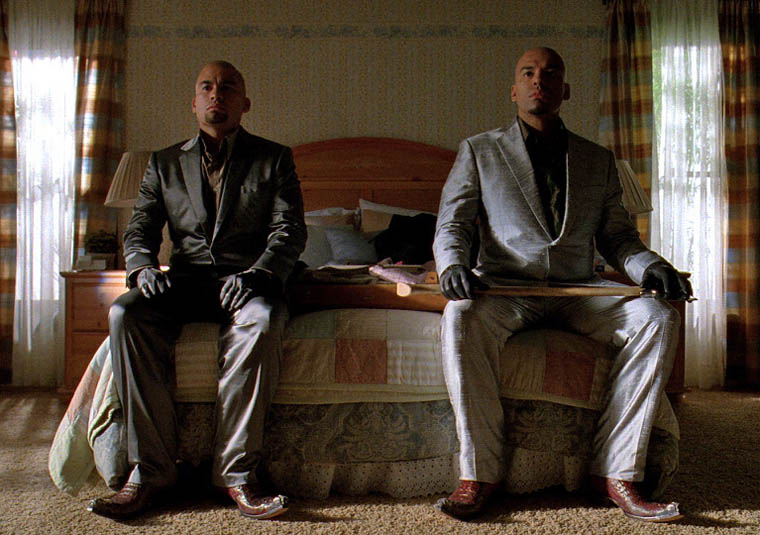
The characters Leonel y Marco Salamanca (Daniel and Luis Moncada)
Breaking Bad is brilliant partly because of the suspense which has been racheted up every single episode since the very first.  Genius Walter White is not only inexperienced in the nefarious activities he is drawn to, but so full of pride and arrogance, he goeth before his own fall, episode after episode. Sometimes Jesse jumps in after Walt, sometimes his choices force Walt's hand.
Jesse, I want to point out, has an exceptional mind but doesn't realize that. He blunted access by way of doping, truancy, small-scale badassing. But he is ingenious, and, point of fact, wouldn't have lasted as Walt's partner in meth-making if he hadn't been able to keep up.

More than the tension so cleverly created, more than the astonishing weirdness (like the Salamanca brothers crawling in the dirt, como penitentes, to a shrine where they supplicate mother death to destroy Walt) Breaking Bad makes me think.  Has me pondering, again and again, ethics, necessity, The Bad, The Good, human nature creating destiny.

It is a thought-provoking show on a major scale.  The Greek's, or one of the ancients' themes--hubris--is presented over and over. Once Walt pays for his medical needs, money isn't really the draw for him.  He knows how to get along. He knows that the financial comfort he is providing--though thwarted--is obviated by how it's provided.

I understand his motivation. If I could finally earn enough money through writing to wipe out my debts, I'd feel justified, regardless of what I wrote.  (Well, maybe.)  He's finally making big money through chemistry.  By the way, I realize he can't just walk out, what with the cartel and all.

Everyone connected to the show shares credit for the depth of character and ethical dilemmas arising out of situations--actors, writers, directors, editors, costumers, art.

The Sopranos was an astonishingly good show and also raised questions but not like Breaking Bad does. It was more a guilty pleasure, with extraordinary acting, plotting, imagination.

Anyway, I don't have a t.v. but this is a show worth buying. I go to Amazon and purchase a download the day after episodes are aired. So tonight, whoa, mama. I'm looking forward to Episode 1, Season 5. I anticipate tension, fear, frustration, and jaw-dropping admiration.

Wednesday, July 11, 2012

Don't Shut Up, Or Down

Someone asked for meaningful essays by women. I blanked--what's new--and then remembered Audre Lorde writing about--against--silence.

Short of rudeness, the context is roundly universal and keeps us alert to hate and its trickle downs and insults of any style and a variety of psychic or physical threats.

In my early twenties, my brother-in-law ran through my sister's purse for my address and showed up unannounced at my apartment.  "I've had my eyes on  you since you were twelve."  It's true. He had. And was here to act on it.  I played dumb and then dumber.  Knew that rush of waterfall meets coal stove in my brain. And with much luck and, truly, wild determination, I got him out of my apartment, so, as such things go, I got off easy.

But I couldn't tell my sister. In fact, I couldn't tell anyone for ten years.  I had massive problems talking.  I couldn't raise my hand in high school or college classes.  Blah blah blah.  This is just a blog. I suspect most of the hits here are for the images and I assure you, reader, that no one in my family reads it.

In part my silence ("silence") was a smart and decent decision. This was the seventies. My brother in law was black. I was worried there would be stereotyping on top of racial assumptions about men of color.  You may make assumptions about that gender, go ahead, no problem. But please no easy racial profiling.

Whether or not my refusal to tell anyone was understandable or not, thrown onto an emotional compost heap from my uneasy childhood (and other stuff), the unsightly and confusing mixed metaphor of verbal docility did damage.  To my self, sense of self, psyche, womanhood. But by the time Clinton allowed Lewinsky to pleasure him, but I do remember feeling so relieved that such male idiocy was being made so public by a white man.

What I keep thinking about, however, isn't what happened then, but that a young relative reacts to my belated coming out. Granted she is young as I was, and the young are fools, but I fit into this person's nasty stereotypes about dykes. I feel a bit angry.  And hurt.  I did all that higher level thinking for my family and somehow I expect more.  Hell, I'd be satisfied if someone would just once say they'd read and liked one (ONE) of my poems or stories.

I need to break my silence and speak to her. I will, in September, when we're in the same state again. Sorry for abusing this posting, but I feel better now.  As Ms. Lorde wrote in "The Transformation of Silence Into Language and Action" . . .    
What are the tyrannies you swallow day by day and attempt to make your own, until you will sicken and die of them, still in silence? 
 And . . .
In the cause of silence, each of us draws the face of her own fear — fear of contempt, of censure, of some judgment, or recognition, of challenge, of annihilation. But most of all, I think, we fear the visibility without which we cannot truly live.

Monday, July 9, 2012

Borges . . .the unalterable / sum of moments granted you by fate. . .

Andy Warhol Self-portrait in drag
(Monroe wig)
I am back to Borges.  


I needed an antidote. Saw an ad this morning for a major chemical corporation, the name of which resonates from the time of the Vietnam War and the occasion of death by formula made product.


Seeing the death star's new slogan was too much. No need to be specific. No need for proper nouns locating actions more improper than the imagination can create.  


Lately I've been remembering the truism: You aren't responsible for your first thought but you are for the thoughts which follow.  


So I'm being responsible. "We live discovering and forgetting / that sweet familiarity of the night." Offering a chance to suck your breath in and marvel. This poem is translated by A.S. Kline

(The Andy Warhol self-portrait kinda turns the table on the adoration here. Well, maybe it doesn't turn tables so much as expand the possibilities. More expansion, ahead.)


The Sum

The silent friendliness of the moon
(misquoting Virgil) accompanies you
since that one night or evening lost
in time now, on which your restless
eyes first deciphered her forever
in a garden or patio turned to dust.
Forever? I know someone, someday
will be able to tell you truthfully:
‘You’ll never see the bright moon again,
You’ve now achieved the unalterable
sum of moments granted you by fate.
Useless to open every window
in the world. Too late. You’ll not find her.’
We live discovering and forgetting
that sweet familiarity of the night.
Take a long look. It might be the last.
 _____
Jorge Luis Borges,  tr. by A.S. Kline, @2008

Thursday, July 5, 2012

Stop: A Poem of Pharmaceutical Advertising


Stop

In an ad agency, Traffic is like
Department of the Shepherds,
or an escort service,
housemother, Charon,
ferrying files from account exec. to writer
to art director to the shop to editorial
back to writer, exec., client, hell.
When the agency is pharm., the ad
could be direct-to-physician, direct-to-
patient, include an ISI (Important Safety Information).
Pharm. pays better than general advertising but
each ad has me fighting early training:
this is a load of crap.
Remember, I wasn't allowed medicine as a kid.
When I was headed to Camp Yallani we needed
a doc. to sign off.
He spotted weeping sores on my hand.
What’s that? he asked Mom.
It’s nothing she said.
Don't blame advertisers for the public's foolishness.
David Ogilvy's Little Red Book
of selling-relevant aphorisms
had typos.
Mao's Little Red Book fell to
reform and reeducation through labor.
There's no poetry in consumerism or
totalitarianism.
Oh save us from our leaders.
All of us.
______
Sarah Sarai, Folly Magazine, February 2012

Note: I wasn't allowed to take biology in high school because of my Christian Science mother. Yet here I am, working in pharmaceutical advertising and not quite fitting in.  I do my quiet thing, my rent gets paid, my poems get written and sunlight and birds reveled in.

Before pharma, I was in general advertising, and yes, Ogilvy Advertising had its founder's Little Red Book, about the same size as Mao's.  Thanks to Folly Magazine for publishing the poem and allowing me to include it here. April 27, 2016 note: Folly is out-of-print.

Sunday, June 24, 2012

The Death & Times of Ancestor Man, a poem


To heck with it. I mean, really.  This poem, for better and worse, has 
been around for fifteen years.  I have never been sure of it although 
I love Ancestor Man and his long reach to the past (which is probably 
fell behind the couch.). So I'm publishing it here. (I DO like it.)
 
I was thinking about something (many things) when I wrote this.  
Authenticity. Colonial Hegemony, stupidities, thereof. Its lingering 
presence. Lies. Sleights.

The misdirection of anthropology. Sometimes, anyway.

Physically, Ancestor Man reminds me of Wile E. Coyote. 
(So let's get down to cases. Since you are a rabbit, 
I am going to eat you for dinner.) 

I did see a Dr. Ma, when I lived in Seattle. And he did sell me a  
brown paper bag filled with dead cicadas. A little creepy. 
They resembled roaches.
 
I boiled them for fifteen minutes, which lent a marijuana-gone-rancid 
air to my apartment. The idea behind the prescription,  
Chinese medicine, was, indeed, I was drinking coolness. 

My body ("hot") in Chinese med. terms, needed a break.


The Death & Times of Ancestor Man 
 
i. 
Where sunlight slips out over there 
cross a yard where a willow cranes, 
watching  lamentation disappear 
over & again—that’s where 
Ancestor Man took leave, not 
in the city like they told you.  
Not Ancestor Man.  Expert teams 
mold casts of his swift tread to read 
truth-in-plaster.  Oh, they pound  
their chests with grief.  Mr. A's gone.   
 
ii. 
I will tell you what happened.  
He sucked himself in as if his body 
weren’t flesh & his mother opened, 
just a little.  Ancestor Man sunk in, 
knowing we look only to the past.  
 
iii. 
When we were Aztecs & quenched 
our thirst with mythic blood downed 
like Big Gulps, the guy was happy.  Well, good riddance, Ancestor Man!” 
Not so quick.  He’s got his quirks but
would accept a token—roses, a card, 
contrition—to know we still care.  
 
v. 
Okay, it goes deeper than that. 
Ancestor Man was a drug lord 
fronting for a cartel. The drug?  
Something even Dr. Ma, 
who grinds cicadas so their wings 
cool my feverish nights, never 
studied. A generic would do,
but sickness is older than cure.  
_______
by Sarah Sarai (and none other)

Tuesday, June 19, 2012

My New Goods: 3 Stories

Three new stories, two published in the last few days (one online, one in print), and a third (online) last month.  Most recently published is "Far Star Girl," although I wrote it a while back.  Editors at Seventeen Magazine once told me they'd wished they could publish this story. (I've heard that before. No, I mean it. And I never quite understand, but anyway.)

"Curtains" is a far newer story, written in the past two years.  I'd  tried to quit writing fiction (the above paragraph might explain why) but there I was, writing again, first "Lillia," then "Curtains."

"Far Star Girl" is in Pangur Ban Party. Editor DJ Berndt goes the extra mile to create spiffy e-books.  First paragraph:  
She thought maybe an angel had called out her name. She wasn't sure. She was waiting for her older sister to return with Jujy Fruits and bonbons. The theater, neither light nor dark, was to Cassie's ten-year-old mind, an appropriate-enough setting for a visit from an angel. Cassie knew better than to mention her divine suspicions to Dot who was five years older and sour.
Also new is "Curtains," in Belletriste Coterie, a new print journal edited by Kimberly Lojewski and team.  The narrator observes from after life. First paragraph:

So you might have heard in 1962 Fidel Castro let Nikita Khrushchev store missiles on the island of Cuba which isn't all that far from the U.S.A. which I am in more of a position to know than you are. Other stuff happened that year like John Glenn going around one of the planets, earth or moon or sun, I've never been sure which even though, again, I can see more than you can. And those people back when James Meredith decided to go to college in Mississippi, I saw them on t.v. and their faces looked like dried apple cores going moldy. I was twelve. I'm thirteen now because I'll always be thirteen because I died in 1963 because my bike flipped because I barreled down the hill, loop-de-looped and landed in a ditch. The hot asphalt guy helping the ditch-digging guy didn't hear the steamroller guy shout. The hot asphalt guy isn't up here yet and I've done everything I can for him (which isn't much of anything but it is something) because he was really sorry about the whole thing.
And here's "Lillia." (In Devil's Lake, published by the University of Madison-Wisconsin.)   I wrote the first paragraph when I lived in Seattle. where the story is set, around 1995. Then I tucked it away only to chance on in a recent tidying frenzy. The editor accepting this story, Marian Palaia, was sharp and supportive.  Here's the first paragraph:
There is nothing I love so much as a fat person, or admire. The largeness of their soul demands abundant sufficiency of casing and, further, because they are so grand of psyche, so much more than those who are skinny (not I!), they need—require—that formidable heft to anchor them to our earth. I fence-sit (or would), between unmistakable plumpness and hands-on girth. Lillia Fly-Eagle was a big one too, and for that I loved her, briefly and dearly.
 Honestly, people. I want to publish a collection of short stories.  Maybe these recent pubs are promises it will happen.(Or not.)

Sunday, June 17, 2012

Joan Larkin's 'Vagina' Sonnet; Argos Books

Ljubica Denkovic
Last night I stumbled, intentionally this time, into a simultaneously cozy and lush club, well, venue. It calls itself a club--The Oracle Club--but there is no House Music. THANK YOU, GOD!!! The music of the house is played on L.P.s with album covers of Bessie Smith, Aretha Franklin, jazz from the thirties. Also heard are musical stylings of Pierre and Edith, chirping plainchant from their light-filled birdcage.

I was there to join Argos Books in celebrating its four most recent publications, stylish chapbooks by Joan Larkin, Bianca Stone, Brandon Kreitler, Dorothea Laskey (who wasn't present, so the artist for her chapbook, Matthew Fische, read). I went with a friend. The event was a party, the party was easy, graceful, a gift of art.

The Oracle Club is in Long Island City-ish. Its precise neighborhood designation wasn't clear to me. That's a lie. It was but I can't remember the name, something like Hunter's Point, but not. The first stop on the 7. That works.

Argos' chapbooks are, as is the nature of chapbooks, delicately crafted creatures. And although the following poem was published several years ago, prior to brilliant Joan Larkin's current chapbook, it is most worthy of sharing and resharing, especially in light of the idiots in Michigan who are so afraid of life they are afraid of its vessels. 


‘Vagina’ Sonnet

Is ‘vagina’ suitable for use
in a sonnet? I don’t suppose so.
A famous poet told me, ‘Vagina’s ugly.’
Meaning, of course, the sound of it. In poems.
Meanwhile he inserts his penis frequently
into his verse, calling it seriously, ‘My
Penis.' It is short, I know, and dignified.
I mean of course the sound of it. In poems.
This whole thing is unfortunate, but petty,
like my hangup concerning English Dept memos
headed ‘Mr/Mrs/Miss’ — only a fishbone
In the throat of the revolution —
a waste of brains — to be concerned about
this minor issue of my cunt’s good name.
____
Joan Larkin. Not printed with permission but with hopes she won't object. From the Ms. Magazine blog.

Saturday, June 16, 2012

Thanks to Roxane Gay for Adding a Few Years to My Life

(The Rumpus used a very cool abacus,
as illustration. Different clip art,
above, but same concept.)

I suppose if I were to keep a daily accounting of how I spend my time I would be forced to acknowledge hours and hours devoted to FUMING. I get rankled, lots.

For Example.  Recently. My entire cranium, except for portions assigned to personal hygiene and paying nominal attention to cabs steering toward me at crosswalks, has had within it the 84th Academy Awards.  Did you see it?

Did you?  Do you remember?  I do. A humongous auditorium of the beautiful (fair enough) and young (okay, what's new) and all white (what!!!!!!!!!). 

What the Academy, the liberal Hollywood elite, presented, quite accurately given its track record within its gated and red-carpeted community, was the essentially all-white event representing an essentially all-white medium.  Sure, sure, sure.  I celebrated Olivia Spencer's Oscar. I haven't seen The Help but reliable friends tell me was terrific. (I can't imagine any actress better than Viola Davis, but, whatever.) I ha ha ha-ed at Chris Rock. He is very, very funny.

But really. Tell me you didn't see a sea, an ocean, the planet before the seas were parted, of white people.  Tell me t.v. listings don't reveal overwhelming white casting. Tell me movies don't recycle the same white actors over and over. I AM SO TIRED OF THOSE SAME THIRTY-SOMETHING FORTY-SOMETHING SO-CALLED FUNNY GUYS IN EVERY MOVIE I COULD, well, get peeved. Gender inequity is also legion, yup, but my concern here is race.  I am  dumbfounded at Hollywood's racism, support for Obama notwithstanding. (Another topic.)

I don't have high blood pressure but other essential elements of my intimate chemistries are stressed as I, every day, think about my beloved movies so abused.  In fact, I'm ashamed for my country. Hollyqoos sure isn't representing my world or America's world.

So that was the example.  The case-in-point is the New York Times Book Review. I stopped reading it with any regularity a few years back. I didn't want to, over and over, expose myself to its chosen cosmos of over 90 percent white (male) writers.  That's not my cosmos.  Whatever "white" means by the NYT reckoning, it doesn't even represent me (and I'm "white") (I'm even one-quarter "Caucasian").

Writer and professor and generally cool, not to mention astute, social critic Roxane Gay looked at the stats. You can read her critique of the NYT in her The Rumpus article, Where Things Stand.  For instance, to quote Gay:

Of those 742 [books reviewed], 655 were written by Caucasian authors (1 transgender writer, 437 men, and 217 women). Thirty-one were written by Africans or African Americans (21 men, 10 women), 9 were written by Hispanic authors (8 men, 1 woman), 33 by Asian, Asian-American or South Asian writers (19 men, 14 women), 8 by Middle Eastern writers (5 men, 3 women) and 6 were books written by writers whose racial background we were simply unable to identify.
The Internet, by way of access to so many sharp news sources, is robbing The Times of its "paper of record" status. Thank you, Internet. Ho hum, NYT. And thank you, Roxane Gay. Secrets and unspoken truths are unhealthy to body and spirit, corpus and soul. I don't know how efficacious truth is, but without, we get no where new.

Friday, June 15, 2012

A Few Notes About Writing

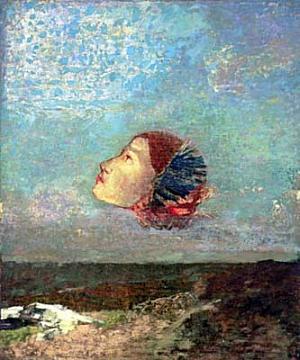
Redon's "Homage to Goya"
A few years ago two friends gently yelled at me. Remonstrated, perhaps. They insisted the first thing I had to do every morning, once ablutions had been made and coffee dripped, was to write here. And I did.

And now I don't, not frequently, not daily, and to my loss, because readership notwithstanding, I discovered that writing some assurance--the Google statistics I can consult--my quick jottings were read at least by one person. The sense of contact served to boost my spirits. Most simplistically, it made me happy and set me up for a good day. An hour well spent beats vagrant time (I'm not sure what vagrant time is, but I like the sound of it).

Writing poetry also boosts and antidepresses but in a different way than writing in a blog, in the way stormy weather forebodes and then the storm breaks and there is sunshine, skies blue as the English countryside's (I rely on the Nineteenth Century novel for the shadings of blue).

Breaking that down, my spirits feel heavy, raincloud like. I don't understand it, I never do, I think I'm upset. And then I write a draft and I'm no longer heavy. Like storybook enchantment my intention has to be honest. I can't stage things, can't realize my sadness can be remedied by picking up my pen or laptop. I have to chance on the cure.

Each time it is required I forget what will work and each time I discover it.

I would like to remember in the essential way memory and work collude and start writing here more.  Who knows if that will happen but at least there are three drafts of poems and perhaps more on the way. I'm not a pretender in at least one sense. In at least one way, the way of writing poems, I'm a poet.

Friday, June 8, 2012

Jack Gilbert Poem. & To Read a Book I Must Read It.

No doubt I should have seen this coming but I didn't, I didn't this this coming. What I saw was merely a notice that the book I'd reserved was being held for me on library shelves.

I'd waited at least two months for it to show. Truthfully, the informational e-mail, such and such by that guy is now ready at your branch library, was more a nuisance than anything. Yeah yeah I was still interested but in the way I'm interested in sweeping the kitchen floor. Doing so is good for the soul, bad for the insects, probably works a few back muscles, though ever so briefly.

Given my questionable attitudes everything is at some time a chore or homework assignment. Unless it's drinking coffee in the morning. Coffee and pink grapefruit. The rest is commentary.

Where was I. Okay, so I had the book in a stack by my bed and realized I had to open it because there is no other way to read a book with pages. My osmosis technique, book under pillow or palm of my hand pressing on the cover of a closed tome, is not even in a beta phase.

I paged to the first poem. And was hit by all the fires of heaven and hell, truth's unsparing divinity, winds of sorrow and joy, hurricane-strength.  The book is Refusing Heaven, poems by Jack Gilbert. The first poem is here, and double-spaced by me, not because I think I can improve on it, I can't, but because there was some font weirdness in copying/pasting my typed single-spaced in Word version.


A Brief for the Defense 
 
 
Sorrow everywhere.  Slaughter everywhere.  If babies 
 
are not starving someplace, they are starving
 
somewhere else.  With flies in their nostrils.
 
But we enjoy our lives because that's what God wants.
 
Otherwise the mornings before summer dew would not
 
be made so fine.  The Bengal tiger would not
 
be fashioned so miraculously well.  The poor women
 
at the fountain are laughing together between
 
the suffering they have known and the awfulness
 
in their future, smiling and laughing while somebody
 
in the village is very sick.  There is laughter
 
every day in the terrible streets of Calcutta,
 
and the women laugh in the cages of Bombay.
 
If we deny our happiness, resist our satisfaction,
 
we lesson the importance of their deprivation.
 
We must risk delight.  We can do without pleasure
 
but not delight. Not enjoyment.  We must have
 
the stubbornness to accept our gladness in the ruthless
 
furnace of the world.  To make injustice the only
 
measure of our attention is to praise the Devil.
 
If the locomotive of the Lord runs us down,
 
we should give thanks that the end had magnitude.
 
We must admit there will be music despite everything.
 
We stand at the prow again of a small ship
 
anchored late at night in the tiny port
 
looking over to the sleeping island: the waterfront
 
is three shuttered cafes and one naked light burning.
 
To hear the faint sound of oars in the silence as a rowboat
 
comes slowly out and then goes back is truly worth
 
all the years of sorrow that are to come.
_______
 
Jack Gilbert,  Refusing Heaven, Alfred A. Knopf, 2005.

Sunday, June 3, 2012

Between my body and the day ... W.H. Auden's "Prime"

Hypnos
by Iker Spozio*
 
I woke up too early yesterday morning; not unusual. And I worried. The tension in this scene arose from my wondering if I'd be able to fall back to sleep or if I'd have to soldier through the day on five hours.

Then in a blip of time I was gone, swept into a cavern, a chamber, an infinite joining with my other community--of near hallucination which shadows my life, distorts it or riffs on it. 

And then I was awake and rested. Three hours of deep sweet sleep, or transitory death, had passed.  I had gone somewhere and I had been returned.

Here is a poem by W.H. Auden. It might be relevant to what I just wrote.


Prime

Simultaneously, as soundlessly,
Spontaneously, suddenly
As, at the vaunt of the dawn, the kind
Gates of the body fly open
To its world beyond, the gates of the mind,
The horn gate and the ivory gate
Swing to, swing shut, instantaneously
Quell the nocturnal rummage
Of its rebellious fronde, ill-favoured,
Ill-natured and second-rate,
Disenfranchised, widowed and orphaned
By an historical mistake:
Recalled from the shades to be a seeing being,
From absence to be on display,
Without a name or history I wake
Between my body and the day.

Holy this moment, wholly in the right,
As, in complete obedience
To the light's laconic outcry, next
As a sheet, near as a wall,
Out there as a mountain's poise of stone,
The world is present, about,
And I know that I am, here, not alone
But with a world, and rejoice
Unvexed, for the will has still to claim
This adjacent arm as my own,
The memory to name me, resume
Its routine of praise and blame,
And smiling to me is this instant while
Still the day is intact, and I
The Adam sinless in our beginning,
Adam still previous to any act.

I draw breath; that is of course to wish,
No matter what, to be wise.
To be different, to die and the cost,
No matter how, is Paradise
Lost of course and myself owing a death:
The eager ridge, the steady sea,
The flat roofs of the fishing village
Still asleep in its bunny,
Though as fresh and sunny still, are not friends
But things to hand, this ready flesh
No honest equal, but my accomplice now,
My assassin to be, and my name
Stands for my historical share of care
For a lying self-made city,
Afraid of our living task, they dying
Which the coming day will ask.
____
W. H. Auden, 1907-1973

Hypnos, by artist Iker Spozio, from http://www.folioart.co.uk/illustration/folio/artwork/hypnos/

Tuesday, May 29, 2012

A Poet Who Doesn’t Suck (review from 2011)


“Garden of Eye” canvas created by Digital-Matrix.*
The following review was published in American Book Review, Volume 32, Number 2, January/February 2011. 

It is reprinted with permission of the author.

The Future Is Happy, BlazeVOX [books], 2009. $16.


The Eccentric St. Sarai, a Poet Who Doesn’t Suck

by Melissa Studdard

The unspoken rules for writing contemporary literary poetry are clear
to all serious poets. For starters, it is NOT okay to use words like
“love,” “rose,” “heart,” “soul,” “butterfly,” or “grandmother” unless
you intend to systematically deconstruct, or even better, negate,
them. If you do insist on using these horrid words (which, I remind
you, is not recommended), you must find a way to rough them up and
scrape away the centuries of grime left on them by the grubby hands of
former poets, such as Shakespeare, Donne and Petrarch (who sadly, did
not know what they were doing) . You must concede to the premise that
sentiment is embarrassing and sincerity is downright disgusting, and
you must recognize that if you’re feeling attached to a line you’ve
written, it’s probably too “precious” to be published and should be
deleted quickly, before anyone else sees the shameful thing that you
have done. Most of all, you must never, ever do anything that comes
across as too poetic. God forbid that anyone should see your poem and
deduce from it that you are a poet. Better for your poem to imply that
you are a bricklayer, waitress, or serial killer.

The problem is that the anti-cliché has itself become clichéd, and the
gruff tone and handling of subject matter are now as anticipated as
the sentimentality they replaced. So what’s a poet to do in a post
post era, when everything that can be done has seemingly been done and
surprise itself is a cliché? Literary history would suggest a swing
back to a kinder, gentler poetry, as each new literary movement has
been a reaction against what came before it. However, the poets of
this generation find themselves in a particularly bitter pickle in
that anyone who writes in the old style would appear not to be aware
of the new style and would therefore run the risk of coming across as
uneducated. That, we cannot have.

What we do find, however, is that there are poets who are aware of
craft, literary history and current trends but who have decided to lay
their own unique voices and minds down on the page anyway, poets who,
finding themselves at the crossroads of convention and deviance,
choose neither but instead drop the reigns altogether and lift into
Pegasian flight. They are smart and sensitive and funny and well-read.
They are aware of what’s going on around them and what came before
them, yet they allow that knowledge to inform rather than dictate
their work. They are skilled at craft, but they do not craft the life
out of their poems.

And so, despite what might have initially sounded like a complaint
about contemporary poetry, I’m here to tell you that there is still
much good poetry being written, and there are still many good
collections coming out. One such collection is The Future is Happy,
by Sarah Sarai, published by BlazeVox Books, a press that proclaims to
publish “poetry that doesn’t suck.” In Sarai’s case, I wholeheartedly
agree. It doesn’t suck at all. It is, in fact, a poetry of luminous,
brave transparency, and though it would by no means be considered
confessional, it lays bare the unique mechanisms of Sarai’s mind, the
wild fluctuations of her pulse, skipped beats of her heart. Sarai has
no qualms about mentioning weed, chili peppers, the bible and the
afterlife all in the same poem, and her wacky, unique perceptions of
the world spawn metaphor after metaphor, analogy after analogy of
sparkling, lyrical, hilarious insight. Crossing the border is compared
to crossing into the afterlife, Emily Dickinson is presented as a Jew
in hiding, and poop cleaned from a baby’s butt is likened to sin wiped
away by grace. What may appear at first to be flippant always has a
deeper meaning, and the mundane is frequently combined with the
sacred. Take the poem “Aristotle,” for instance, short enough to be
considered in its entirety:

There’s no clean slate
in God’s classroom.
He was clapping erasers
as your ebullient soul popped
like gleeful corn charging
an aluminum lid.

You ker-chewed
from dust falling milky.

What an act of hubris, to be born. 
(Sarai 50, 2009)

Here we see Sarai’s characteristically zany way of handling subject
matter. Reincarnationists have long considered the idea of the earth
as a schoolhouse for the soul, but Sarai makes the idea palpable by
giving God a classroom and erasers to clap. One only need look at the
titles of the individual poems, such as “St. Sarai Carrying the Infant
Christ Child,” “Like Breasts on the Copier,” and “When the Sun Sets
Like a Nice Salmon Mousse,” to pick up on the humor and originality of
the collection. Yet reading the poems reveals a voice that is also
earnest, vulnerable and raw. Alongside these wacky, philosophical
poems are poems about losing faith in poetry, running into a former
lover, and empathizing with a mother who has cancer. Particularly
stunning is the poem, “My Various and Sloppy Forgiveness,” which ends
with an unabashed portrayal of longing.

Sarai is sexy, funny, philosophical, gracious and irreverent –
sometimes all in the same poem, combining the elevated with the lowly,
the drab with the lyrical, the complex with the simple. But in the
end it is not her eclectic subject matter or her charming, sassy style
that will win the reader over - it is her willingness to, without
artifice or pretension, offer her truth to the page.

American Book Review, Volume 32, Number 2, January/February 2011.

Melissa Studdard is the author of the bestselling novel Six Weeks to Yehidah (winner of  the Forward National Literature Award), as well as the newly released My Yehidah, both published on All Things That Matter Press.  She is a book reviewer at-large for The National Poetry Review, a contributing editor for Tiferet Journal, and host of the radio interview program Tiferet Talk.  

Melissa's blog, Bareback Alchemy. Her website.

*Digital Matrix: http://maat-order.org/blog/?p=1113

Monday, May 28, 2012

Memorial Day. Tolerance and Peace.

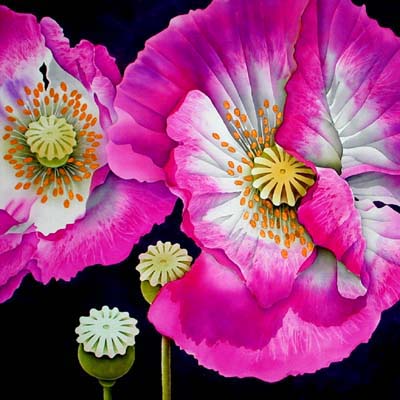
from http://www.silkartist.co.uk/poppies.jpg
I see the men in fatigues outside the Armory near my house. They are beautiful in the way that's inevitable for the young and strong, the disciplined, the fragile. Many have already served, will return to action.  Beautiful, equally, the women, at risk by virtue of gender but willing to strike a new path.
I admire the complexities of duty, bravery, ambition in today's soldiers and in soldiers who had no choice but to serve. 

There is little positive net result to the wars of my lifetime, and an infinitude of collateral damage, but I can hope for an end run around the phenomenal gain of the industries of war and corporations without conscience.

If we can love the now and tolerate the person next door, allow our intellects to be engaged in planning for cooperation and civility and not allow that small warp of willful ignorance which is rampant in the country, right now, grow and intensify, then there is hope and the wheel or spinning firmament of karma and grace will help our Memorial Day mean something tomorrow.

Today is a day of gratitude. Today is a day of love. Today the seeming strangeness of things unfamiliar is tolerated, seen for what it is, something new and untested. Something that won't be strange after proximity and acquaintanceship.

Peace.

Tuesday, May 15, 2012

Ha Jin's "Questions" of a "useless scarecrow" of a god

"Dragon" from the museum at RISD
Sunday, I stopped off at two parks, Madison Square and then Washington Square. Both stops I claimed bench space and read Wreckage by Ha Jin.

I could have finished the collection but found it so good, so interesting--I held off--did the old savor, as in I'm savoring these poems and don't want the collection to end.

Both narrative and historical, successfully imitative of a cultural voice (Ha Jin's country, true), Wreckage, by way of persona, relates an historical culture of Chinese emperors, with echoes in the present.

Mongol intrusion and coups, an everyday of history; stupidity of bureaucracies, another everyday; human folly. All play out.

Here, from the second-to-last section, Between Heaven and Earth, is "Questions."

Questions


                After lay Buddhist Aina

Lord of Heaven, how old are you?
Why have you no eye or ear
for our troubles?
Where's your forked grumble?

Those who kill, steal and bully others
bask in honor and security.
Those who follow your scriptures
are cold, starved, trampled.

Lord of Heaven, how can you govern
the earth like a fool
and let officials multiply
more than laborers and taxpayers?

Better if you were not there.
What a useless scarecrow you have
become, that rots in evil winds.
Why don't you topple down?
_____
Ha Jin, Wreckage (Hanging Loose Press), 2001.

Monday, May 14, 2012

Auden's :The Fall of Rome" ...fear the reindeer.

Beware the reindeer, the lurking north. Beware the unhappy worker, utterly universal in her discontent. 

It is unlikely that great Rome, or any stand-in for such a powerful, decaying empire, would fear animal or discontented worker. And in its oblivion to danger lies the seeds of trouble, or smouldering coals of, I don't know, conflagration, mongrel hordes, invasion.

Everything must end; those granted poetic hindsight, those who have lived through world wars, as did Auden, can gorgeously dally with reasons.  You can find a wonderful discussion of this poem at The Wondering Minstrels.

The Fall Of Rome

The piers are pummelled by the waves;
In a lonely field the rain
Lashes an abandoned train;
Outlaws fill the mountain caves.

Fantastic grow the evening gowns;
Agents of the Fisc pursue
Absconding tax-defaulters through
The sewers of provincial towns.

Private rites of magic send
The temple prostitutes to sleep;
All the literati keep
An imaginary friend.

Cerebrotonic Cato may
Extol the Ancient Disciplines,
But the muscle-bound Marines
Mutiny for food and pay.

Caesar's double-bed is warm
As an unimportant clerk
Writes I DO NOT LIKE MY WORK
On a pink official form.

Unendowed with wealth or pity,
Little birds with scarlet legs,
Sitting on their speckled eggs,
Eye each flu-infected city.

Altogether elsewhere, vast
Herds of reindeer move across
Miles and miles of golden moss,
Silently and very fast. 
_________
W. H. Auden, 1947

Tuesday, May 1, 2012

May Day / Poetry Assembles


If you are in New York City, come to Union Square at 3:00 p.m.  Look for the noble statue of George Washington and some noble poets.

Bring a poem, of course, and participate in the Poetry Assembly, 3-4. Merge into other rallies and events.

Wednesday, April 25, 2012

Ms. Magazine...I'm in a Q&A with Stonborough and Meriam

by Andrea Heimer
Please take a look at the Ms. Magazine blog posting of April 23, 2012. [Link below.]

Mary Meriam, poet and editor of Lavender Review, poses questions for Elaine Stonborough, poet, and me, poet et al.  I'll let you follow the links on the posting (links which reveal splendid insights into Stonborough, who is English and a scholar, and Meriam, who is tri-state-al, those states being New York, New Jersey, and somewhere in a forest region in the middle of this continent).

"A Woman, A Lesbian, A Poet" on the Ms. Magazine blog.  I'm honored to be part of this.