Wednesday, March 23, 2011

Ladies & Proud Possessors of a Penis: DaDA & Three Rooms Press

To your left, ladies and proud possessors of a penis, is the cover of MaiNtENaNt5. I got my copy Friday night at the annual DaDA festival, soiree, reading and publishing event at the Cornelia Street Cafe on (multiple choice) 1) Street Street; 2) Cafe Street; or Cornelia Street.

The cover (on your left) is designed by Kat Georges of Three Rooms Press. It is beautiful not unlike, or in fact, like the entire journal also Kat Georges' designed. Cover art -Shark- by Paolo Pelosini. Like a poem, it's found, but of metal.

If you glance at MaiNtENaNt5's table of contents which is not on your left but in the journal, you will find over 120 poets and artists, alas, not in the flesh as there is no copy machine large enough to duplicate so many internal organs and the like. Nonetheless, that's a hunka DaDA, which, as you may recall, was the child of the brains of antiartists, unartists, uberartists of various antibourgeois stripes, plaids, ribbons, bassoons, mimeographs, Plantagenets, corpuscles, pacifists and Zurich.

I was kindly allowed to be one of the readers last Friday night, as I am one of the over 120. The kindly was provided by aforementioned Kat Georges and co-editor Peter Carlaftes. Click on the first mention of Three Rooms Press for details.

Sunday, March 13, 2011

Spoiler Alert: Karl Marx Is Dead

*
Even with My 3,000 Loving Arms' superpowers it isn't easy to eavesdrop on history. I tried but had to do my laundry and while I was comforting my white anklet with pink accents, over the loss (in the dryer) of its twin, Karl Marx died.

You may think I'm uncaring for talking about white socks with pink accents more than Karl Marx but if you think I'm bad, look at legislators playing computer Solitaire and Hearts. All the while Karl Marx's love for humanity, for workers who are most often little more than legal and duped serfs, was agan scorned this week.

Unions were killed--for the moment, anyway--in Wisconsin; “terrorists” hunted in D.C.; programs which could help people like you and me, the ones who breath and don't receive orders from Greedo Limbaugh of Planet Hate, were ignored.

Please read Isaiah Berlin's biography of Karl Marx (entitled Pete King Is a Big Fat Arsehole Though His Actual Arsehole Is Probably Teeny Tiny Accounting for, Hence, his Many Fears, and Further and Also I Wonder if The Billionaire Koch Brothers Back King as they Backed the Governor of Wisconsin Who Is Killing Unions Which Benefit People, All People, Black People, Women Because the Billionaire Koch Brothers Want More Money in Their Coffers (Why, I Don't Know). NO! It's entitled Karl Marx!

Question:  Are you sure Isaiah Berlin's biography of Karl Marx, published by Oxford University Press paperbacks, isn't called  Who Killed Elvis? NO! It's Karl Marx.

He was poor and difficult. A German in England. Jewish but not so happy with being Jewish though if his father converted to Christianity why was he considered Jewish? His vision of all workers joining and his convincement that history is a progression, each era new, not replicating, fills my heart with gratitude. He wanted each person to be able to actualize their greatest potential, to have the freedom to be creative and happy. I'm sorry you died, Karl Marx. Like other brilliant thinkers including Aristotle, Jesus, St. Francis, the Buddha, Hafiz, Tagore, Dorothy Day you are respected but not enough followed.

*http://blogs.courant.com/capitol_watch

Thursday, March 10, 2011

Karl Marx Is Lost (but Will Be Found)

Though the Germans, the French and then, I believe, the Belgians worried Karl Marx had too keen a perception of reality (wherein the rich do not get poor) and therefore should live in the next country over, I don't recall reading of midnight dashes across cobblestones smeared with proletariat sweat as he and his family moved on.

Neither was he hid by trusted fellow travelers (who wouldn't have been traveling) (or how could they offer hospitality?). However, Marx in New York is a whole different historical event.  The event includes one Sarah Sarai who has mentioned Marx quite a bit the past few days. Alas, she cannot find Isaiah Berlin's biography, so aptly titled, San Diego on $10 a Day (NO, Karl Marx) and so won't being saying any more about Marx today.  

Tune in tomorrow, however, when order is restored to the living quarters of this poet and fiction writer. 

Tuesday, March 8, 2011

Karl Marx and The Perks of Writing a Musical

What would Karl Marx think of Kickstarter? See, I am reading a biography of Karl Marx entitled, Sal Mineo Is Alive & Hiding in South America, NO! entitled Karl Marx. It’s by Isaiah Berlin and not over 200 pages but I am stringing it along with other reading. My goal this week is to see the world as Karl Marx would (i.e., accurately).

And to do so even if the connection between my topic and exploitation is frayed. My topic is Kickstarter, an entrepreneurial online fundraiser, and playwright Tom Diggs. All big business was at some point the start-up of an entrepreneur, rich or poor. My friend the playwright Tom Diggs is not rich nor poor so he is soliciting funds thusly (even from me!).

Diggs, or “Tom” as I call him, has one more Pulitzer nomination to his belt than I have to my belt. (I have none and rarely wear belts, in case you are compiling your Christmas list.) I met him as artists meet in N.Y.C. (lap dancing at the Pussycat Dolls lounge) (NO! through friends).

A while back he emailed me the script of his Pulitzer-nominated play; I was wildly impressed. It was intelligent, had a distinct point-of-view and superb political insight. And good roles for women!

Tom is raising money for a musical, The Perks of Writing a Musical. (I suggested Karl Marx Is Alive & Hiding in South American, but oh nooooooo. Whatever.) Read about it here and donate if you want to add Supporter of the Arts to your belt. His musical from a few years back, based on Photographing Fairies, was also wonderful. I’d both read the book and seen the somewhat obscure movie, so I was an informed audience. I loved Diggs’ & composer’s vision of a Nineteenth Century encounter with fairies—in England, of course—and Sir Arthur Conan Doyle.

So Kickstart, my fellow Marxists. Capitalists allowed. To learn more about the process of raising money, writing a musical or any play, working with actors, getting insurance for the play, and more & more, go to Tom Diggs' The Perks of Writing a Musical.

Monday, March 7, 2011

Karl Marx at Sarah Lawrence, or if not him, me, I'll read there, Tues., 3/8, 7 pm

I've written about Karl Marx three days in a row. I'm reading Isaiah Berlin's biography, Annette Funicello: The Early Years, NO! Karl Marx (Oxford).

Contrast, please, the seething poverty Marx and his family endured in London with Bronxville, the upper-scale upscale town atop which Sarah Lawrence College sits. Can't be done. Marx and his brood lived in two crappy rooms that sound like a crack house with filth and broken furniture. Maybe Yonkers, a few blocks away, has a crackhouse or two (which the super rich slum in), but not CEO-aplenty Bronxville.

I will have to bring poverty (and maybe sloth and anarchy) to my co-reading at Sarah Lawrence College on Tuesday, March 8 at 7 p.m. in Slonim  House. (It's such a small campus and Slonim's well-known; you'll find you're way.) Co-readers are Todd Dillard, Sam Starkweather, Sally Bliumis-Dunn.

I'm a wonderful reader out louder of poetry. Please do stop by if you are in Westchester County. It's free (ahem) and there'll be a Q&A and maybe cookies, wine or revolution.  More on Marx soon.

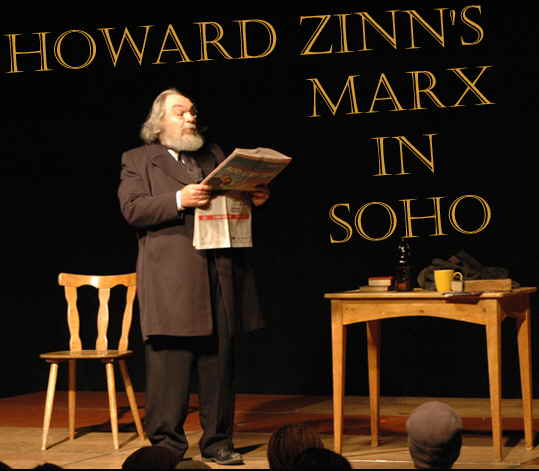
*poster for Howard Zinn's play Marx in Soho

Sunday, March 6, 2011

Old Marx, Debbie Does Capitalism, poet as revolutionary

I continue to read Isaiah Berlin's biography of Karl Marx (entitled Debbie Does Capitalism, NO! entitled Karl Marx). My last mention of this was yesterday. Marx is now in London, having lost the Jerry Lewis look-alike contest in France. 

England is very British, it turns out. The country allows ("allows") Marx and other revolutionaries to stay but cold-shoulders them in its upper crust, colonial way.  Meanwhile, the brilliant Capitalist Manifesto is out there to inspire. The proletariat (me, maybe not you, but me) is being urged to see through and beyond received images of the rightness of the ruling elite and its self-serving institutions.

I see the poet as revolutionary. It's not a vision original to me by any means, but nonetheless . . .  Poets must reveal the great hype of capitalism or any system of rule in which so much is owned by so few. It's the nature of any society, however small, to mold us. Native tribes teach the young as well as huge countries. Simply being in relationship (to government, to institutions including religious, to family) means we have to give up a little of our selves.

With a loved one or small family that's fine, although even that small robbing of what is perceived as our true self causes some to rebel.  There are always rebels. However when ChaseManhattan, Goldman Sachs, Big Insurance, any corporation is organized around the principle of giving vast sums, overwhelming percentages of profit, to one or two percent of its workers (the Board of Directors) we give up too much.

And unnecessarily. Yes, we want to get along with family (of origin or family of friends). We need each other and so the "sacrifice" of not singing "Hello Dolly" at 3 a.m. is a small one. The sacrifice of working 40 hours a week and receiving lackluster or no insurance or a pension which disappears is too much. Millions of deaths from famine; allowing the land to be ravaged in the interests of Big Business (think, Africa; think, decimation of native Americans . . . ) is evil.

I'm a bit all over the map.  Still reading about Marx. Here's a poem on him I am appropriating from The New Yorker online. It's by Polish poet, Adam Zagajewski.

Old Marx

I try to envision his last winter,
London, cold and damp, the snow’s curt kisses
on empty streets, the Thames’ black water.
Chilled prostitutes lit bonfires in the park.
Vast locomotives sobbed somewhere in the night.
The workers spoke so quickly in the pub
that he couldn’t catch a single word.
Perhaps Europe was richer and at peace,
but the Belgians still tormented the Congo.
And Russia? Its tyranny? Siberia?

He spent evenings staring at the shutters.
He couldn’t concentrate, rewrote old work,
reread young Marx for days on end,
and secretly admired that ambitious author.
He still had faith in his fantastic vision,
but in moments of doubt
he worried that he’d given the world only
a new version of despair;
then he’d close his eyes and see nothing
but the scarlet darkness of his lids.

(Translated from the Polish by Clare Cavanagh.)

Saturday, March 5, 2011

Karl Marx, Close Observer to the Max

a Monty Pythonization of Karl Marx
I've been reading a biography of Karl Marx (titled Bippy Goes to the Circus, NO! titled Karl Marx) by Isaiah Berlin and published by Oxford paperbacks.

It's brilliant. Berlin describes Marx' intellectual context, that being the what's what and who's who in Europe; the thinkers of Germany, France (and soon England--I'm waiting for the next chapter); much on Hegel; Marx' family--he had a warm relationship with his father, despite his father's desire to, as we say, fit in.

And Marx' character; he was a true rebel with a grand cause and no gun, and far more intellectual than Che Gueverra, who was no dullard himself.  Just as Marx (and Engels) demonstrated an eye for detail and facility with close description, as in the Communist Manifesto, he demonstrated an enormous capacity for reading and analysis.

He saw that in the industrialized era, production caused, in Isaiah Berlin's words, "intellectual, moral, religious beliefs, values and forms of life . . . which uphold the power of the class whose interest the capitalist system embraces."  A Catch 22 in the making.

Capitalism and production are not timeless in the way Truth, Love, Compassion are. They are simply "uphold the power of the class whose interests the capitalist system bodies." Capitalism is not a "timelessly valid institution" but it is seen as such.  It's as if the belief in a divine king and queen were simply auctioned off to the highest bidder and that bidder is the rich who control production and product and thus become falsely "valid."

I don't see how to break through but I am hoping that as we awaken to the corruptibility of capitalists, as in crashes of the past few years, we just might inch toward some improvement in the distribution of wealth (to coin a phrase).

Now back to Bippy Goes to the Circus. Can't wait until the movie comes out.

*http://www.brickshelf.com/gallery/Dunechaser/MontyPython/WorldForum/02-karl.marx.jpg

Friday, March 4, 2011

Foodstuff Friday: Kidneys & Michelangelo


from The Chiropractic Journal


Kidneys? Not fried, roasted, braised. beaded. Not with parsley, tomatoes, potatoes, rick-rack. Not even chocolate sauce can (IN THIS BLOGGER'S OPINION) make a kidney edible so why even mention the organ with a twin?

Apologies for cultural insensitivity to Britain & co.
Because work (work work) today is about hemodialysis (or editing a paper thereon), and so I googled poems about kidneys and voila who should appear but Michelangelo who should have sued the Vatican for workplace injury.

And demanded an ergonomically satisfying scaffold. If I may on-the-spot edit this posting, it's too cute up to this point.  And now, Michelangelo, c. 1509.

Poem 5

A goiter it seems I got from this backward craning
like the cats get there in Lombardy, or wherever
—bad water, they say, from lapping their fetid river.
My belly, tugged under my chin, 's all out of whack.
Beard points like a finger at heaven. Near the back
of my neck, skull scrapes where a hunchback's lump would be.
I'm pigeon-breasted, a harpy! Face dribbled—see?—
like a Byzantine floor, mosaic. From all this straining
my guts and my hambones tangle, pretty near.
Thank God I can swivel my butt about for ballast.
Feet are out of sight; they just scuffle around, erratic.
Up front my hide's tight elastic; in the rear
it's slack and droopy, except where crimps have callused.
I'm bent like a bow, half-round, type Asiatic.
Not odd that what's on my mind,
when expressed, comes out weird, jumbled. Don't berate;
no gun with its barrel screwy can shoot straight.
Giovanni, come agitate
for my pride, my poor dead art! I don't belong!
Who's a painter? Me? No way! They've got me wrong.

from The Complete Poems of Michelangelo, tr. by John Frederick Nims.

Nims on poem # 5. 1509-10. Sonetto caudato [sonnet with tail], the tail consisting of six additional lines at the end of the sonnet, as in 25. It was written while Michelangelo was painting the ceiling of the Sistine Chapel (1508-12). In the margin of the manuscript the artist has drawn an image of a strained figure with a bent back painting a ghostly shape on the ceiling. The "Giovanni" of line 18 refers to Giovanni da Pistoia, a member of the Florentine Academy who sent several sonnets to Michelangelo, whose own letters confirm his extreme discomfort at the time.

Thursday, March 3, 2011

An Errant Blogger Returns

I like writing this blog. I like my imaginary readers. I have real readers, at least if I go by the statistics, pardon me, the metrics, Goggle provides, and real readers are 3000 Loving Arms-worthy, no question.

My imaginary readers, however, accept with intensity my oddness.  Could be that it's wracking of my nerves to envision readers of flesh and of blood tolerating this simulcrum of Sarah Sarai which makes it to the postings; plus I have trouble with intimacy (me and no one else has that problem).

Remember what it was like to be adolescent and ponder all the versions of yourself existing in different dimensions? Readers younger than me may find such imaginings routine in our post-Matrix society (though science fiction and quantum physics preceded my generation, so I could have been as jaded).

Why my parallel life musings?

I read a poem about such conjecture at my reading last Saturday at Small's.  What a good feeling to read new work. To know I can write something substantial. I'm not posting the poem just yet but know I was full of love when I wrote the first draft.  I was mother (or Aquarian) to the world.

Segue #2.  I was able to send off my National Endowment for the Arts Literature Fellowship application (Fiction). I am so happy to show up for myself, to pull it together by deadline. The prize, a fellowship, money, recognition, would be nice but being part of the process is joy too.  I hope to return to you all beginning tomorrow. I've missed you, you who are real and you imagined. It'll be a return to the process of connection.

Monday, February 28, 2011

Yes, I have a computer.

I've working, work-working, for-the-man work-working, as would a bat in hell for the past week, will resume at 2 p.m. today, and so immediately and swiftly sneak in a nonpoetic, nonfictional rant, directed at those who on hearing I'm not financially prosperous start tiptoe-ing with comments such as,
If you have a computer . . .

What lack of imagination! The person in question, a decent, hardworking woman, and sterling feminist, became trepidatious when she realized my financial situation was not equal to hers. Well, if you have a computer . . .

How would I blog without a computer? How would I keep writing poems and stories, fiddle with the beloved idiocy of social networking, submit my work, email my friends?  (She'd seen My 3,000 Loving Arms.)

There's more to the story and since such a decent person is involved, decent but not artist-to-the-core like me (that was a compliment a few years ago--I wish I could remember who told me--You're an artist to the core) I'll back off. But for this:

Although research is often part of my worklife--I copyedit and have to check a variety of facts and names only quickly ascertainable through use of my quick fingers and relentless curiosity--I don't google people I might date, at least until I've met them. What you learn from googling is information.

Information.  I don't need that; I need to meet the person, sense their heart, idiosyncrasies, get (if you will) their damn vibe.  This keeps happening.  I meet someone who has googled me, thus obtaining information about Sarah Sarai.  So they show up with a fixed and rigid sense of who I am which doesn't begin to match who I really am--so flawed; so wonderful.

I will return to my normal schedule of blogging soon.  I don't kid myself that the numbers are vast in terms of readership but cyberworld is vast and connections subtle and often real. Why are people difficult and the imaginary simpler? Sigh, oh, yes, sigh.

*fractal done on a computer & sourced by way of a computer (my computer)

Saturday, February 26, 2011

Today, Saturday, 5 p.m. at Small's Jazz Club: I'm reading (and more)

Saturday, February 26, 2011
Sarah Sarai & Alan Semerdjian 
Reading with open mic (OPEN mic is 1st)
Small's Jazz Club
183 West 10th St. / 7th Ave.
New York City
5-7 pm, $7ish (I'm not sure)
Lee Kosinsky & George Guida at the helm.
I worked 45 hours this week.  Looking forward to poetry and friends.

Sunday, February 20, 2011

Cihan Okuyucu on Rumi, his piety hiding in divine love

 
Cihan Okuyui, author of
Rumi, Biography and Message
"Rents . . . increased excessively..." That statement strikes dread in the hearts of New Yorkers.  Fortunately the rents referenced were in Baghdad in the early 1200s. That's when Rumi and family fled Balkh in northern Afghanistan. Mongols descended as Mongols were want and destroyed Balkh and other cities, hence a westward migration to Baghdad, hence a spike in rentals. Rumi's family caravaned to Hejaz, which might have been cheaper than Baghdad, but who knows, a city's a city.

His father and relatives were scholars and religionists, and he was well educated well into his adult years. A teacher, Burhanaddin, stepped in after his father's death and sent him to Aleppo and Damascus to perfect disciplines of learning, culture, art, Koranic study, mysticism over a period of nine years; then insisted on three 40-day ascetic retreats after which Rumi's heart was "awakened to divine secrets."* I don't doubt it.

Barhanaddin left Kayseri where he died. His tomb is still the most-visited n the city. I can't tell you where Kayseri is, but I will visit the tomb of Rumi's teacher in meditations. Students visited Rumi.  He had "divine love in him but his love was hidden in his piety."*  Later, "his piety would hide in his love."*

*I'm reading Rumi, Biography and Message (The Light, 2007) by Cihan Okuyucu, who teaches Turkish lit at Fatih University.

Friday, February 18, 2011

Foodstuff Friday: dogs {of orange}

My family was not prone to appreciation of the precious, of sausage-curled tots who might wander to our table at a deli. My father had names for them:  Shirley and Seymour.  He mocked them (not in their kewpie-doll presence, but still...)... "Helllooooo, Mister Man." (His imitation.)

My sisters and I stayed seated, and while not entirely silent--our parents weren't Be-courteous or Sorry-for-Sin (two Puritan names--see Charles Bardsley's Curiosities of Puritan Nomenclature, 1880)--we sensed that though we might be intellectually superior to tots who freely addressed strangers in a deli without fear of reprisal, freedom aced out intellect. We were verbally free. That's something.

We did have, however, a cute name for orange sections. Dogs. Lore was that one of my father's brothers made it up. To make dogs: Cut the orange in half, north to south pole, then half those sections.

Oranges? Royalty roly poly bright.  They were not unlike the hem of Jesus--touch that or eat an orange.  Either way you would be cured. They were chicken soup, ginger ale and a kiss from my mom, rolled in one.

The cutting into sections is, I assume, universal and especially so in families where many grubby fingers wiggle toward the sweet.  Here's Lisel Mueller on oranges. Such a good poet.

Blood Oranges

In 1936, a child
in Hitler's Germany,
what did I know about the war in Spain?
Andalusia was a tango
on a wind-up gramophone,
Franco a hero's face in the paper.
No one told me about a poet
for whose sake I might have learned Spanish
bleeding to death on a barren hill.
All I knew of Spain
were those precious imported treats
we splurged on for Christmas.
I remember pulling the sections apart,
lining them up, sucking each one
slowly, so the red sweetness
would last and last --
while I was reading a poem
by a long-dead German poet
in which the woods stood safe
under the moon's milky eye
and the white fog in the meadows
aspired to become lighter than air.
___________
Lisel Mueller

Thursday, February 17, 2011

Bob Kaufman's "On" punctures America's conceits

Allen Ginsberg worked at branding himself. I don't know if "branding" was an everyday word at the time but you don't need nomenclature to do it. Some contemporary poets work hard at getting their names in lights and turning same over to ironworkers. 

It doesn't help the poetry.  History is an assemblage, prism, chosen set of facts. Some know how to choose facts (and "facts") about themselves. They don't set the record straight, they straighten the record. Tidy it.  Okay, I'm ranting and since I'm not naming names of the self-branding still alive I will name an overlooked poet who was more influential than Ginsberg, who out-howled Howl. And didn't howl enough having kept a vow of silence through much of the Vietnam War. Kaufman lived the theology behind being a poet. Ginsberg lived the life style (yes, Ginsberg wrote two terrific poems, Howl and Kaddish, but was not the end all be all claimed by so many, at least here in New York).

For information I offer (at least part of) Maria Damon's introduction to a Callalo feature on Kaufman who was black and white, Catholic and Jew and Voodooist and Beat. Maybe the original Beat. And click his name after the poem. And note EACH LINE in this poems punctures America's conceits.

On

On yardbird corners of embryonic hopes, drowned in a heroin tear.
On yardbird corners of parkerflights to sound filled pockets in space.
On neuro-corners of striped brains & desperate electro-surgeons.
On alcohol corners of pointless discussion & historical hangovers.
On television corners of cornflakes & rockwells impotent America.
On university corners of tailored intellect & greek letter openers.
On military corners of megathon deaths & universal anesthesia.
On religious corners of theological limericks and
On radio corners of century-long records & static events.
On advertising corners of filter-tipped ice-cream & instant instants
On teen-age corners of comic book seduction and corrupted guitars,
On political corners of wamted candidates & ritual lies.
On motion picture corners of lassie & other symbols.
On intellectual corners of conversational therapy & analyzed fear.
On newspaper corners of sexy headlines & scholarly comics.
On love divided corners of die now pay later mortuaries.
On philosophical corners of semantic desperadoes & idea-mongers.
On middle class corners of private school puberty & anatomical revolts
On ultra-real corners of love on abandoned roller-coasters
On lonely poet corners of low lying leaves & moist prophet eyes.
______________
Bob Kaufman, from the Modern American Poetry site

Wednesday, February 16, 2011

Where to write? At work, with speed and subterfuge.

**No lambs harmed.
I do the work for which I'm hired. A jacket (or "jacket" since it's rectangular, plastic, flat) is placed in my hands and I study every word and image; I evaluate spacing; content; the overall look of an ad or brochure or whatever.  I am a good copyeditor, editor, proofreader and rewriter.

But there are lulls in the workload, and while I'm not going to flourish a feather pen from my pack, adjust my velvet cap or post "Room of One's Own" on the office door, I can "sneak in" writing time. Legitimately. But always with a bit of guilt.

So what.  Guilt doesn't harm a first draft, which can be massively sloppy and incomplete. The point is to get the blood roaring, wake the dragon, blow on the live spark. Once an idea starts to show itself it wants all of itself to be shown and will summon the artist in more legitimate moments of repose to give it its due, to refine and whittle the first draft over and over and over and over.

Sometimes I'm settled in an individual office rather than a cubicle. Because everyone looks busy at a keyboard I am able to hide writing, though for extra insurance use the acting exercise of memory retrieval. Recently the memory I retrieved was of Googling a recipe. I was specific. Looking in later, one of the kids in Traffic might have asked, How was the rack-of-lamb with a persillade of olive oil, garlic cloves, smoked paprika and whole rye bread crumbs?

I thought parts of the above paragraph were voices crying out in the wilderness of a borrowed office, but I lopped them off the poem, many drafts later (writing at home). I let the poem drift.  

It can be helpful, in fact, to force myself to thunder out a draft while at a keyboard at a job because speed and subterfuge numb my conscious mind and the first draft may be usable (as a first draft). What about you?  Do you write at work?  Where do you write? 

**re: the lamb. I eat very little meat and don't cook it at home. Little Lamb, who made thee?

Monday, February 14, 2011

Poem: A Scarlet Moss. Love so slippery needs handles.

***
The great news is it's about two years since I've been able to write a traditionalish love poem. Love poems work best when the poet worries her love will fall prey to the myth of death; when she acknowledges the body's short span relative to life's 16 billion years. Love itself? I am full of love. Just ask me!

I love nieces and nephews, friends, trees, parks, birds, books, the arts fine and coarse. I love our short, odd incarnation in flesh, the jackhammer and its dental-like technician. Like that.  Most of all I love this, thinking, staring, writing, being; conjecture on life and not-life. 

And the word "blubbery."  Tough word for a woman. Good word for the dental technican at the jackhammer. And our progress towards healing. Bingo. Enjoy, my Valentines.

A Scarlet Moss

It was weird. Mom disapproved
and Pop started shaking
like he'd seen a fluffy pooch.
He has his fears.
I stripped.
So what if I'm blubbery.
I want to roll on whorish moss.
I could wake up or you could
set fire to the marriage counselor.
Love so slippery needs handles.
Wedding planners are a food group.
So is roast beef.
The horseradish of a different color is pink.
Perhaps you're hip: Work sucks.
That one gets folk fired.
Her husband's mean.
I hope a scarlet moss does cover the land.
All I need is
rub its science fiction with bare feet.
The human soul has been invaded.
Rub it and heal.
_______________
Sarah Sarai, pub. in MiPoesias, 2010

***rapt attention provided by Jonathan Morse and friend

Sunday, February 13, 2011

Dan Pagis, Bukovina, poetry

Dan Pagis
Bukovina, in the northeastern Carpathian Mountains, is one of those eastern European countries whose existence was fleeting--part of history's annexations and redrawn borders. Once sovereign, once part of Rumania, once part of the Ukraine, of Poland, of Russia. Paul Celan was born there.

Dan Pagis was too, which is why I mention it. I read Variable Directions, an anthology of Pagis' poems, not long after I started writing poetry, and fell into it. He  spent three years of his adolescence in a concentration camp (he escaped). Yet (yet?--what's the right conjunction for a segue from horror?) his sort-of airy touch was what made the owners of Open Books: a Poem Emporium in Seattle lead me to him. My poem Everyday I Write God a Letter by Way of Maintaining Connection and Lessening Rage includes this (this = Pagis and Open Books).

I think. I keep stopping to reread him and keep feeling consciousness layering on me, eiderdown on eiderdown, as if I were dropping to sleep down a spectrum of whites and luminescent, insisting turquoises, and aware of it.

I'm not sure what of his is in print right now but it's easy enough to get your independent bookstore to find used copies for you.  Here's the final poem in Variable Directions.

End of the Questionnaire

Housing conditions: number of galaxy and star,
number of grave.
Are you not alone or not.
What grass grows on top of you,
and from where (e.g., from your stomach, eyes, mouth, etc.).

You have the right to appeal.

In the blank space below, state
how long you have been awake and why you are surprised.

__________________
Dan Pagis, Variable Directions, tr. Stephen Mitchell, North Point Press, 1989.

Friday, February 11, 2011

Foodstuff Friday: words; intimidated by theory no more

*see below
Today I'd like to look at a few of the words echoing the Skylight Room of CUNY's Grad Center (please see yesterday's post). One is "the." "The" is an article, in this case preceding "good."  "The good."  Socrates, we are told, had an interest in "the good" for the person and the state. Plato definitely professed that same interest as documented in his Dialogues.

Wed. night I talked about "the good" as part of my theory in the "Transitions" series in which three speakers present a manifesto on poetics (theory on poetry). I am not convinced that sophisticates who are eagerly conversant on theories of Derrida can think independently or in depth.

What I often observe (Wednesday night is just a pretext, I see this all the time) is a generation of poets who love theory and theories of Derrida and other contemporaries. But they don't really listen because they can only hear in that singular context. And they can only deconstruct their experience of hearing.

People asked me about "good" (an adjective) which is different from "the good" (a noun). In addition for calling for poetry to lead us to "the good," my manifesto also calls for a poet to know humility and be humble.

The question I got was about humiliation.

My final crankiness is that I was asked a question intended to get me to talk about my Manifesto -- for which I am grateful -- but the interrogator could only reiterate what I'd already said or the experience of hearing what I said. No content. I hear a lot of that from theory-heavy poets -- they can repeat the words, query the "experience" of the text, but not ask one question indicating they know depth or breadth of thinking, moved though they may be. They may know they are having feelings but don't know what they are feeling.

Of course I am generalizing. Generlizations are dangerous and surface-skimming so I run the danger of being what I criticize. That said, I am not off base. My pink cloud (see yesterday's posting) is red.

*ARTWORK BY Karin Kuhlmann
http://www.karinkuhlmann.de/DigitalWorlds/fractals2/artdeco3/fractal_ArtDeco.jpg

Thursday, February 10, 2011

I Present a Manifesto; & abide in a pink cloud

Heya . . . I'm Sarah's
pink cloud.*
I do, I present a manifesto. Not here, not today, but I did last night at the City University of New York Graduate Center. Whooo hooo.

Whooo hooo is a scholarly term obscure and quietly, sullenly essential in comprehension of theory, poetic theory, of which I know little, though last night, at the Tendencies series run by Trace Peterson, a doctoral candidate at CUNY, I knew much. I had to. I delivered a manifesto on poetry.

Also manifesto presenting were poet Christopher Schmidt and filmmaker Joel Sachs. I'm still so happy with the evening, my manifesto, my co-presenters, I can't unpink my cloud. I'm in the pink cloud of manifesto presentation, a fuzzy happy space which has little correspondence to "reality" but more to spaces of the mind in which flight--flight--lifts us up and over.

There is a lesson here. See, one evening I got off my rear to go to a reading in Brooklyn because two of the three poets interested me. Tim Peterson was one; we became friends and a year later, a manifesto was born.

I often send out many invitations to my readings, hoping poets who never show up for me will suddenly show up for me. Hoping poets who I show up for will show up for me. They don't. They don't. What I changed was who I asked to come. Who I asked were warm friends and of course they showed.

GO TO THE WARMTH!

See you soon, you warm snuggly reader, you. Remember to use your Wonder Woman bracelets to fight negativity and self-pity.

Sarah's pink cloud by Michel Feder. So beautiful.  From the site http://www.michelefeder.com/clouds/pink_cloud.jpg

Monday, February 7, 2011

A Teaching Moment on Racism? I wish. The word. Flannery. N.

It was a comic (weird comic) (dark comic) sight. Good liberal New York Episcopalians using the n-word.

It transpired when author Brad Gooch lectured on Flannery O'Connor, some months before publication of his biography, Flannery, A Life of Flannery O'Connor. This was at the same church  I wrote about in my post on R.S. Thomas. Enough about me.

I am not sure how it came up but quite reasonably Gooch was called on to explain Flannery's use of a word we find repugnant and were trained to find repugnant. The solid folk were appalled and Gooch suggested Flannery O'Connor, a southerner, was mirroring the south of her time. There was talk back and forth, nothing surprising or new. And suddenly some line was crossed.

No. Not a line. Not crossed. A taboo was obliterated. People felt free, liberated, to use the n-word, not about anyone specifically, mind you, but in discussing the stories of O'Connor we'd read, I heard sweet ladies with skin fair enough to have a lifetime of fine SPF-rich cream preserve its ivory hue spouting the n-word. And with gusto.

And getting off on it like kids who say fuck. Fuck fuck fuck fuck. (This was not a crowd to say fuck.) Perhaps if we were discussing Henry Miller, these same ladies and gents might in a final session start sputtering the legion terms kind and abrasive describing genitalia and male and female and female and male and male joinings.

In that scenario we'd end up giggling because cunt and cock and such, said by nicely clothed white people in a meeting room of a progressive NYC church would be funny, ludicrous, a displacement and therefore silly. 

But it was the n-word.

I still wonder what was really happening. Not one of those people would use the n-word in proximity of a person of color, nor would they teach hate. I'm sure of that. But implicit conditioning of race, class and gender are among the best teachers around.  And we hear the word as booming lyric in rap and hip hop. And white people (I'm one) are our own version of a boy in a bubble. Some black people might say it's white privilege though I believe use of "privilege" gives away power. It s what it is?

I'm not judging so much as "just saying" and part of what I'm just saying is it was not the most comfortable moment of my life.  I did not use the n-word, but my life has not been all-white. (I enjoy not-all-white privilege.) And that staying conscious of such moments is one way forward to the true promises of a decent religion, those rewards being compassion, kindness, redemption.

Sunday, February 6, 2011

Emily D. bets it all and wins, plus ". . . industrious angels . . ."

Here's some attitude from Ms. Dickinson. Or a combination of attitude and party line, the party being the Protestant work ethic, in which industrious angels are rewarded.

All those laggard angels, the ones smoking dope in celestial alleyways, skipping out early on promises to us (that explains a lot about life on earth) have to (with their wings) inscribe Divinity For All on passing clouds.

I get it, Emily. Who wants to hang out with sodden youth not half as bright as you are, when there's a promise of beatification. That's taking a risk but Emily's bet-hedging paid off.

That Crown and Emily Dickinson achieve immortality here and there. May we all win that bet.


God permits

God permits industrious angels
Afternoons to play.
I met one,—forgot my school-mates,
All, for him, straightway.

God calls home the angels promptly
At the setting sun;
I missed mine. How dreary marbles,
After playing Crown!
___________________________
Emily Dickinson courtesy of Bartelby.com

Saturday, February 5, 2011

Deborah Reich, poem . . . a sensible voice prays in the hat

The great thing about copyediting and proofreading, two fragile and sometimes indistinguisable functions in the corporate world, is the occasional like-minded co-worker. Deborah Reich is one. We met at a long-term job in educational publishing.

Those were the days, six or seven years ago, when it wasn't uncommon to bring newspapers to work. The online habit hadn't sunk in. We shared the Times and tabloids, edited and talked and discovered our mutual interest in poetry.

Deb's masters from Julliard wowed me. I can't imagine a better background for poetry than the precision in classical music, which jazz musicians also praise as training. 

A few days ago I asked her to send me a poem. It's a while since we worked together but email and the yearly tea keep us in touch. She informs me bensch is Yiddish for a blessing after a meal. Read inventiveness, sadness and a reaching upward.

Park Bensch

Left in the park, an elder hat?
No, a new one. Left by mistake,
ostensibly.
From the bench, a sensible vice:
reprehensible.

Take the hat and wear it.
It is a scary hat.
This hat needs to be licked clean
by an elder lamb.
Or watched from a distance.

It may have legs. Or fleas.

You silly. It’s a cat on the bench.
His name is Reb Kilometer.
Such a name impales interest, doesn’t it?

Left in the park, an elder’s hat?
Someone might be cold somewhere,
might need a hat, a really warm hat.
From the bench, a sensible voice
prays in the hat.
_____________________
Deborah Reich, Brooklyn

Friday, February 4, 2011

My AWP: The Wall, Lincoln & Washington, a reading of awesome proportion, a chance to boo the Heritage Fdn thimk tank

Wednesday night's reading at Busboys and Poets in Washington, D.C. was great. Wonderful editors (Reconfigurations' Scott Howard among them), blessedly attentive audience (fellow readers A.J. Patrick Liszkiewica and Daniel Tiffany among them) and a venue sympathetic to the written word and serving up tasty dishes. Swift in-city passage provided by D.C.'s Metro. That's one impressive subway system.

Then Thursday. While everyone else was at AWP, I saw three monuments. My goal, since it was built, has been to see The Wall, the Vietnam War memorial. As I approached I liked that the grass was brown and trees stripped down like old cars. There were ducks grazing on pond murk and the water was more restful in a Siddhartha kind of way than the Hudson. I don't know why.

And there it was, sunk into the ground and of it, the simplest, most elegant and most easy to overlook monument I know of. I cried as I read names on each light-reflecting stone, not that my reaction means anything compared to the huge number of death in that war, but there you have it. Maya Lin's design is genius, the tribute is raw and meditative.

I also went to the Washington Monument, that spindly stunning obelisk with views of 30 miles. He was a good man, George Washington. Seems to have been humble and craved peace. Quotations of his were inside. And also  the memorial for Lincoln, our secular saint. The very famous statue is larger than life in one sense, but not really. 

I walked r/t, most of it on pebbled concrete, wearing fancy leather boots. I was wearing the fancy leather boots, alas, and not the concrete. The weather was gorgeous.

Shortly after I started out I passed the Heritage Foundation on Massachusetts Avenue. It's a conservative thimk tank, where Rush Limbaugh and thimkers like him thimk. I stood in front of the little building that looks like a realtor's office in Connecticut and booed. A lower life-form both noxious and bilious scurried off.

Passing by both Houses of Fools and various and assorted housed bureaucracies, I got a sense of how impossible it is to get anything accomplished. It's so big. Like soooooooooooooooooooo big.  I did see a few men in fifties CIA-chic, but most everyone else was jogging. I was in a business park, essentially.

Maybe by next year I will be AWP-ready. For me, a solid reading, new friends, two presidents I can truly admire and The Wall sufficed.

Wednesday, February 2, 2011

"In our sky, women not ignored." I should change my socks but I'd rather write to you, my dears

Sarah Sarai is on a bus headed to Washington, D.C.  Out the window--trees at their most humble. 
Wise, too. They know what's coming. The melted butter petals of forsythia have been spotted. Spring with her seven thousand greens and earth that's brown, not white, are in order in the natural order.

It's still an adventure for us all, trees, earth, Sarah Sarai. Ice, storms, the grainy spectacle of human dreams of domination. All to be witnessed; withstood.

My feet are cold.  It was an icy slog from my apt, but now I'm in a warm bus with wifi.  Can you imagine?  There's little traffic, the driver knows what he's doing, it's getting even warmer here. My feet are still cold.

Tonight I'll read at Busboys and Poets, 1025 5th Street at K, NW, www.busboysandpoets.com/ . I'm going to a museum tomorrow. Crocuses will be here soon.

I'm going to change my socks now, if you don't mind. I leave you with a few lines from "Our Pointillist Galaxy" which along with "Are the Roses Doing Nothing" is in Reconfigurations. Reconfigurations is the journal inviting me to read tonight.

Throw myth and a caution to the midnight sapphire,
light the stuck fires to warm goddesses and their rapists.
In our sky, women not ignored.
__________
Sarah Sarai

Read "Our Pointillist Galaxy" in full here:
http://reconfigurations.blogspot.com/2010/11/sarah-sarai-2-poems.html

And please keep your feet warm.

Tuesday, February 1, 2011

I Brave Icy Roads to Read on Wed., 2/2, 6-8pm, Busboys & Poets, 5th & K, Washington, DC, FREE

Starting Wednesday, a gaggle of writers, most of whom are attached in some way to teaching / the academy, will convene in Washington, DC for an annual conference.  I'm not going.

But I couldn't resist an invitation to read, OFF-SITE, from editors of Reconfigurations. Storm or no storm, I have a ticket on a Bolt Bus, a reservation at a hostel, a song in my heart. Here's the flyer. Be there, oh please. And introduce yourself to me.


AWP Off-Site Poetry Reading:
Free Verse/Editions, Reconfigurations, and Word For/Word
*

Wednesday, February 2, 6-8 PM,
Busboys and Poets (5th and K)
1025 5th Street, NW, Washington, DC.
http://www.busboysandpoets.com/

**
Readings by:

James Capozzi, Geoffrey Gatza, Adam Golaski, Matthew Klane, Adam Liszkiewicz, Marjorie Maddox, Brittany Perham, Sarah Sarai, Jon Thompson, Daniel Tiffany, Sam Truitt, and Bryan Walpert

***

From:

Word For/Word,
http://www.wordforword.info/vol17/index.htm,
Free Verse/Editions,
http://www.jon-thompson.net/free-verse-editions.html, and
Reconfigurations,
http://reconfigurations.blogspot.com/
****

This event is free. We hope to see you there.

W. Scott Howard, editor & publisher, Reconfigurations
Jonathan Minton, editor & publisher, Word For/Word
Jon Thompson, editor & publisher, Free Verse/Editions

*****

James Capozzi lives in Binghamton, NY. His poetry has been published widely, including journals and magazines such as BOMB, New Republic, Denver Quarterly and Chicago Review. His book, Country Album, won the New Measure Poetry Prize and will be published by Free Verse Editions in 2011.

Geoffrey Gatza is the editor and Publisher of BlazeVOX [books] and the author of eight books of poetry; Secrets of my Prison House will be out in the Fall of 2010. Kenmore: Poem Unlimited and Not So Fast Robespierre are now available from Menendez Publishing. HouseCat Kung Fu: Strange Poems for Wild Children is also available from Meritage Press. He lives in Buffalo, NY with his girlfriend and two cats.  http://www.geoffreygatza.com/ & http://www.blazevox.org
Adam Golaski is the author of the collections of short stories, Worse than Myself (Raw Dog Screaming Press, 2008) and Color Plates (Rose Metal Press, 2010). He is the co-founder and co-editor of Flim Forum Press and writes at the blog Little Stories.

Matthew Klane is co-editor/founder of Flim Forum Press. He is the author of the book B_____ Meditations from Stockport Flats Press (2008). His latest chapbooks include Friend Delighting the Eloquent, Sorrow Songs, and The- Associated Press. He currently lives and writes in Albany, NY.

A.J. Patrick Liszkiewicz lives in Buffalo, NY, where he is an MFA student in Media Arts Production at the University at Buffalo. He is the Assistant Editor of Digital, Visual and Sound Poetry at the journal, Anti-.

Director of Creative Writing and Professor of English at Lock Haven University, Marjorie Maddox has published Perpendicular As I (Sandstone Book Award) and others.

Brittany Perham is a Wallace Stegner Fellow at Stanford University. Her first collection of poems, The Curiosities, will be published in 2011 by Free Verse Editions/Parlor Press. She holds degrees from Tufts University and from the University of Virginia, where she was a Henry Hoyns Fellow.
Of Sarah Sarai's collection, The Future Is Happy (BlazeVOX), Gerald Schwartz wrote, "the confrontation and interactions with an emotional life gives the author's poems a nervy, discomfiting vitality. Their very rawness and urgency bring these poems to a kind of transcendence." Poems in Threepenny Review, Parthenon West, Mississippi Review, and others; a chapbook soon from Loose Gravel Press. She lives in her New York and dreams of her California.

Jon Thompson teaches at North Carolina State University where he edits Free Verse; A Journal of Contemporary Poetry & Poetics and the single author poetry series, Free Verse Editions. His first book of poems was The Book of the Floating World; his most recent book is a collection of lyrical essays, After Paradise: Essays on the Fate of American Writing (Shearsman Books, 2009).

Daniel Tiffany is the author of three books of poetry: Puppet Wardrobe (Parlor Press); The Dandelion Clock (Tinfish Press); and Privado (Action Books). His critical books include Toy Medium: Materialism and Modern Lyric and Infidel Poetics: Riddles, Nightlife, Substance. In addition, he has translated works by Georges Bataille, Sophocles, and the Italian poet, Cesare Pavese. He teaches at the University of Southern California in Los Angeles.

Sam Truitt is the author of numerous books in the Vertical Elegies series, including The Song of Rasputin, Falltime, Raton Rex, The Section, Anamorphosis Eisenhower, and the forthcoming Street Mete. He lives in Woodstock, NY where he edits Station Hill Press.

Bryan Walpert is the author of a collection of poetry, Etymology, and collection of short stories, Ephraim's Eyes. He holds an MFA from the University of Maryland and Ph.D. from the University of Denver. His work has appeared widely in journals, such as AGNI, Crab Orchard Review, Hayden's Ferry Review and Tar River Poetry. A recipient of the James Wright Poetry Award from the Mid-American Review, he teaches creative writing at Massey University in Palmerston North, New Zealand.