Saturday, October 13, 2012

"Use It." A Transexual Tale.

Originally titled "Jordan Jones, Then and Now," "'Use it.'" was published in 1992 in West, a journal edited at Hampshire College.


“Use it.”

by Sarah Sarai
When Jordan is a boy, his father signs him up for Scouting. “Be good for you, son.” Jordan asks why and his pop bops him one on the head, then pours out a tall whiskey. Hunkers into his chair.
“Fellowship, companionship. It’s good to be like everyone else.”
Jordan tries.
“I eat wimps for breakfast,” Scoutmaster Frank snarls. The stumpy man’s shoulders move up his neck with stealth as one eyebrow lifts like a Black Hawk on a mission. “You a wimp, son?”
In an early wet summer the troop is camping in the mountains. All eight Scouts huddle around the fire, and listen to wood crackle like an old radio in a garage. They’ve dragged through wet mud all day. Hoping to prevent mildew growth, Jordan sets his boots by the fire.
“Eat it.” Jordan must look startled because Scoutmaster tears at one of Jordan’s boots with meaty hands, snorting as the toe guard loosens. He hacks away with his reg knife and displays the crusty leather like it’s a freshly slain fox. Jordan chews a small chunk of shoe and more meekly throws up. The following day, wearing sneakers, he leads the troop along rocks and twisty trails, to show he’s no weakling.
“Maybe,” the leader spits, “you’re not a wimp, kid.” He levels his gaze to Jordan’s darting eyes. “Time will tell.” Jordan doesn’t reveal that his favorite part of camping is wishing on every bright star in the dark mountain sky to make him a girl.
He quits scouting. “Mom, it’s just no way to have fun.” He and his mother are standing in their small service porch, Mom at the ironing board, Jordan folding terry cloth towels. The windows’ limp green curtains flutter like a trapped canary as the steam iron clunks along. Mom responds variously and with a pause between each comment.
1. “Good for you, Jordan.” She whacks at an inset shoulder.
2. “That was a stupid thing to do.” Mom slops brandy into her morning coffee, and taking slight care to avoid making creases, slings Jordan’s father’s shirt onto a wire hanger.
3. She unplugs the iron; plugs it in again; looks around as if for a clue to her next move. “What’d you say?”
Jordan’s parents are light on child-rearing theories. Parenting as a concept or philosophy would strain the native inevitability of their approach: eat drink read have a kid see the kid reads. His parents are not en-people. En-people have en-kids. Empowered enabled entitled. His father, like an N-reactor, however, is unpredictable. He expresses pleasure at the demise of Scoutdom in the family.
“Bunch of militarists. Stay home. Read a book. Learn to smoke. That’s what a boy should do. Learn to smoke.” He gives his startled son fifty cents for his first pack of cigarettes and returns to Huck Finn after refreshing his drink.
So Jordan smokes and plays with dolls and secretly dresses this way and that. He volunteers as prop master in the school plays and is also dummy for the hemming and fitting of the leading lady’s clothes. Wearing dresses with ruffled skirts and fitted bodices makes him feel normal. Then and now he is the same height and weight as the school prima donna. Then and now: 5-3, 130, black hair with waves like a pond on a sweet breezy day.
High school is the pits and that’s enough of that. Everything happens after he graduates. Instead of going to college, which he assumes will be an extension of the discomforts of high school, Jordan is a clerk in the main library downtown. Now all along he accepts his virility as a fait accompli and one of nature’s cruel flukes, yet feels wrong and empty. He figures there must be something in the world that can make him happy.
He meets Heidi. She’s an auditor for the City and comes to the library to examine financial ledgers. “I don’t really like to read,” she explains, tucking a blonde wisp behind her glasses. She pauses at his desk to ask if there’s a snack bar and as if she were at least a little chagrined by her nonintellectual admission—which he later realizes she isn’t—nervously bites her bottom lip, thin but painted, and reveals shallow dimples on either cheek.
“So what good are books?” He slips out his marker from volume four of Galsworthy’s Forsythe Saga, suddenly finding all families, unhappy or happy, to be merely worrisome. He decides then and there that Heidi’s attitude, which keeps her safe from fiction’s heady twists, is the right one to have. He directs her to a coffee shop a block away and offers to meet her for lunch.
Heidi is five years older than he is and everything he isn’t: tall, slim, blonde, mathematical, remote and female. He falls: splat into love.
About the same time as he meets Heidi and in what feels like a parallel but distant galaxy, he becomes incensed, like he’s a chafing dish with an eternal flame as sterno. A tan skinny woman in turquoise sweats and loose strings of gold chains comes into the library and asks for the works of Shirley MacLaine. “Lady, look on the astral shelves,” he snaps, punching a blank piece of paper in the automatic date stamp. She’s confused. “You’re stupid, you know that?”
When a bug-eyed mother of two loud brats demands he remove Lord of the Flies, he rips out the flyleaves from three copies of the book she’s carrying and crams them into her cold sweaty hand. The deciding incident occurs in the elevator heading up to the fourth floor. Some athletic coach-type presses the third-floor button, in search of cowboy paperbacks Jordan figures, flipping the coach-type the bird followed up with a resonant raspberry. The head librarian, Mrs. Applebalm, insists Jordan get help.
After a few phone calls and referrals followed by more phone calls and a screening interview so that he can be more incisively screened and referred, he begins seeing a therapist and attending group. Everyone in the non-geometric circle talks about their parents and he takes the hint, revealing more than he thought he knew or remembered.
“I don’t think they listened to me very closely.” He looks at the members of group, sitting on folding chairs in the dumpy room with People and Psychology Today on the Formica coffee tables.
He tells about the Fall day his parents drove to the desert to practice archery. Pop and Mom noisily unloaded the car; slung on quivers. The red rocks watched them without comment. “Stay close to me, Jordan,” his father cautioned. He screwed the cap back on his flask and aimed his thirty-weight bow straight up. “Galileo didn’t think of this one,” he boasts, shooting a steel-tipped arrow into the clear desert air.
“Watch out, Pop,” Jordan warned, weakly tugging at his father’s arm.
“Son, have I ever steered you wrong?”
They shaded their eyes and watched transfixed as the arrow shot straight up in a seeming attempt to outrun natural laws, give up, accede to the inevitable and shot straight down, landing one foot from where they stood. Only its striped feathers were visible above the desert earth.
Jordan’s mother came running. “Oh my God,” she shouted at Pop, “you could have been killed.” She slugged Jordan on the arm. “You’re supposed to take better care of your father. This is your fault. Why aren’t you like other boys?”
“What are you talking about? The kid’s a bum. You a bum, Jordan?” Jordan shrugged and tried without success to unearth the buried arrow. Pop bopped him one on the head. “Let’s eat,” he said. “So are there sandwiches or not?”
“What’s the rush?” Mom stretched and smiled as sweetly as Eve awakening into another morning in paradise, maybe her last. She stared at Jordan as if trying to remember who he was and reached for Pop’s flask.
Jordan’s therapy group hears the family narrative. His sharing is even more intensely tracked when he joins an anonymous fellowship. “I think Heidi’s not like my family. I think Heidi does care,” he explains. His throat hurts. “I think she does listen.” Folks look concerned, their eyes flickering compassion and warning. “She does,” he insists, pushing on his Adam’s apple. She’s not a woman to love too much.
Well, they do have some good times. She’s a birder, a fact which inspires him to buy several field guides. Heidi the auditor says he shouldn’t be so extravagant.
“I thought you liked birds,” he protests. “Heidi, your interests are my interests.”
“Jordan, there’s no need to spend money.” They are speaking on the phone, but he can imagine the stern line of her lip, ending in a dimple like an indentation in sand. He traces hearts and their initials in the margins of a guide to feeder birds.
One time they drive a bit on a Saturday morning and park his beater of a car by an open field. “That’s a Robin redbreast, Jordan. You know them.” Heidi hands him her thrift-shop binoculars. He adjusts for myopia then locates: a fingerprint, an abandoned Chrysler and, finally, a simple winged creature, a Turtus migratorius, etc. etc., as Heidi explains.
“More, more,” he says, enthused by her erudition. Heidi bashfully lowers her eyelids and suggests they drive further up the road. They hold hands when they arrive at the next spot. Rain has begun to spatter her window and the trees and sturdy grasses hide the birds from their view. “I love you, Heidi. I want to be just like you.”
He invites her to a party that night, a fellow library clerk has become engaged to her high school beau, now an English teacher, but Heidi says she’s had enough for one day, not that she’s had enough of Jordan, but that she’s tired. By the time he drops her off, she’s nodding blankly as he gabs on. He describes his parents; his reluctant masculinity; career dreams; the big changes he feels imminent within.
“I had fun.” Heidi clutches the door handle, her knuckles white as a pigeons’ breast, “and I think we should do this again and I’m glad you’re around because you’re good for me.” He asks what she means and she says that he makes her contact her own emotions and dreams, which she understands is important to do.
Jordan is in heaven. Someone wants him to be as he is, talkative and questing. They go birding two more times and Heidi opens to him like the door to her soul is an not only an automatic one, but has a back-up generator for emergencies, or so he believes. “Sometimes I’m scared,” she confides. When he asks her of what, she furrows her brow and squints as if she sees a new aerial species on a far tree. She talks about staying with the City for another ten years and then moving to private industry. Cutting expenditures is a lifelong goal. His goals are also grand but not so specific. He’s begun taking college classes and thinks about being therapist some day.
“Could you change, Jordan?” she asks as they eat her peanut butter and margarine sandwiches on day-old bread. It absorbs the tastes better, she maintains.
“How?”
“Not always be so emotional?” She shakes out the baggies and tucks them in her purse.
He buys a string of pearls, and calls her that evening. They chat then she says she’s tired and hangs up. He calls back and she hangs up. He calls back again. She doesn’t answer. The next morning she’s happy to talk.
“I’m sorry,” he says.
“Don’t be silly. I just unplugged the phone. I’m as happy as a clam.”
He’s grateful she still wants to see him the next weekend. When they’re together, Heidi tries on his pearls, but says the strand is too long for her. She holds them up to Jordan’s face and quickly lowers them.
A few weeks later, they discuss commitment. She swivels those cool green eyes to his teary blue eyes and says, “I have none.”
He argues that he can change.
All couples form habits and follow patterns and this is theirs: his calling and getting hung up on several times; his panicking; driving to her place, begging to be let in, being let in, sweet closeness, and then fighting about the style of that closeness.
He wears his first string of pearls to work. Whether or not the pearls’ luster set off his cherry cheeks and blue eyes is not the issue, he now knows. He is still a biological man, feeling like a woman, in a relationship with someone whom, these days, he wouldn’t even choose to be friends with.
His therapist notices his pearls. He acknowledges they’re more than just a fashion statement. He wants the accessories that go along with his accessories—like a bustline. His therapist also broaches the fact that he claims to be in love with a human who only causes him pain. He skirts the possibility. When that same issue of his loving an inappropriate human comes up in his groups he is more honest.
“I’m terrified of being alone.”
After the pearls come the lace collar, patiently tatted in 1899 by a Philadelphia Quaker. He still owns it, it’s quite lovely. Then he shaves the hair from his chest, arms and legs. He recalls that day well, because he shaves the hair, then phones Heidi with the news.
“That’s okay, Jordan,” she assures him. “That’s not why I don’t want you.”
“But do you love me?”
“I don’t care to talk about that.”
“Will you go out with me Friday?”
“If you insist.”
“And next Friday?”
“Don’t hassle me.”
“Can I come over?”
“No.”
“Please?”
She hangs up. He calls back. No answer. He drives to her house. “Let me in.” She opens the door, takes a hammer and begins to whack at him. He gets a fleshwound. She bops him one on the head with her fist. He falls to his knees, kisses her lap and stares at her with adoration.
“A woman likes being looks at like that,” she admits. “It makes a woman feel good.”


His transsexual support group hears as much about Heidi as they have about what it’s been like to live on hormones, and go through four operations. They’ve been great. His emotional peers are those who know the impact of the pull of one body for another body; it’s as strong as gravity as described by Newton, as distance between two masses. This pull is the impact of his type of love for Heidi. His peers help him disentangle himself from the shame of the pull. They point out that Heidi is stuck.
They remind him of the time he asked Heidi if she’d get counseling with him. She refused, saying, “My boyfriend in high school tried therapy, and it changed him.” She has a recurring dream which he doesn’t divulge: “I’m in a stream, and a big group of loud people are having fun over in the distance on the shore and I’m wearing all my clothes, including my wool coat, and hugging my knees and can’t get myself to move.”
While he and Heidi are still going together and still fighting, she finds someone else, and that’s that. Anyone who has ever loved, or been loved, or had a friend who’s loved or been loved, or even sat next to someone on a bus or plane or train, someone who’s loved or been loved; anyone who’s ever read any of the greats, near-greats, or purveyors of sleaze and trash, or seen an opera, soap, mini-series, or movie; or followed the lives of the stars as recorded in the tabloids, knows that story, so he’s free to continue with his.
Except that soon after Heidi starts seeing the man, Jordan wakes up in such internal agony that he decides suicide is okay, that this stuff about sin is a notion, a held belief, and that if it doesn’t fit he doesn’t have to heed it. He looks up guns in the yellow pages and tears out the half-page listing stores where he can buy a revolver or something. He is going to shoot Heidi and then himself. He phones to tell her.
“Are you serious?”
“I’m not sure. I think so.”
“Leave me alone. And go ahead shoot yourself.” She hangs up.
He jumps in his car and sideswipes a VW on his way over. She screams he’s sick when he bangs on the door. She calls the police. He isn’t arrested, just asked to leave. His transsexual transition group meets at his apartment. Folks help him en-vision a new way of filling himself, without Heidi. “How do you want to feel about your life? What do you see yourself being and doing?”
He wants to feel calm, positive, and fearless. He sees himself as female.
“Repeat affirmations,” folks say.
“I am powerful,” he declares. “I am serene,” he coos. “I am woman.”
“Go for it,” friends cheer.
He does.
He dresses as he feels is natural, in skirts, shirtwaists and graceful slacks. He tries heels but decides flats are fine for this woman, although he does like the look of a shaved leg. He arranges his waves into a shapely coif, buys a flattering shade of lipstick, five eye shadows (creams and glitters), and a motorcycle jacket from the Goodwill, experimenting with what it means to be female.


He goes to a gender-identification clinic back east where he’s tested extensively, and is in therapy for five years. He has a boyfriend for three of those five years but the boyfriend isn’t ready for a lifetime partnership.
“It’s not that you were once a man,” Brad says, gripping Jordan’s soft hands. “It’s that I need to keep myself open to experience. And how can I be sure you’re the person to spend all of my life with?”
All the while he’s opening up as a woman Jordan’s opening up his humanity. He can’t help but feel that being a woman serves as a metaphor for being a peacemaker. “But I know my violence and need to hurt Heidi wasn’t in me because I’m a man.” He offers this information to his group, along with more tales of poor modeling during childhood years. At one time in his life, he had no idea that aggression and nastiness weren’t standard operating procedure. “Jordan, there are other ways to be in this world.” Alternative behaviors are described and discussed. They aren’t fluid or natural to him, but he gives them a shot.


He’s been partner in a group practice for five years. Feeling guilty at drawing on his life experiences, he listens to his old friend Mrs. Applebalm, when she advises, “Use it.”
“I couldn’t have behaved otherwise back then,” he shares with his client. He fiddles with the leaves on his potted ivy. “And you’re doing the best you can do every minute.”
“You don’t make me feel like I’m sick, like other therapists do.” His client’s blush warms his heart. He doesn’t know if he’s changed the world one bit. But having cushioned his need to hurt and be hurt is, if not the end of ire, a continuation of all that his body, with its moving and very interchangeable parts, has told him all his life. And if it’s true, and he knows it is, that some people find him an aberration, a distortion of nature or some divine plan, all he can say is, “Think again.” 
_________
by Sarah Sarai.  "'Use it.'" was published as "Jordan Jones, Then and Now," in West, Hampshire College, 1992.

Friday, October 12, 2012

Rexroth..."The doom of versifying —"

A gorgeous passage, a smidgen--relative to the over 200 pages of Rexroth's flow...the beginning of poem, The Dragon and the Unicorn. I scouted Rexroth and tra-la found a body, if you will, of links at the Bureau of Public Secrets. It's a great source.

And to tempt you, here is a philosophic teaser from the following excerpt, promising more than philosophy:

As one time is / Measured against the other, both / Are considered to lie in a / Neutral medium of serial / Instants, or against a linear / Background of dots in series.


“And what is love?” said Pilate,
And washed his hands.

                                  All night long
The white snow falls on the white
Peaks through the quiet darkness.
The overland express train
Drives through the night, through the snow.
In the morning the land slopes
To the Atlantic, the sky
Is thicker, Spring stirs, smelling
Like old wet wood, new life speaks
In pale green fringes of marsh
Marigolds on the edges
Of the mountain snow drifts. Spring
Is only a faint green haze
On the high plains, only haze
And the fences that disappear
Over the horizon, and the
Rails, and the telegraph
Poles and the pale singing wires
Going on and on forever.

All things are made new by fire.
The plow in the furrow, Burns
Or Buddha, the first call to
Vocation, the severed worms,
The shattered mouse nest, the seed
Dripping from the bloody sword.
The sleepers chuckle under
The wheels, mocking the heartbeat.

We think of time as serial
And atomic, the expression
By mechanical means of a
Philosophical notion,
Regular divisibility
With a least common divisor
Of motion by motion, so
Many ticks to a century.
Such a thing does not exist.
Actually, the concept
Of time arose from the weaving
Together of the great organic
Cycles of the universe,
Sunrise and sunset, the moon
Waxing and waning, the changing
Stars and seasons, the climbing
And declining sun in heaven,
The round of sowing and harvest,
And the life and death of man.

The doom of versifying —
Orpheus was torn to pieces
By the vindictiveness of
Women or struck down by the
Jealousy of heaven.
The doom of the testicles —
Chiron’s masculinity
Was so intense that all his
Children were adopted and
Later destroyed by the gods.

The deed done, Orestes draws
His steel penis like a snake
From its hole. The sun and moon
In Capricorn, Electra,
The little she-goat, bleats and squirms,
Her brother between her thighs,
From whose wounds pour forth both blood
And water, the wine of whose
Maidenhead turns to water
Of baptism, the fiery
Mixture of being and not being,
The artist is his own mother.

Chicago, the train plunges through
A vast dome of electric gloom.
Cold wind, deepening dark, miles
Of railroad lights, 22nd
And Wentworth. The old Chinese
Restaurants now tourist joints.
Gooey Sam where we once roared
And taught the waiters to say
Fellow Worker, is now plush.
As the dark deepens I walk
Out Wentworth, grit under my feet.
The smell of frying potatoes
Seeps through the dirty windows.
The old red light district is
Mostly torn down, vacant lots
Line the railroad tracks. I know
What Marvell meant by desarts
Of vast eternitie. Man
Gets daily sicker and his
Ugliness knots his bowels.
On the site of several
Splendid historical brothels
Stands the production plant of
Time-Luce Incorporated.
Die Ausrottung der Besten.

Do not cut a hole in the
Side of a boat to mark the
Place where your sword dropped and sank.

In experience each present
Time includes its past and as the
Future appears it is included
In it. Only when we come to
Compare the time of one group of
Facts with another do we have
To imagine a common factor,
The instant. As one time is
Measured against the other, both
Are considered to lie in a
Neutral medium of serial
Instants, or against a linear
Background of dots in series.
With hardly any exceptions
The great philosophers have held
That this kind of time is unreal.

Women of easy virtue,
Nanda and Syata, came
To Buddha before the first
Enlightenment. Ambipali,
A whore richer than princes,
Before the last Nirvana.
Jesus was born in Rachel’s tomb,
John’s Salome his midwife.

A freshman theme, “It is the
Contention of this paper
That the contemporary world
Is fundamentally corrupt.”
...
______
by Kenneth Rexroth, more information at the Bureau of Public Secrets

Thursday, October 4, 2012

Wallace Stevens. "Farewell to Florida" in my Chakras.

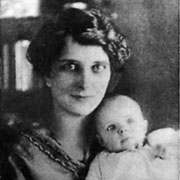
Elise Stevens & child (Holly?)
I answered a call to read Wallace Stevens' "Farewell to Florida" out loud, and a good choice it was, an exemplary way to positively reward my recent push to say Yes! to opportunity.

It was Bob Quatrone who put out the call. An established (as they say) poet in the New York open mic scene, with no small level of erudition when it comes to poetry and poets, Bob curates the Four Horsemen reading at the Cornelia Street Cafe in the Village.

He was specific in asking for a reader for this poem. I didn't remember having read it. Maybe I did, maybe I didn't. My edition of Stevens' poems crumbled with age last year and I still haven't replaced it.

"Farewell to Florida" isn't necessarily elegaic, though it is, Bob told me, written after Stevens wife died.  What made this such a wonderful poem to read out loud several times before the reading--on the subway platform, while walking crosstown on Bleecker, while on my building's stoop--was its subtlety. Which is subtle. On first read it is, as Harold Bloom has written, Shelleyan and Spenser-like (paraphrase), and that slight formality, that almost clever rhyming surprised me, and not happily.

Cleverness is something to be fought, in poetry.  Any poet worth her lines is enormously clever. Clever is easy, a cheap trick. It was the rhyming that seemed too easy, although I don't encounter rhyme much in poetry I read, unless it is slight as a functional braincell in a Tea Partier's brain. So when I read, "Her mind had bound me round. The palms were hot / As if I lived in ashen ground, as if / The leaves in which the wind kept up its sound. . . " I wasn't won over.

Dissection isn't the necessary ticket to embrace, it turns out.  (Read that sentence both ways.)  The poem itself, in its being, won me over, the poem in my head, heard through the mic, off subway walls and track. The poem feeling its way through my body, blood, organs, weaving through chakras, from sexual to celestial and back again.  The silk of it, the tongue-teasing rhythms like the swaying palms Stevens has written of. I suggest you read this poem out loud several times, and tell me if you agree. Also tell me what you think Stevens means by "I am free." Don't be glib.

Farewell To Florida

I
Go on, high ship, since now, upon the shore,
The snake has left its skin upon the floor.
Key West sank downward under massive clouds
And silvers and greens spread over the sea. The moon
Is at the mast-head and the past is dead.
Her mind will never speak to me again.
I am free. High above the mast the moon
Rides clear of her mind and the waves make a refrain
Of this: that the snake has shed its skin upon
The floor. Go on through the darkness. The waves fly back


II
Her mind had bound me round. The palms were hot
As if I lived in ashen ground, as if
The leaves in which the wind kept up its sound
From my North of cold whistled in a sepulchral South,
Her South of pine and coral and coraline sea,
Her home, not mine, in the ever-freshened Keys,
Her days, her oceanic nights, calling
For music, for whisperings from the reefs.
How content I shall be in the North to which I sail
And to feel sure and to forget the bleaching sand ...


III
I hated the weathery yawl from which the pools
Disclosed the sea floor and the wilderness
Of waving weeds. I hated the vivid blooms
Curled over the shadowless hut, the rust and bones,
The trees likes bones and the leaves half sand, half sun.
To stand here on the deck in the dark and say
Farewell and to know that that land is forever gone
And that she will not follow in any word
Or look, nor ever again in thought, except
That I loved her once ... Farewell. Go on, high ship.


IV
My North is leafless and lies in a wintry slime
Both of men and clouds, a slime of men in crowds.
The men are moving as the water moves,
This darkened water cloven by sullen swells
Against your sides, then shoving and slithering,
The darkness shattered, turbulent with foam.
To be free again, to return to the violent mind
That is their mind, these men, and that will bind
Me round, carry me, misty deck, carry me
To the cold, go on, high ship, go on, plunge on.
____________
by (1879-1955) Wallace Stevens

Saturday, September 29, 2012

Regarding "The Master": masterful but a miss

I saw Paul Thomas Anderson's The Master at the earliest possible occassion--the Friday of its early release. There was the promise of pseudo-arcane secrets of pseudo-religion--that being the dangerous con, Scientology; a strong cast (though almost all white people). There was the fact of Paul Thomas Anderson, a great director who grew up in the San Fernando Valley, aspects of which he nailed in Boogie Nights.

The acting is great, as is Anderson's visual artistry, but the story lacks thrust and luster. Yes, Philip Seymour Hoffman's gusty bellow thrille. He's just slugged back bootleg poison brewed by Joaquin Phoenix' character. And Phoenix is a slinking skanky marvel of a drifter. But the relationship between the two men doesn't carry the movie, though it is the movie's core.

I was reminded of the father-son relationship, touching and angry, in There Will Be Blood.  Not so riveting in The Master even though father-son bonds, men succumbing to their more feeling portions, is one of Anderson's themes. There was hints of homo-eroticism, but isn't that in the eye of the beholder. (i.e., So what.)

Two actors who, in effect, had cameos despite strong billing, were riveting. Their implicit and untold backstories begged to be developed. One was Hoffman's movie wife, Amy Adams. (Hoffman's character is reputedly based on Ron Hubbard of Scientology.) Adams delivers a freaky-eerie performance as a woman not-too-far-behind-the-great-man. She authors at least part of his magnum opus and we spy on her as she dictates.  Is she taking dication from the spirits? 

The son-in-law was played by Rami Malek, blinking his children-of-the-corn eyes, innocent and sinister. I wanted more. Jesse Plemmons from Friday Night Lights and more recently from Breaking Bad was beautifully cynical about, and loyal to, his father (the Hoffman character).

But I got bored. The Master was masterful, gorgeous, splendid, cinematically intriguing, but not fully developed as a story, and not a story which, as presented, interested me. I hope Anderson returns to cinematic storytelling greatness. Punch-Drunk Love definitely counts. Boogie Nights is the best screen capture of seedy Los Angeles.

Friday, September 28, 2012

Regarding Warhol at the Met. Sorta Ho Hum.

I wasn't surprised by Regarding Warhol: Sixty Artists Fifty Years at the Met. It's not that I don't revere Warhol for all sort of reasons, from his work ethic to his inventiveness to his knack for holding the spotlight, even unto death. And his Bowie-like looks, more Bowie-like than Bowie.

And it's not that I consider his art to be mere novelty, though novelty is part of its appeal; nor is is that I wasn't excited by the prospect of several galleries of Warhol. I wasn't, but hey. 

I was even less enthused when I realized the galleries were bursting with art inspired by Warhol. Simply, I couldn't imagine being enchanted and I wasn't enchanted. Though Regarding is fair-enough tribute considering the staying power of Warhol's slo-mo moment in history, and a reasonable enough exhibit to draw in crowds, not that the Met is suffering from inattention.

But not my thing. My thing, which I visited after the Warhol, is this summer's roof art, Tomás Saraceno's architectural sculpture Cloud City. See it, enter it, re-see the world in its presence. Before the Warhol I spent time with some no fail masters--Hals, Rembrandt, Steen.

The Warhol galleries abounded with lots of strong craft, much skill. Me with my standards, I want more than craft and skill at the Met. Warhol-inspired works which didn't disappoint were by Jean-Michel Basquiat, Vija Celmins, Takashi Murakami, Edward Ruscha, John Baldassari. True, I'm predisposed to those artists, to begin with, and Ruscha and Baldassari are Californians, which gives them a special glow in my book of glow. I'm not interested in Chuck Close or Jeff Koons, who produce crafty novelties. (I know some will fight me on Close.)

I rarely miss Met exhibits. My sense of obligation to my favorite museum--a sense that prompted me to the Warhol--is usually met with joy, delight, intellectual prodding, companionship of the soul. I'm not sorry I saw the Warhol, which was crowded crowded crowded. I'm never sorry I've visited the Met.
___
pictured: Burning Gas Station by Edward Ruscha.

Monday, September 24, 2012

From the "Bureau of Public Secrets" . . . literally

The original, presented, transliterated, and translated by Robert Aitken:
The old pond;
a frog jumps in —
the sound of the water.
Furu ike ya               
kawazu tobikomu    
mizu no oto              


Old pond!
frog jumps in
water’s sound

Now. Six more translations:

A lonely pond in age-old stillness sleeps . . .
Apart, unstirred by sound or motion . . . till
Suddenly into it a lithe frog leaps.
Translated by Curtis Hidden Page


Into the ancient pond
A frog jumps
Water’s sound!
Translated by D.T. Suzuki


The old pond;
A frog jumps in —
The sound of the water.
Translated by R.H. Blyth


An old pond —
The sound
Of a diving frog.
Translated by Kenneth Rexroth


Pond, there, still and old!
A frog has jumped from the shore.
The splash can be heard.
Translated by Eli Siegel


Old pond
     and a frog-jump-in
          water-sound
Translated by Harold G. Henderson

To read the other twenty-four translations, along with Robert Aitkin's commentary and analysis, go to the Bureau of Public Secrets' "Matsuo Bashô: Frog Haiku."

Tuesday, September 11, 2012

Hocquard "...our understanding / of citrus fruits..." & a FREE link to Brett DeFries' review

Hocquard
CutBank Literary Magazine has reviewed Cole Swensen and Rod Smith's translation of the 2003, The Invention of Glass (Canarium Press, 2012), by French poet and verbal handyman, Emmanuel Hocquard. I did not expect to take a fancy to Hocquard when I began reading, for reasons I might explain another day, and, also--on general principles. I don't mind keeping a closed mind, now and then, and thrill in being caught off guard when it is uneasily pried open, when the soggy sodden gray matter gives up spark and explosion and results not in my being seared but in my humbling. Arrogance is merely a process and an underrated one, at that.

It would be cheesy of me to write more about the recently published (8/23/12) review, except it's intelligent, without attitude, by Brett DeFries, and available HERE. The following excerpt from Hocquard, again, translated by Swenson and Smith, is shooting sparks out of the smouldering crater of my clamshell mind. I'm allergic to shellfish. Miracles, every day.

I
When one speaks
of water, subject and object
form in the phrases.
[...]
There is
an abyss. Poetry
does not speak of the world.
World is a word
that flaunts itself
in order to be. The middle road
is an odd place
and it would be wrong to take
the tepid for the wise.
Given that
a phrase is always clear
ctenaire by analogy: one no longer
wants to be defined. To say the spoken
is within the speaking is
to take the void’s measure.
Wanted or not
he contrives to spread doubt
across the land.
Adventure also carries
this risk. After the war
a child bit
into a glass. The parallel
escapes no one. It has
no exit.
[...]
I eat an orange.
For the record,
Robert S. W. Sikorski
(grandson of the general who gave
their name to the helicopters)
wrote that one-line poem
which is no small contribution
to our understanding
of citrus fruits. And so,
a series of decisive encounters
that makes vertigo
switch sides.
(21-4)
________
Emmanuel Hocquard. The Invention of Glass. Trans. Rod Smith and Cole Swensen. Ann Arbor: Canarium Books, 2012.

Saturday, September 8, 2012

June Jordan, Lady Di, Paris

*See below
I understand the Diana cult but stand outside it. Offered the opportunity to tea-and-crumpet it up with someone legendary, it'd be June Jordan.

From the Random House website, a worthy exclamation: "There aren't any streets or postal holidays named for June Jordan, but she's cherished by and collaborated with her own share of landmarks: she has planned a new Harlem with R. Buckminster Fuller, sipped coffee with Malcolm X, gotten teaching advice from Toni Cade Bambara, co-starred in a film with Angela Davis, and written an opera with John Adams and Peter Sellars. But no June Jordan Day. Yet." (Click on June Jordan, after the poem, to read more.)

Though given how people in-the-flesh can disappoint, I'll take Paris as a stand-in.
.
Poem on the Death of Princess Diana

At least she was riding
beside
somebody going somewhere
fast
about love
__________
June Jordan, 10/3/97 

*Map from Ninety years of Paris

Thursday, September 6, 2012

Slackline. Dear S —


But you sit at your window and dream of that message 
when evening comes. Franz Kafka, “An Imperial Message”


We know poetry and prose married and what sprang off their discrete union—yes, discrete, as numbers are—was a hybrid. The poem and the prose did not choose one last name or even move into the same house. Nonetheless they dare to speak their love, as the wordy will, and incessantly. Where was I? Oh, the offspring: The prose poem, which, in Slackline (Hank's Original Loose Gravel Press, 2012, $7),  Judy Roitman's latest chapbook, gets frisky with the epistolary form. 

Prose poem missives. Among other opportunities, they afford a reader a chance to spy. Me and my lesser angels appreciate that chance, or at least illusion of overhearing Roitman and her addressees — M — and S — and A — 

Spying, or, to be kinder, our curiosity, is why we read letters (of the famous and not)—the hope that the correspondence is without the fabrication, fantasy, or lie of straight-ahead fiction and poetry. If in the process of reading we're inhale a world view (and more) as is the case in Keats letters or the correspondence between Bishop and Lowell, all the better. That said, the epistolary prose poem is a hybrid's hybrid. 

The first letter begins, “Dear M —.” And then, “It's impossible, the walk around the reservoir and now this, a simple vessel in the kitchen, failed. Foxes all around us, even here, unrecognizable, the way they sit, watching or move without acknowledgment, their soft tails.” What a delicious mystery. But it's over soon and then we're onto “S.”

“Dear S — I tried to stop you but was stopped at the light.” Each missive (and of course the two I've quoted are each meatier than what than I served up), pulls in the reader, who is soon all ajumble, assuming it's true that the human mind seeks to establish order. The third, also addressed to “S —,” asks, “How come everyone I know seems to have a name that begin with S —?” There's more than one “S — ”? Or “M — ”? Abandon the hope of tidiness in favor of creativity's inconclusiveness. 

“H” (on page 22) is informed, in a sort of neighborly manner, “You told me about the snake but I didn't believe you and now it's become a milk carton left too long in the trash.” This is one of my favorites. Roitman conjures complementary memories — “children running up to you with their glasses on...” “The way you sat on your couch...” and “that fabulous blouse, the grey one with buttons.”

It is easy, and good, to identify with the combination of specificity of detail and seeming pulled-from-the-air reference—the mind at work, with its inherent logic, honed from a lifetime of dreaming, living, reading.

A third of the chapbook is graced with woodblock illustrations by Sally F. Pillar. They are charming, work well with the letters, and my only complaint with Slackline is the omission of Pillar's bio. 

Finally. These prose poems remind me of sonnets, in that, a question is posed in the first sentence or two, and in some way responded or referred to in the final sentences. Forms are reinvented all the time. Roitman may have had that in mind, and whether it was conscious or not, she's a well-read poet, and thus well-informed by the unconscious.

*The Kafka quotation was my choice and not referenced in the chapbook.

**Judy Roitman lives in Lawrence, Kansas. When she told me she was visiting New York at the beginning of the summer I set up a reading with her, Patricia Spears Jones, Elizabeth Macklin, and myself. We were in the garden at Unnameable Books in Brooklyn on the Solstice. I mention this in the interest of disclosure, which is never full, but always necessary.

Wednesday, September 5, 2012

Rain..."He wanted to go inside them / and live..." Naomi Shihab Nye

by Emily Carr
I woke up thinking it was raining and (almost) simultaneously realizing, yet again, that air conditioners drip into the airspace.

A thing is not what it seems, sometimes, anyway. Same with a person or a kid who is a person, although it is not so much subject matter or convergence of this poem and my morning brain rattle as the fact that I felt an urge to protect after reading Naomi Shihab Nye's "Rain."

Rain
 A teacher asked Paul
 what he would remember
 from third grade, and he sat
 a long time before writing
 "this year somebody tutched me
 on the sholder"
 and turned his paper in.
 Later she showed it to me
 as an example of her wasted life.
 The words he wrote were large
 as houses in a landscape.
 He wanted to go inside them
 and live, he could fill in
 the windows of "o" and "d"
 and be safe while outside
 birds building nests in drainpipes
 knew nothing of the coming rain.
_________
 Naomi Shihab Nye

Sunday, August 19, 2012

Frances Perkins on the "dreadful consequences of economic insecurity"

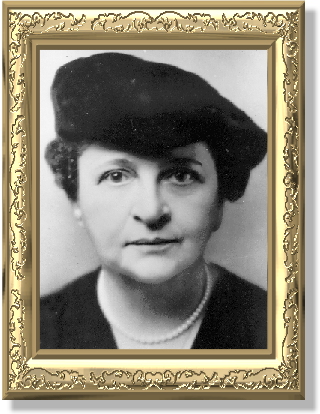
Her words are at least as significant today as they were in 1935. I am speaking of Frances Perkins (1882-1965), the first woman cabinet member, who served as Secretary of Labor from March 1933 to July 1945. When Perkins spoke on Social Security, she was encouraging a means to protect the people. Remember the Wall Street crash of 1929 and its impact on jobs and the economy.

Sound familiar?

Now that forces (think: Romney; think: Ryan) choose to favor the wealthy rather than protect the majority, her words carry a disturbing resonance.

Text of the entire 1935 speech is available on the Social Security Online History Pages. I bolded "We pay now for the dreadful consequence of economic insecurity--and dearly."  To read more about Frances Perkins, click on her name.

The establishment of sound means toward a greater future economic security of the American people is dictated by a prudent consideration of the hazards involved in our national life. No one can guarantee this country against the dangers of future depressions, but we can reduce these dangers. We can eliminate many of the factors that cause economic depressions, and we can provide the means of mitigating their results. This plan for economic security is at once a measure of prevention and a method of alleviation.
We pay now for the dreadful consequence of economic insecurity--and dearly. This plan presents a more equitable and infinitely less expensive means of meeting these costs. We cannot afford to neglect the plain duty before us. I strongly recommend action to attain the objectives sought in this report.

____
Frances Perkins, 1935 (see above for links)

Friday, August 10, 2012

"...there is only one of you in all of time..." Martha Graham to Agnes de Mille

From a letter Martha Graham wrote Agnes de Mille. Consoling, encouraging, true.

There is a vitality, a life force, an energy, a quickening that is translated through you into action, and because there is only one of you in all of time, this expression is unique. And if you block it, it will never exist through any other medium and it will be lost. The world will not have it. It is not your business to determine how good it is nor how valuable nor how it compares with other expressions. It is your business to keep it yours clearly and directly, to keep the channel open. You do not even have to believe in yourself or your work. You have to keep yourself open and aware to the urges that motivate you. Keep the channel open. ... No artist is pleased. [There is] no satisfaction whatever at any time. There is only a queer divine dissatisfaction, a blessed unrest that keeps us marching and makes us more alive than the others.
Martha Graham 

Friday, August 3, 2012

Oedipus is Supideo backwards. And other truisms. 2 poems.

These two poems were published in West Wind Review 2012.  "Marilyn Hacker" (see previous post) was the third poem WWR 2012 published.

No comment, no lead up, no explanation.  Just two poems needing much explanation.  Or justification.

I hope you enjoy them. They were sure fun to write!


Faith & Practice

Easier to make an enemy than beef Wellington.
An ill wind blows "Mandy."
No one can hear you sing "Polly Wolly Doodle" in space.
Oedipus is Supideo backwards.
Call me Sheena.
When you die no one can hear you slurp.
The Liberal Arts are no substitute for a hot bath.
Lemonpepper has come and gone.
As ye sow so shall ye perform a triple axel.
Mint jelly will substitute for sixth-period history.
Your anger turned to tapioca.
Your toes turned in.
That's not your bra, is it?
The guns of August are summering.
Inconsolable angels go shopping.
Satan covered the casserole with grated Cheddar.
A mist covered the sports desk.
The willow grabbed for designer Kleenex.
All good things must bend.
Sing glory for the Lord She is great.
Sing glory for the Host serves good snacks.


Sneaking Around the Multiplex

She wanted to have a baby.
I'm with stupid.
Say you love me.
Promise you don't tell my mother.
The farmer raised me ten dollars.
I was startled by her many breasts.
The national anthem is not an easy song.
If you were Johnny Cash I'd be Juneteenth.
Never edit dharma.
Never f- your career coach.
No such thing as aiming too Fa Fa.
Kiss me, woman.
I was glad she didn't wear a bunker.
Money is the love of all evil.
Roots lead nowhere, really.
Teens tipped the stockbroker.
If you go to heaven bring a nice bottle of wine.
Many men love their wives.
It's good to connect with old friends.
My brain is not working today.
I'm afraid I'll never write again.
Fear is the sand in the clam.
Irritation is death or beauty.
Most days I'd rather not feel.
Angels talk to you at bus stops.
God brought me a Diet Coke.
I asked Her for a few more ice cubes.
_______
Sarah Sarai. Originally published in West Wind Review, 2012, Southern Oregon University.

Thursday, July 26, 2012

Marilyn Hacker Inspires "Marilyn Hacker"

I hadn't gone to the Center library with the thought that I needed to situate myself by any one author. Without doubt, I was headed to the Poetry section, to restore myself after a difficult day. At 7 pm I was going to meet a friend at an event. Until then I had an hour loose as pocket change. An opportunity to make a transition from my work self to my looser, more authentic self. Some people might accomplish this with a cocktail and more power to them. I needed to read a poem.

So there I was in the LGBT Center, in its second floor library modestly snuggled into a corner down the corridor from the Keith Haring room. I found myself by the H's, and in the H's saw "Hacker, Marilyn" and within my grasp I placed, as stated above, her collection, Taking Notice (Knopf, 1980). 

I read "Sequence" which begins: "A woman is talking to you. . ."

You--an oblivious man. I read the poem (which I am not critiquing, analyzing or even fully appreciating here--just explaining how we came to this place), bounded out and onto the bench in the hallway, dragged out my notebook and wrote the poem below.

The friend I was meeting at 7 saw me, but I waved her away.  It was 6:45 and I was still writing, maybe not as elegantly as Hacker, but I was true to myself and recent experiences, including my having met Hacker, as described in the poem below. My friend came by at 7 and we talked and listened, listened and talked. It's what we do, we women.  (On a good day.)


Marilyn Hacker

She says you are talking to a woman
disinteresting you and I wonder if
I am that woman disinteresting you
but think I disinterest not anyone
though being interesting assigns
problems when you are a woman
which you are not but I am a woman
interesting you are not talking to
and I ask Why so disinterest yourself?
At Barnes and Noble (note 2 Barnes
1 Noble) a Chinese guy American
points to a white woman editorial
in the cafe and asks his friend if she
is the “chimp woman Jane Goodall”
cause she has “that Anglo patrician
look.” I'll bet you have no bananas
there exist Anglo patrician men
disinterested in Goodall interesting
who (said particular patricians) spin
about their noggin a men's club of
mosquito netting or Pigpen's flotsam.
Once at a feminist writers and so on
I, needing more coffee, wondered
How do I ask Marilyn Hacker to move?
The woman was buttonholed in front
of the urn. I asked her, How do you
ask Marilyn Hacker to move? She is
small and attentive and Marilyn Hacker.
My query disinteresting made her grin.
 _______
Sarah Sarai, first published in West Wind Review, Southern Oregon University, 2012.

Sunday, July 22, 2012

My Kith and Kin Are Armed

art by Stacy Innerst
Pittsburgh Post-Gazette
At first it was shock, then some kind of shame, the kind a family member feels relatives get in the news for doing nothing good.

I'm taught to (and do) consider myself lucky for our relative freedoms of press, religion, for other rights, and our communal effort to expand or ensure freedoms, to continue to reinvent the Constitution as a document protecting humanness and encouraging humanity. We try, at least, and in the snarling face of furious opposition.
The NRA is furious, opposing, and wrong.

When I was a kid, I remember being ashamed when my folks were parental in the stiff manner of adults.  As my world expanded there was racism (to make me ashamed of my greater family, the kith and kin of the U.S.), and then the Vietnam War. More racism, more war. Financial arrogance on an institutional level. Gender inequality. The corruptness of politicians. The trumpeted contention that we have to import our freedoms and the fact that we do so by slaughtering civilians in the Middle East, the Far East, any place where white people won't get killed. And there is the odd coincidence of corporate gain, all the Haliburtons raking it in by providing private militia while securing oil and mineral rights. By protecting the "right" of the ridiculously wealthy to step up to teller's window to make another deposit.

But what is the outstanding freedom we offer?  Right now it is the opportunity to amass an arsenal of weaponry and ammunition in our apartments. Sure, the intention of the Second Amendment wasn't that we'd be free to go to a movie theater to slaughter a dozen people and wound another fifty. But we're able. We're ready. We do it over and over. And we're constitutionally protected.

There will be a next time. I hope you stay safe and have the wisdom and heart to enjoy a glorious now because it is all we have. And prayers and love. Regret. Maybe a more honest interpretation of the Constitution and the Amendments. 

Please visit The Brady Campaign to Prevent Gun Violence. Sign on. Step up. Donate. Write. Phone. Email. Tell the NRA its platform is a lie. By the way, according to its website, "The full NRA experience requires a broadband connection." And bloodlust.

Thursday, July 19, 2012

Nina Corwin, "On Listening to the Brahms Violin Sonata #1"

"...a grace note of magenta..."

Ekphrastic poetry is ode-like in that is a tribute to, an argument with a painting or sculpture or another poem. Or a sonata. It zooms in on a specific work of art, is inspired by the work or art as a whole, revels in its inspiration.

What strikes me about Nina Corwin's "On Listening to the Brahms Violin Sonata #1," beyond its breathtaking investigation into artistic choice, and its second sentence speeding along like a driver and a car freed to be their most cruising selves, is its exploration.

Respond to this poem's questioning, its suggestion and unabashed synesthesia--feeling the music as color.  Join Corwin and knowing the chords as hues--magenta, deep forest green. And those hues, as sounds, will play in our mouth. New images will appear, the chandelier, the chef with her cilantro, then textures offering a sense of, an equivalent.

Corwin shares her love of sound, of a specific piece of music, of the singular and exuberant freedom of listening when accompanied by speed and scenery.  This is a good poem. 


On Listening to the Brahms Violin Sonata #1

And just like that! Cruising up Route 94 with the classical radio station
crooning on all four speakers, when it gets to the moment of that certain
crescendo where the violin does what violins do so well, and the bow
catches the sinews inside my chest as if they were strings stretched across
an unfretted fingerboard, it strikes me that perhaps when Brahms composed
he chose his instruments the way a painter chooses colors, dabbing his
brush in a grace note of magenta because the violin can shimmy up a string
so sweet, maybe turning it over in his hands as he imagines the sound of
magenta rubbing up against the chords of a deep forest green, the way a
poet might choose a word, say, magenta because the sound curves against
the roof of the mouth, or the way a word like piano makes a kind of
corkscrew between the cheeks, how clutter clicks, and chandelier is sensual
and elegant at the same time, or how a chef picks a leaf of cilantro for its
clean line and timbre where taste meets texture curried up against a
cardamon pod, the contrapuntal harmonies when they echo with magenta or
piano, the chords they make together in a sentence or crooning on a car
radio, and it couldn't be flute or oboe, not here, this moment, but now, these
cadenzas, this final G major, now, the violin.
______
Nina Corwin. "On Listening to the Brahms Violin Sonata #1" first appeared in Poetry East, no. 52, Spring, 2004.

Monday, July 16, 2012

Breaking Bad, Heisen's Burg

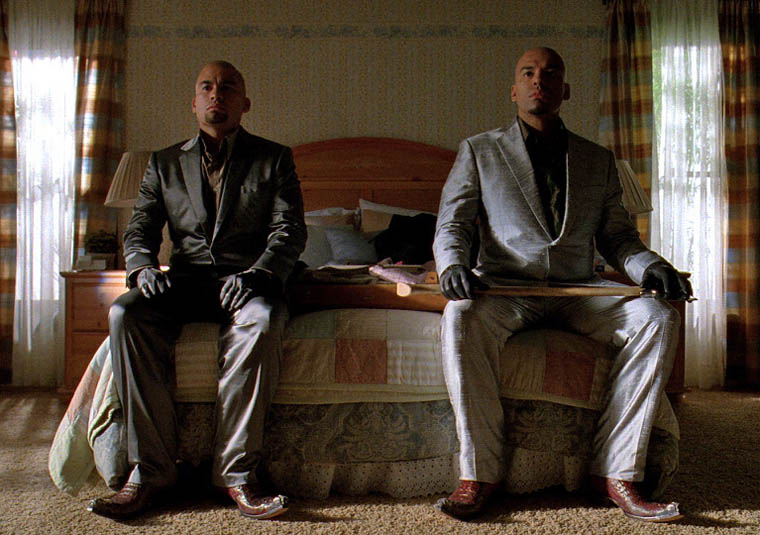
The characters Leonel y Marco Salamanca (Daniel and Luis Moncada)
Breaking Bad is brilliant partly because of the suspense which has been racheted up every single episode since the very first.  Genius Walter White is not only inexperienced in the nefarious activities he is drawn to, but so full of pride and arrogance, he goeth before his own fall, episode after episode. Sometimes Jesse jumps in after Walt, sometimes his choices force Walt's hand.
Jesse, I want to point out, has an exceptional mind but doesn't realize that. He blunted access by way of doping, truancy, small-scale badassing. But he is ingenious, and, point of fact, wouldn't have lasted as Walt's partner in meth-making if he hadn't been able to keep up.

More than the tension so cleverly created, more than the astonishing weirdness (like the Salamanca brothers crawling in the dirt, como penitentes, to a shrine where they supplicate mother death to destroy Walt) Breaking Bad makes me think.  Has me pondering, again and again, ethics, necessity, The Bad, The Good, human nature creating destiny.

It is a thought-provoking show on a major scale.  The Greek's, or one of the ancients' themes--hubris--is presented over and over. Once Walt pays for his medical needs, money isn't really the draw for him.  He knows how to get along. He knows that the financial comfort he is providing--though thwarted--is obviated by how it's provided.

I understand his motivation. If I could finally earn enough money through writing to wipe out my debts, I'd feel justified, regardless of what I wrote.  (Well, maybe.)  He's finally making big money through chemistry.  By the way, I realize he can't just walk out, what with the cartel and all.

Everyone connected to the show shares credit for the depth of character and ethical dilemmas arising out of situations--actors, writers, directors, editors, costumers, art.

The Sopranos was an astonishingly good show and also raised questions but not like Breaking Bad does. It was more a guilty pleasure, with extraordinary acting, plotting, imagination.

Anyway, I don't have a t.v. but this is a show worth buying. I go to Amazon and purchase a download the day after episodes are aired. So tonight, whoa, mama. I'm looking forward to Episode 1, Season 5. I anticipate tension, fear, frustration, and jaw-dropping admiration.

Wednesday, July 11, 2012

Don't Shut Up, Or Down

Someone asked for meaningful essays by women. I blanked--what's new--and then remembered Audre Lorde writing about--against--silence.

Short of rudeness, the context is roundly universal and keeps us alert to hate and its trickle downs and insults of any style and a variety of psychic or physical threats.

In my early twenties, my brother-in-law ran through my sister's purse for my address and showed up unannounced at my apartment.  "I've had my eyes on  you since you were twelve."  It's true. He had. And was here to act on it.  I played dumb and then dumber.  Knew that rush of waterfall meets coal stove in my brain. And with much luck and, truly, wild determination, I got him out of my apartment, so, as such things go, I got off easy.

But I couldn't tell my sister. In fact, I couldn't tell anyone for ten years.  I had massive problems talking.  I couldn't raise my hand in high school or college classes.  Blah blah blah.  This is just a blog. I suspect most of the hits here are for the images and I assure you, reader, that no one in my family reads it.

In part my silence ("silence") was a smart and decent decision. This was the seventies. My brother in law was black. I was worried there would be stereotyping on top of racial assumptions about men of color.  You may make assumptions about that gender, go ahead, no problem. But please no easy racial profiling.

Whether or not my refusal to tell anyone was understandable or not, thrown onto an emotional compost heap from my uneasy childhood (and other stuff), the unsightly and confusing mixed metaphor of verbal docility did damage.  To my self, sense of self, psyche, womanhood. But by the time Clinton allowed Lewinsky to pleasure him, but I do remember feeling so relieved that such male idiocy was being made so public by a white man.

What I keep thinking about, however, isn't what happened then, but that a young relative reacts to my belated coming out. Granted she is young as I was, and the young are fools, but I fit into this person's nasty stereotypes about dykes. I feel a bit angry.  And hurt.  I did all that higher level thinking for my family and somehow I expect more.  Hell, I'd be satisfied if someone would just once say they'd read and liked one (ONE) of my poems or stories.

I need to break my silence and speak to her. I will, in September, when we're in the same state again. Sorry for abusing this posting, but I feel better now.  As Ms. Lorde wrote in "The Transformation of Silence Into Language and Action" . . .    
What are the tyrannies you swallow day by day and attempt to make your own, until you will sicken and die of them, still in silence? 
 And . . .
In the cause of silence, each of us draws the face of her own fear — fear of contempt, of censure, of some judgment, or recognition, of challenge, of annihilation. But most of all, I think, we fear the visibility without which we cannot truly live.

Monday, July 9, 2012

Borges . . .the unalterable / sum of moments granted you by fate. . .

Andy Warhol Self-portrait in drag
(Monroe wig)
I am back to Borges.  


I needed an antidote. Saw an ad this morning for a major chemical corporation, the name of which resonates from the time of the Vietnam War and the occasion of death by formula made product.


Seeing the death star's new slogan was too much. No need to be specific. No need for proper nouns locating actions more improper than the imagination can create.  


Lately I've been remembering the truism: You aren't responsible for your first thought but you are for the thoughts which follow.  


So I'm being responsible. "We live discovering and forgetting / that sweet familiarity of the night." Offering a chance to suck your breath in and marvel. This poem is translated by A.S. Kline. 

(The Andy Warhol self-portrait kinda turns the table on the adoration here. Well, maybe it doesn't turn tables so much as expand the possibilities. More expansion, ahead.)


The Sum

The silent friendliness of the moon
(misquoting Virgil) accompanies you
since that one night or evening lost
in time now, on which your restless
eyes first deciphered her forever
in a garden or patio turned to dust.
Forever? I know someone, someday
will be able to tell you truthfully:
‘You’ll never see the bright moon again,
You’ve now achieved the unalterable
sum of moments granted you by fate.
Useless to open every window
in the world. Too late. You’ll not find her.’
We live discovering and forgetting
that sweet familiarity of the night.
Take a long look. It might be the last.
 _____
Jorge Luis Borges,  tr. by A.S. Kline, @2008

Thursday, July 5, 2012

Stop: A Poem of Pharmaceutical Advertising


Stop

In an ad agency, Traffic is like
Department of the Shepherds,
or an escort service,
housemother, Charon,
ferrying files from account exec. to writer
to art director to the shop to editorial
back to writer, exec., client, hell.
When the agency is pharm., the ad
could be direct-to-physician, direct-to-
patient, include an ISI (Important Safety Information).
Pharm. pays better than general advertising but
each ad has me fighting early training:
this is a load of crap.
Remember, I wasn't allowed medicine as a kid.
When I was headed to Camp Yallani we needed
a doc. to sign off.
He spotted weeping sores on my hand.
What’s that? he asked Mom.
It’s nothing she said.
Don't blame advertisers for the public's foolishness.
David Ogilvy's Little Red Book
of selling-relevant aphorisms
had typos.
Mao's Little Red Book fell to
reform and reeducation through labor.
There's no poetry in consumerism or
totalitarianism.
Oh save us from our leaders.
All of us.
______
Sarah Sarai, Folly Magazine, February 2012

Note: I wasn't allowed to take biology in high school because of my Christian Science mother. Yet here I am, working in pharmaceutical advertising and not quite fitting in.  I do my quiet thing, my rent gets paid, my poems get written and sunlight and birds reveled in.

Before pharma, I was in general advertising, and yes, Ogilvy Advertising had its founder's Little Red Book, about the same size as Mao's.  Thanks to Folly Magazine for publishing the poem and allowing me to include it here. April 27, 2016 note: Folly is out-of-print.

Sunday, June 24, 2012

The Death & Times of Ancestor Man, a poem


To heck with it. I mean, really.  This poem, for better and worse, has 
been around for fifteen years.  I have never been sure of it although 
I love Ancestor Man and his long reach to the past (which is probably 
fell behind the couch.). So I'm publishing it here. (I DO like it.)
 
I was thinking about something (many things) when I wrote this.  
Authenticity. Colonial Hegemony, stupidities, thereof. Its lingering 
presence. Lies. Sleights.

The misdirection of anthropology. Sometimes, anyway.

Physically, Ancestor Man reminds me of Wile E. Coyote. 
(So let's get down to cases. Since you are a rabbit, 
I am going to eat you for dinner.) 

I did see a Dr. Ma, when I lived in Seattle. And he did sell me a  
brown paper bag filled with dead cicadas. A little creepy. 
They resembled roaches.
 
I boiled them for fifteen minutes, which lent a marijuana-gone-rancid 
air to my apartment. The idea behind the prescription,  
Chinese medicine, was, indeed, I was drinking coolness. 

My body ("hot") in Chinese med. terms, needed a break.


The Death & Times of Ancestor Man 
 
i. 
Where sunlight slips out over there 
cross a yard where a willow cranes, 
watching  lamentation disappear 
over & again—that’s where 
Ancestor Man took leave, not 
in the city like they told you.  
Not Ancestor Man.  Expert teams 
mold casts of his swift tread to read 
truth-in-plaster.  Oh, they pound  
their chests with grief.  Mr. A's gone.   
 
ii. 
I will tell you what happened.  
He sucked himself in as if his body 
weren’t flesh & his mother opened, 
just a little.  Ancestor Man sunk in, 
knowing we look only to the past.  
 
iii. 
When we were Aztecs & quenched 
our thirst with mythic blood downed 
like Big Gulps, the guy was happy.  
“Well, good riddance, Ancestor Man!” 
Not so quick.  He’s got his quirks but
would accept a token—roses, a card, 
contrition—to know we still care.  
 
v. 
Okay, it goes deeper than that. 
Ancestor Man was a drug lord 
fronting for a cartel. The drug?  
Something even Dr. Ma, 
who grinds cicadas so their wings 
cool my feverish nights, never 
studied. A generic would do,
but sickness is older than cure.  
_______
by Sarah Sarai (and none other)

Tuesday, June 19, 2012

My New Goods: 3 Stories

Three new stories, two published in the last few days (one online, one in print), and a third (online) last month.  Most recently published is "Far Star Girl," although I wrote it a while back.  Editors at Seventeen Magazine once told me they'd wished they could publish this story. (I've heard that before. No, I mean it. And I never quite understand, but anyway.)

"Curtains" is a far newer story, written in the past two years.  I'd  tried to quit writing fiction (the above paragraph might explain why) but there I was, writing again, first "Lillia," then "Curtains."

"Far Star Girl" is in Pangur Ban Party. Editor DJ Berndt goes the extra mile to create spiffy e-books.  First paragraph:  
She thought maybe an angel had called out her name. She wasn't sure. She was waiting for her older sister to return with Jujy Fruits and bonbons. The theater, neither light nor dark, was to Cassie's ten-year-old mind, an appropriate-enough setting for a visit from an angel. Cassie knew better than to mention her divine suspicions to Dot who was five years older and sour.
Also new is "Curtains," in Belletriste Coterie, a new print journal edited by Kimberly Lojewski and team.  The narrator observes from after life. First paragraph:

So you might have heard in 1962 Fidel Castro let Nikita Khrushchev store missiles on the island of Cuba which isn't all that far from the U.S.A. which I am in more of a position to know than you are. Other stuff happened that year like John Glenn going around one of the planets, earth or moon or sun, I've never been sure which even though, again, I can see more than you can. And those people back when James Meredith decided to go to college in Mississippi, I saw them on t.v. and their faces looked like dried apple cores going moldy. I was twelve. I'm thirteen now because I'll always be thirteen because I died in 1963 because my bike flipped because I barreled down the hill, loop-de-looped and landed in a ditch. The hot asphalt guy helping the ditch-digging guy didn't hear the steamroller guy shout. The hot asphalt guy isn't up here yet and I've done everything I can for him (which isn't much of anything but it is something) because he was really sorry about the whole thing.
And here's "Lillia." (In Devil's Lake, published by the University of Madison-Wisconsin.)   I wrote the first paragraph when I lived in Seattle. where the story is set, around 1995. Then I tucked it away only to chance on in a recent tidying frenzy. The editor accepting this story, Marian Palaia, was sharp and supportive.  Here's the first paragraph:
There is nothing I love so much as a fat person, or admire. The largeness of their soul demands abundant sufficiency of casing and, further, because they are so grand of psyche, so much more than those who are skinny (not I!), they need—require—that formidable heft to anchor them to our earth. I fence-sit (or would), between unmistakable plumpness and hands-on girth. Lillia Fly-Eagle was a big one too, and for that I loved her, briefly and dearly.
 Honestly, people. I want to publish a collection of short stories.  Maybe these recent pubs are promises it will happen.(Or not.)

Sunday, June 17, 2012

Joan Larkin's 'Vagina' Sonnet; Argos Books

Ljubica Denkovic
Last night I stumbled, intentionally this time, into a simultaneously cozy and lush club, well, venue. It calls itself a club--The Oracle Club--but there is no House Music. THANK YOU, GOD!!! The music of the house is played on L.P.s with album covers of Bessie Smith, Aretha Franklin, jazz from the thirties. Also heard are musical stylings of Pierre and Edith, chirping plainchant from their light-filled birdcage.

I was there to join Argos Books in celebrating its four most recent publications, stylish chapbooks by Joan Larkin, Bianca Stone, Brandon Kreitler, Dorothea Laskey (who wasn't present, so the artist for her chapbook, Matthew Fische, read). I went with a friend. The event was a party, the party was easy, graceful, a gift of art.

The Oracle Club is in Long Island City-ish. Its precise neighborhood designation wasn't clear to me. That's a lie. It was but I can't remember the name, something like Hunter's Point, but not. The first stop on the 7. That works.

Argos' chapbooks are, as is the nature of chapbooks, delicately crafted creatures. And although the following poem was published several years ago, prior to brilliant Joan Larkin's current chapbook, it is most worthy of sharing and resharing, especially in light of the idiots in Michigan who are so afraid of life they are afraid of its vessels. 


‘Vagina’ Sonnet

Is ‘vagina’ suitable for use
in a sonnet? I don’t suppose so.
A famous poet told me, ‘Vagina’s ugly.’
Meaning, of course, the sound of it. In poems.
Meanwhile he inserts his penis frequently
into his verse, calling it seriously, ‘My
Penis.' It is short, I know, and dignified.
I mean of course the sound of it. In poems.
This whole thing is unfortunate, but petty,
like my hangup concerning English Dept memos
headed ‘Mr/Mrs/Miss’ — only a fishbone
In the throat of the revolution —
a waste of brains — to be concerned about
this minor issue of my cunt’s good name.
____
Joan Larkin. Not printed with permission but with hopes she won't object. From the Ms. Magazine blog.

Saturday, June 16, 2012

Thanks to Roxane Gay for Adding a Few Years to My Life

(The Rumpus used a very cool abacus,
as illustration. Different clip art,
above, but same concept.)

I suppose if I were to keep a daily accounting of how I spend my time I would be forced to acknowledge hours and hours devoted to FUMING. I get rankled, lots.

For Example.  Recently. My entire cranium, except for portions assigned to personal hygiene and paying nominal attention to cabs steering toward me at crosswalks, has had within it the 84th Academy Awards.  Did you see it?

Did you?  Do you remember?  I do. A humongous auditorium of the beautiful (fair enough) and young (okay, what's new) and all white (what!!!!!!!!!). 

What the Academy, the liberal Hollywood elite, presented, quite accurately given its track record within its gated and red-carpeted community, was the essentially all-white event representing an essentially all-white medium.  Sure, sure, sure.  I celebrated Olivia Spencer's Oscar. I haven't seen The Help but reliable friends tell me was terrific. (I can't imagine any actress better than Viola Davis, but, whatever.) I ha ha ha-ed at Chris Rock. He is very, very funny.

But really. Tell me you didn't see a sea, an ocean, the planet before the seas were parted, of white people.  Tell me t.v. listings don't reveal overwhelming white casting. Tell me movies don't recycle the same white actors over and over. I AM SO TIRED OF THOSE SAME THIRTY-SOMETHING FORTY-SOMETHING SO-CALLED FUNNY GUYS IN EVERY MOVIE I COULD, well, get peeved. Gender inequity is also legion, yup, but my concern here is race.  I am  dumbfounded at Hollywood's racism, support for Obama notwithstanding. (Another topic.)

I don't have high blood pressure but other essential elements of my intimate chemistries are stressed as I, every day, think about my beloved movies so abused.  In fact, I'm ashamed for my country. Hollyqoos sure isn't representing my world or America's world.

So that was the example.  The case-in-point is the New York Times Book Review. I stopped reading it with any regularity a few years back. I didn't want to, over and over, expose myself to its chosen cosmos of over 90 percent white (male) writers.  That's not my cosmos.  Whatever "white" means by the NYT reckoning, it doesn't even represent me (and I'm "white") (I'm even one-quarter "Caucasian").

Writer and professor and generally cool, not to mention astute, social critic Roxane Gay looked at the stats. You can read her critique of the NYT in her The Rumpus article, Where Things Stand.  For instance, to quote Gay:

Of those 742 [books reviewed], 655 were written by Caucasian authors (1 transgender writer, 437 men, and 217 women). Thirty-one were written by Africans or African Americans (21 men, 10 women), 9 were written by Hispanic authors (8 men, 1 woman), 33 by Asian, Asian-American or South Asian writers (19 men, 14 women), 8 by Middle Eastern writers (5 men, 3 women) and 6 were books written by writers whose racial background we were simply unable to identify.
The Internet, by way of access to so many sharp news sources, is robbing The Times of its "paper of record" status. Thank you, Internet. Ho hum, NYT. And thank you, Roxane Gay. Secrets and unspoken truths are unhealthy to body and spirit, corpus and soul. I don't know how efficacious truth is, but without, we get no where new.