I'm still thinking about Dorothea Tanning--and her dates--1910 to 2012. She wasn't one of the cigarette-smoking, National Geographic women of the Caucasus Mountains, blowing smoke across the Black Sea while outliving most Americans.
She was an American woman with an incredible story, its narrative being one of art and writing, geography and romance.
All homes are homes; mirages / everywhere.
Here is another* of her poems, exemplar of a spirit too expansive for limitation of land or death.
*The other posted here on February 1.
The sunflower is by Richard Gilkey, who, as far as I know, has no connection with Tanning. He was one of the Northwest School artists.
Are You?
If an expatriate is, as I believe, someone
who never forgets for an instant
being one,
then, no.
But, if knowing that you always
tote your country around
with you, your roots,
a lump
like a soul that will never leave you
stranded in alien subsets of
yourself, or your wild
entire;
that being elsewhere packs a vertigo,
a tightrope side you cannot
pass up, another way
to show
how not to break your pretty neck
falling on skylights:
reward-laden
mirages;
then, yes. All homes are home; mirages
everywhere. Aside from
gravity, there are no
limits,
never were, nor will there ever be,
no here and there to foil
your lotus-dreaming
legend.
Stay on the planet, if you can. It isn't
all that chilly and what's more,
grows warmer by the
minute.
_____
Dorothea Tanning, from A Table of Content, Graywolf Press, 2004. (GREAT title).
Saturday, February 25, 2012
Thursday, February 23, 2012
The Banal and the Profane
Quick mention of an article-ish by me on the Lambda Literary site. What I want to mention is, IT'S THERE.
The Banal and the Profane: Sarah Sarai.
It's all about me; me detailing a week in my life. The best part is I was able to include a description of the Poetry Assembly we ran at the Bowery Poetry Club in January. The first such event since Zuccotti Park was de-peopled. (We = Occupy Poetry, a working group of OWS.)
I am fortunate to have been asked to transcribe an approximation of my life, and so I don't let Lambda down, if you want to read the article and then "Like" it, at the end, well, I wouldn't talk you out of it. (Browser-wise, liking is easier, I am told on Mozilla Firefox.)
And while you are there, explore the reviews and fabulous array of articles and events and insights. subscribe to the Lambda mailing list, too. Send money, send love, send blessings. And more money and more love.
Thursday, February 16, 2012
Those People with Missing Chunks in their Infrastructure. p.s. The medium [of a blog] is authentication
![]() |
| from Missing Chunk . com |
I don't quite understand why posting on you can ratchet up my sense of self or self-esteem but it can. A few years ago, two friends insisted I post here every day. I didn't, not every day, but I did try to do so most days, and it worked. No longer a slug who had to fight lethargy, avoidance, the droopsies or Factor X, I was getting up, drinking my coffee and communicating.
The content might not be important so much as the product--a shiny graphic, a new poem of mine or a fabulous poem by a master, an observation on the world. You write a little, you slap on a graphic, and you've got yourself a visible sign you exist and function, maybe cleverly or not, maybe wisely or not, with or without impact. But here you are.
The medium of a blog posting is not the message, the medium is authentication. It is, Hey, Ma, Look what I've done. It is a friend discovering My 3,000 Loving Arms last Sunday and telling me it looks good, even if she doesn't (to her way of thinking) understand poetry.
Today I submit a specific, though perhaps random, observation. I can't offer details or background as I'm not running an expose machine and don't want to hurt anyone (unless it's Romney, Santorum, Barbara Bush or her sons, any of the 1 percent who refuse to see the global untenability of their lifestyle).
I'd begun noticing in this professional, shall we say, I was seeing for a time, that he had huge chunks missing. I'd seen it before, and never moved my insight ahead. But as I began to catch on to his inability to assist me beyond our first meetings, when I was directed to some local agencies, I realized he didn't have the capacity to do so, boyish good looks notwithstanding.
And though I'd begun wondering if those missing chunks (of emotional infrastructure) signalled something menacing, as if he might be one of those functional sociopaths who are in the news these days (in press conferences relating to their votes in Congress), I finally caught myself. I was overthinking.
My aha! came when he explained away a huge glitch in his information sharing (he was the one who glitched, if you will) with a petulant, "My bad." My bad? That's it? You've wasted a month and a half of my time and your full expression of regret or shame or even concern for me is, My bad?
The chunks that were missing? They are missing chunks. That's all. He's probably not a sociopath or psychopath, just a slightly hollow person, one I don't have much interest in.
And writing this makes me feel better.
Yours,
Sarah Sarai (aka Sarah Gancher Sarai)
Tuesday, February 14, 2012
Leaving the Familiar: Clouds abounded but there was no rain; the air rang sweet and dank.
I have no memory the equivalent of the Cascade Mountains, but a thing being equal to itself, I do have that memory, of backpacking, when I lived in the Pacific Northwest. I drew on the spans of green beauty to write this story about a kid who skips out on her family to find something new.
Thanks to the publication Whistling Fire for publishing "Leaving the Familiar."
... to read the rest of "Leaving the Familiar" click on the title or here.
Thanks to the publication Whistling Fire for publishing "Leaving the Familiar."
C.G. went to the forest. She lied about going on a sleepover―at Eleanor’s, Ma, and found her parents’ trusting, Okay, Cee, maliciously benign. She slammed the front door, shouted an apology and left, to pedal furiously along the road winding like a concrete shoreline by the river. At its end she hid her bike under bushes.
A farmer she recognized from the Saturday market allowed her on the back of his pickup along with his cants, toms, corn and berries. She ate one ear of fresh, raw corn while she was in the back of that truck, threw the husk to the floorbed and let the silk glide in the air to the road. . . .
... to read the rest of "Leaving the Familiar" click on the title or here.
Monday, February 13, 2012
It Will Be Revised (poem found in journal)
There are others--poems I've scribbled in journals and forgotten. You are not forgotten poem. You are blogged.
Lofty
The bed was lofty
his thoughts were dirty
the room drafty
the wind dipsy
the day drifting
the cloud another childhood toy.
Her loft was airy
its mice walled in
the cat nappy
the rug Persian
the taffy toffee
the dish, well, it is always
the dish.
They drank
slept on it
woke stiff
woke the stiff
stiffed the woken
amassed the masses
got smashed at Mass
sleep walked
washed it off.
The repetitive nature of
a tunnel haunts me.
We could extradite the dead
if God'd sign on
the dotted line.
You could wander all Canaan
in search of a three-part
self-carbon form.
You could gnash your teeth
to dust.
All choices are multiple
too many questions an essay
String theory does nothing
for lasagna.
Suicide is always an option.
The faint thought
beside the point
of being love and
obliged to feed the poor
to know the sun in your pores
is not sex but
it will do when you're out
and about.
_____
Me (Sarah Sarai), Feb. 2012
Sunday, February 12, 2012
Some Questions for U.S. Bishops (trying to spare you the task of compassion or original thinking)
Headline from today's Washington Post: "U.S. bishops blast Obama's contraception compromise."
So: the U.S. Conference on Bishops "has declared total opposition to any compromise on the issue." As I understand the most recent iteration of this debate, President Obama and his advisers worked out a compromise so the churches and religious institutions in general weren't required to foot the bill for women's contraception but, instead, insurance companies would cover the costs. So that women were still covered and church fathers were spared the task of compassion or original thinking.
Assuming the Conference assumes it knows best I have to ask the U.S. bishops about their experience with contraception, and the cycle of life (as in the menstrual cycle) itself. I realize there are some lay bishops who are female, bur we're still talking male domination. So let me ask you, bishops:
-Have you ever wondered by Tampax aren't tax deductible?
-Have you ever had a miscarriage?
-Have you ever worried about leakage?
-Have you ever asked a stranger if she had an extra Tampax you could use?
-How many underpants have you tossed away because they had menstrual blood on them?
-How many slacks or pantyhose have you thrown away because they had menstrual blood on them?
-Have you ever been forced to have sex with a man, against your will?
-Have you ever had a miscarriage?
-Has your life ever been at risk from a dangerous pregnancy?
-Have you ever been raped?
-Have you ever known you just didn't want to have children?
-Have you ever had to support children after their father had abandoned you?
-Have you ever found that raising children, with or without the support of a partner or village was too stressful an experience to repeat?
-Have you ever wanted to have a career, you know, in a field you had gone through apprenticeships or college before you could achieve success?
-Have you ever wanted to have a child but known it just wasn't the right time in your life?
-Have you ever wanted to make decisions about your own body?
-Have you ever felt disgraced or enraged because institutions believed they knew what was best for you when in fact they simply wanted to control you?
-Have you ever realized that an overwhelming majority of Americans are in favor of Planned Parenthood and organizations providing similar care, but that the U.S. Conference of Bishops still thinks it judge and boss women?
-Have you ever had cramps? PMS?
-Have you ever considered killing the next person you saw if you couldn't get some relief to your pain (from cramps or PMS)?
-Have you ever had a vile workday where all you wanted to do was go on and wrap yourself in blankets? But you still showed up for work and did a good job?
Wednesday, February 1, 2012
Dorothea Tanning: "Dwarves crushing mouse families."
![]() | ||
| Palaestra. 1947 |
A painter, she wanted to meet Surrealists so she sailed to Europe and when war or its threat drove artists back here, she returned. Married and divorced. Met Max Ernst who left Peggy Guggenheim for her.
Imagine stealing Peggy Guggenheim's man. Tanning and Ernst moved to Arizona then France where in a joint ceremony with Man Ray and Juliet Browne, married. That must have been a festive day.
After Ernst's death in 1976, Tanning came to New York for another round of lifetimes and adventures, which included gallery exhibits and the writing of poetry and memoir.
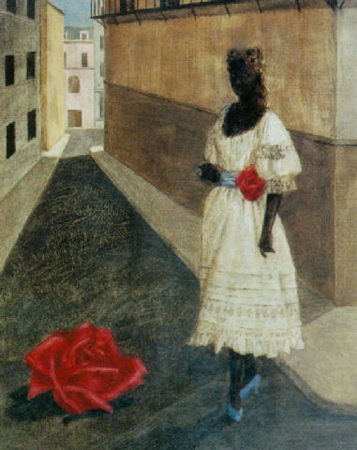
![]() |
| The Black Rose |
When young, Tanning was extraordinarily beautiful, which is such an extreme gift and one so randomly given, but there you have it.
"Cultivation" is stolen or at least copied and pasted, from the pages of Paris Review.
Cultivation
Cultivating people can be arduous,With results as uncertain as weather.
Try oysters, meerkats, turnips, mice.
My mouse field was a triumph of
Cultivation—pink noses poking
Through quilts of loam, scampering
In the furrows—until the falling
Dwarves (it was that time of year)
Began landing on my field. Fear for
Its harvest had me down on hands
And knees muttering, “Not here,”
My nails clawed at tangles of fat
Dwarves crushing mouse families.
Then, unbelievably, it was over.
By morning every dwarf, maddened
By nibbling mice, had fled the field.
Now, as before, each day, dozens
Of perfect mice leave for the city.
There, they have made many friends
Among computers, and with them
Are developing skills inconceivable
To their forebears. Already, these
Cultivated mice and their computers
Penetrate guilty secrets. Soon they will
Prevail over the turmoil that defines
This darkest of ages. And they will
Find me, asleep in my cave.
_______
Dorothea Tanning
Sunday, January 29, 2012
Round-up of My Latest Publications & News
January 31 Update: I tried to fix a line break a few minutes ago and voila! the entire page disappeared. I'll recreate the content but it'll take me some time. Bummer.
Jubilant (stem of jūbilāns, present participle of jūbilāre to shout, whoop). What is jubilantly whooped herein is news of a recent event and recent publications.
FIRSTLY, the first PoetryAssembly held outside of Zuccotti Park was a great success. We were given a free slot at the Bowery Poetry Club, and we filled the club. A few poets used the People's Mic, but otherwise, stood and addressed the circle.
The rest of my news:
3 poems in Reconfigurations: A Journal for Poetics & Poetry / Literature & Culture.
2 poems in Truck: RESOLUTION/REVOLUTION, curated by Larissa Shmailo.
1 short story, "An Archive of Paranormal Inquiry Into Coping," previously published in The Writing Disorder, now anthologized in The Writing Disorder, Anthology, Volume 2, 2012.
1 essay and 2 poems published on Poets on the Great Recession.
Friday, January 27, 2012
Mad Crazy Love. 3 Years Later, Jane Eyre. Charlotte Bronte. She Endured.
![]() |
| Professor Heger, maybe 20 years after Charlotte worked for his family. |
I cannot separate Charlotte Bronte from the collective
female. Her poems are, perhaps, undistinguished. (Emily Bronte has
three poems on Poets.org but Charlotte has none.) But she (and Emily) towers over literature.
And that's why my first reaction to the news that Charlotte's love letters were being published today was dismay. Can't we allow the woman a little privacy? Many, female and male alike, have known torments and grief of illusion and unrequited love. Whole industries serve that impulse with how-to books, including the classic of my generation, Women Who Love Too Much, with its iterations for men and across all gender preferences.
But what next struck me about Charlotte's infatuation with her employer Professor Constantin Heger, an older man with a wife and children (this when she was a governess in Belgium), was the timeline.
So she's 28, and that's a Victorian 28, not a wise, once-divorced 28 of the new millennium. She falls in love, whatever love is.
And three years later, when she's 31, publishes Jane Eyre. This is not Medea killing her children because of Jason's infidelity. This is not Dido, self-immolating when Aeneas dumps her. (Both accomplished women, myths surely based on flesh and blood.) Charlotte's life, however, doesn't end. It just has a bump.
I'm posting this article from the Telegraph here
BECAUSE I can't separate Charlotte Bronte from the collective female
which she advanced and amplified.
Stupid crazy love, yes.
Three years later, Jane Eyre. One hundred years later? A television or movie re-envisioning of Jane Eyre practically every other year. A book which remains a favorite for readers and critics. A woman who endures.
Sunday, January 22, 2012
What will the indecipherable future dream? ... Borges (Still missing Etta & Johnny)
![]() |
| Ric Nagualero* |
Every so often I'm proud of the human race. We don't have much capacity to identify stupidity, but sometimes we do know genius.
Tonight I'm going to post another selection from Poems of the Night, a gathering of work from several of Jorge Luis Borges' collections. I want, for myself, his easy passage into dream and back, his understanding of depth, process and transparency of the collective unconsciousness, of the momentous occasion of its existence, and a personal access through myth and dream (and good fortune). Borges gives me hope as an artist and as a believer (in many things).
Each sentence below is a meditation.
Someone Will Dream
What will the indecipherable future dream? A dream that Alonso Quijano can be Don Quixote without leaving his village and his books. A dream that the eve of Ulysses can be more prodigious than the poem that recounts his hardships. Dreaming human generations that will not recognize the name of Ulysses. Dreaming dreams more precise than today's wakefulness. A dream that we will be able to do miracles and that we won't do them, because it will be more real to imagine them. Dreaming worlds so intense that the voice of one bird could kill you. Dreaming that to forget and to remember can be voluntary actions, not aggressions or gifts of chance. A dream that we shall see with our whole body, as Milton wished from the shadow of those tender orbs, his eyes. Dreaming a world without machines and without that afflicted machine, the body. Life is not a dream, Novalis writes, but can become a dream.
Suzanne Jill Levine tr.
_____________
Borges, Waiting for the Night, Poems of the Night (Penguin).
*Painting by Ric Nagualero: www.nagualero.com / Facebook.com/nagualero
Friday, January 20, 2012
Great Souls Creating Their Own Proximity: Etta James & Johnny Otis. America's Great Black Musical Triumph. A Poem by Pessoa.
A great soul creates its own proximity. I don't need to have seen or touched Etta James or Johnny Otis to have been touched by them and in some way seen, my raging heart witnessed and deafened, especially by Etta. My life was as, hey, more, enriched by their presence on the planet as by any number of people I've shook hands with, taken classes with, received paychecks from.
As you know they were astonishing soul musicians. Neither had to make the choice to be other than messengers, though for Johnny Otis, a Greek American, there was a transition and it was a bit more conscious than Etta's. She was black. He wasn't, but Johnny Otis understood himself to be a musician in the tradition and community of America's great black musical triumph. He decided to move in that community very early in his career. Otis was a different kind of beautiful.
Miss James was all kinds of beautiful.
So to honor them I wanted to post a poem about joy and about humility, the true victory. The True Victory. Which is, at least as of 6:30 p.m., 1/20, to have lived and understood the meaning of all this, which is to say the humiliations and sufferings, the rapture of being alive. I don't presume to say they did or didn't understanding what I naively refer to as "the meaning." Like I do?
I bow to them.
Courtesy of Fernando Pessoa:
XVIII
If only I were the dust on the road
And the feet of the poor were tromping on me...
If only I were the flowing rivers
And there were washerwomen on my bank...
If only I were the poplars next to the river
And only had the sky above me and the water below me...
If only I were a miller’s donkey
And he beat me and valued me...
Better those than someone going through life
Looking back and feeling sorry about it...
____
Pessoa, 1914 (Portugal), from http://alberto-caeiro.blogspot.com/
Thursday, January 19, 2012
"In My Room" ... Brian Wilson & the Boys of Beach
So, okay. I knew very little about myself back then. Some little nub poked my psyche. Not that I thought about it. I was in junior high. I was in my room and my room was still a retreat much needed.
Sometime in the early seventies, my musician sister told me Wilson's composition compared with Bach's. I believed her but still can't say I had any place inside me, any room in which to consider that statement in depth. I experienced songs, felt them, didn't necessarily analyze.
While I didn't, then, disapprove of "In My Room," I sure didn't get the striped shirt-look of the The Beach Boys. It is good that they reformed and got sloppy.
Thank you, Sarah Sarai's parents,* for never ever objecting to rock, pop, r&b or soul, even though you were Bach, Beethoven, Brahms (and Rodgers and Hart)-happy.
By the way, I've wanted to read Wilson's autobiography, Wouldn't It Be Nice since it was published, but there were layers of glass between me and the book. The layers dissolved like sin in the grace of the Noon-day sun, a month ago. Yeah, it was a great read, and yeah, for me, a necessary read, if only to hear about art and rawness, transparency, filters.
Though not a great poem, it is a great song. Lyrics to "In My Room":
There's a world where I can go and tell my secrets to
In my room, in my room
In this world I lock out all my worries and my fears
In my room, in my room
Do my dreaming and my scheming
Lie awake and pray
Do my crying and my sighing
Laugh at yesterday
Now it's dark and I'm alone
But I won't be afraid
In my room, in my room
_______
Brian Wilson and Gary Usher
***back then I was Sarah Gancher...
Sunday, January 15, 2012
You Open to the World ("you" vs "I" in a poem)
I'm working on a new poem. It's a mystery how it came into life although the midwife is enough gifted and magically so, it's a mystery why I say it's a mystery.
Second poem in a row I've opened a collection of Borges' poems and found a word to start me. When you think of Borges, with his bottomless knowledge of myth and bottomless well of mythical creation, it may seem a poor reflection on duncehead simple-minded me that the word was, in fact, "myth." But there you have it. When a girl is starting a new poem, she ingests the sure witchery without looking back, the sure transformation from emotion to word with gratitude and unquestioning acceptance.
I began:
The poem moves on to the hereafter and the here and now. Writing some days later, some drafts later, I realized that what satisfied me most about the poem--it's obvious hint of self-revelation--worked against the poem opening to the universal and becoming more than confessional. So (with the second stanza added here) I changed pronouns:Myth is the man with the hook
cramped on the door handle of
my family's red Rambler. Seems
I'm about to leak the hue's variant,
a worser rose oxidized in
Mulholland's moist night air.
Myth is the man with his hook
cramped on the door handle of
your family's red Rambler.
Seems you're about to leak the hue's
variant, a worser rose oxidized in
Mulholland's moist night air.
As a reader I'm now more excited about the poem, where it's heading. I have a tingling sense of participation. Granted, I'm easy, a willing participant, happy to be suspended in disbelief, more so after the change because I'm a "you."Your death will be a mystery because
you don't drive on Mulholland at night.
This poem, currently "Poem for Mr. Sage," weaves death, the caring and uncaring universe, kindness, callousness, connection, family, a lover. I think it does, anyway. I believe the poem stands a better chance of being what I just promised it was, with the pronoun substitution. YOU, dear reader, are invited in through more stanzas, more transformation.
Wednesday, January 11, 2012
Pessoa, Bossa Nova, "I'm in no hurry." A Pessoa poem.
![]() |
Beatriz Milhazes (Brazilian, 1960) |
But this thought, which, really (or as you might suspect), just occurred to me, does incline me to transmigrate my soul into a Portuguese-speaking body, and, while we are at it, in Brazil rather than Portugal. I'm always eager to escape European shadows though Pessoa's is a shadow providing sun.
Hey, ignore me and read this poem which I found on http://alberto-caeiro.blogspot.com/. A better blogger than myself would rethink her freewheeling associations and present interpretation. I am not the better blogger. Heart heart Pessoa. This poem is not titled.
I’m in no hurry. What for?
The sun and moon aren’t in a hurry: they’re right.
Hurrying is believing people can get past their legs,
Or that, jumping, they can land past their shadow.
No; I don’t know how to hurry.
If I stretch out my arm, I get exactly where my arm gets---
Not even a centimeter farther.
I only touch where I touch, not where I think.
I can only sit down where I am.
And that’s funny like all really true truths,
But what’s really funny is that we’re always thinking something else,
And we live truant from our reality.
And we’re always outside it because we’re here.
__________________
Fernando Pessoa / Alberto Caeiro (6/20/1919)
Monday, January 9, 2012
Legislators of the World (There Should be a Club in High School)
![]() |
| from The African Tarot |
Yesterday I was with a group of poets toward the end of the day, toward the end of the weekend. None of us could remember the exact quote or the correct poet.
I shamefacedly, humbly admit I came up with Keats, Auden and Eliot. Why not Shakespeare? Why not the Bible, with whom Ben Franklin has been confused, quote wise.
It was easy enough to Google and even more fun to Google an image. My Tarot deck is the Haindl, but that's a tricky deck to find online. It's so beautiful and very mysterious. I am very happy, however, to have discovered The African Tarot. Sleek and otherworldly.
Of course Shelley wasn't thinking about Tarot decks when he wrote In Defense of Poetry, though I wouldn't be surprised if he or any of the Romantics studied Tarot. Many poets have. I keep getting sidelined.
Here is the quotation in full. As you know, a hierophant is a priestess or priest, an interpreter of sacred mysteries or arcane knowledge.
Poets are the hierophants of an unapprehended inspiration; the mirrors of the gigantic shadows which futurity casts upon the present; the words which express what they understand not; the trumpets which sing to battle, and feel not what they inspire; the influence which is moved not, but moves. Poets are the unacknowledged legislators of the world. Percy Bysshe Shelley
Sunday, January 8, 2012
Fiction: Dream Bed. A short story from 1988.
Dream Bed
by Sarah Sarai
{Reprinted from The Written Arts. King County Arts Commission, Seattle, WA}
by Sarah Sarai
{Reprinted from The Written Arts. King County Arts Commission, Seattle, WA}
My nineteenth summer, before my Sophomore year, I went to San Francisco to stay with Fredric, an old friend of my newly divorced parents. I was given a bedroom facing the afternoon sun, the setting sun. Its bed was double-sized and more than soft. The sinking pliancy was empyrean. So cushioning and tranquilizing was that bed, I slept from ten at night to ten by day, or nine to nine, or eleven to eleven, making my waking life a half-life or my life of dreams and imagination the same. Altogether, the effect was that of living an evenly divided sphere of waking and sleeping so balanced and contiguous, all summer was a rhythmic lap of waves on a mirror-smooth sheathing.
Each morning Fredric ground coffee and whisked eggs. He’d scout European bakeries for heavy, dark bread on which we’d smear avocados, then salt and pepper them for our lunch. Our dinners were seafood sweetly simmered in wines and sherries, roasts lovingly coddled, basted as often as sleeping infants are checked by tender mothers. I was as treasured as rare beef; a delight under any circumstances I’m sure, and a necessary slab of humanity in these circumstances. Fredric’s lover had left a few months before my stay. Friends still visited to join in lamentation, as if for the dead.
“Nola, Lon was tops for Fredric, that’s for sure,” I’d hear.
“He was such a beautiful man.”
“So kind.”
“And handsome.”
“So smart.”
“I thought Fredric should have kicked Lon out long ago. Lon’s cold.”
“He was offered a job with a public relations firm. He wanted it more than he wanted me. What could I say?” Fredric explained when the guests had gone and we were still seated, fiddling with the pie’s crust. “Well, of course I tried and said everything, but none of it took. The Sunday before he left we saw a play matinee, then a movie, then a cabaret that evening. He indulged me. Who else will do that?”
I fell asleep sad that night.
I woke one morning to find him moored on my bed. “Let’s go.” He tapped my arm. We drove to Ocean Beach where he and Lon had talked. He pointed to the very wave that pounded Lon’s moving announcement.
“Each time he spoke my stomach opened like an anemone and was crushed by his words.”
We sat, cold, on the sand.
“When I drove Lon to airport,” Fredric said, “I didn’t walk in with him. We stayed in the car until he almost missed his flight. Both of us were crying. Both of our hearts were broken and we knew it.
“Death may hit hard, Nola, but there’s nothing like lost love for a full emotional sweep. Maybe it would help if I had an office to go to. I should buy another restaurant instead of living off my past laurels.” My parents had met him while dining at his spare, moderate and fabulous establishment.
I heard Fredric moving around in the kitchen that same night.
“I’m sorry to wake you.” He stroked my hair.
“It’s okay.”
He threw a dish towel on the counter. “My nightmare ended and I had to get myself out of bed.”
I needed an explanation.
“I was driving back from the desert, a resort in a desert, and I realized I’d left something behind and looked, someone else was driving, and I saw the Saguaro cactus twisting like ocean flora, then grow huge, then fade. Lon became a Saguaro, twisting on the horizon. I shouted, but he wouldn’t hear. I believed he wouldn’t hear, refused to hear.”
It was six in the morning; we stayed up. I ground coffee. Fredric made omelets and passed them under the broiler. The cheese-graced eggs puffed.
Another day I was reading in bed and heard him yell.
“His heart!”
“What?”
“When we were at the beach, Lon and I, we stuck close and quiet. Did I tell you this? That’s why we’d gone there, to work us out, peaceably. I’ve been remembering this, Nola. We didn’t talk after a while. I was trying to exude hope. I could feel Lon’s heart. It wouldn’t move. Mine kept pounding like the waves. I realized it always would, no matter what.”
“That you’d keep living.”
“Of course I’ll live. But I decided I’d never use any excuse, any excuse, to lose heart.” He lifted a glass I'd set on the bedstand. “That I wouldn’t be a downer, Nola. Like Lon. When I’m honest about him, I can admit he was a downer, cold, not willing to try.” The glass rattled with melted ice.
I trekked to and from the kitchen. “Drink,” I told him.
He put both hands around the glass I held out. “I was the one doing the thinking. I was the one hoping.”
“I understand hope,” I said, “but I understand wanting better.” I wanted the arts of history and prophecy abolished. The surprise divorce of my parents was an ambush of my innocent serenity. My world had been overturned and I not unreasonably saw their unhappiness as a threat to my future happiness; an indication of my future inabilities.
I never slept fitfully in Frederic’s house but I slept thickly one night and awoke fraught and coincidental to the phone’s ringing I sprang into the kitchen and yanked the receiver. My father was on the line. He talked and talked and I kept my ear dutifully glued. My friend was by my side by the time my father had finished.
“He drives me crazy!” It was my turn. “ He called to see if I’d talked to my mother recently because even though they’re miles apart, in all ways apart, he’s still attached. Of course he is. But he has to let meknow. ‘Your mother’s a good-looking woman,’ he says and I hear the clink of ice in the glass and more than o.j. is being poured.” I click my glass of spring water against his.
“‘You don’t understand any of this,’ my pop says, ‘you kids don’t understand. So have you been in touch with your mother? Your mother and I spent many years together. What do you know? What does your mother know, anyway? That temper of hers. Your mother should take care of herself. Your mother has some deep troubles. Maybe a psychologist would help. Have you considered that? Have you asked her?’ Finally, we said our good-byes. I was crying but I didn’t let him know.”
Fredric poured me coffee then raced out and returned with fresh raspberries from the little market on the corner and served crisp waffles under berries.
I walked and rode the bus that day, all over the city. Twice, cast-adrift men followed me and it was part my doing. By looking into faces, by trying to read character and nature, I connected with the vulnerable fringe. I had to divest myself of my enamorees, once by hopping on a bus, once by asking directions from a cop. When I returned home, I asked:
“How could you two break up after crying together about breaking up?”
“It was bad,” he conceded, “and it doesn’t make sense. I guess the heart isn’t connected to the brain; and I believe the body does have a deep wisdom. Maybe it’s too deep.”
I slept soundly that night and dozed the next day and slept even more deeply the following night and said to Fredric in the kitchen the next morning:
“It’s doomed. My future is doomed. My love future. All the information I’ve been given is deceptive.”
“Because your parents divorced?”
I stared. “All of it. Because everything they passed on that could lead me to believe I could live and love and do it all successfully, has been changed by the divorce.”
“Now, Nola . . .”
“No, listen,” I interrupted. “Something went wrong way back. Have I told you my aunt’s story? My mom told me. This was years ago when they were still living at home. Aunt Sheila fell totally in love. And he was totally in love with her. A nice guy, too, my mother said. They became engaged and he asked her if she’d work the first couple of years of the marriage so they could get ahead. Sheila refused and the engagement busted. She turned down her true love and then she cried for a year. Can you imagine that? She cried a whole year. My mother watched and vowed she’d never get hurt like that. Maybe she adored my father when she married him, but he wasn’t the man for my poor mother to love. So what chance do I have?”
“Thatisan awful story.” He turned the radio on and off. “They could make an opera about Sheila. I can see that kind of resolve in your mother. But didn’t you write last spring you were seeing someone?”
“Yes, and it was crappy. Thank God it didn’t last. Three months of begging for love.”
“You’re not the first.”
“Well, any begging is too much. I’d be at his place and it would be logical for me to spend the night and he’d say no and I’d have to ask a couple of times for him to relent. Who knows who’s right. It felt like begging and as I did it I swore I’d never do it in another romance. Do you believe romance and marriage is all no-fault?”
“Not always.” Fredric sounded balanced.
“He wanted everything his way. I stayed with him the last few days before finals were over and vacation began. I had one dream.” I described the dream:
“There was a light-skinned black woman. She had purple blemishes on her body, below the collarbone and across her cheeks. I thought they were splotches and began trying to be overtly sympathetic. Then I saw her boyfriend. He had the same markings. I inspected him. The blemishes were swirls in the marble. Both man and woman were statues. I touched them. The man was perfect. She crumbled.”
We busied ourselves. We beat eggs. We baked three layers of genoise; light, rich, spongy cake. The confectioners of heaven get orders for this sybaritic delight. Angels eat their namesake cake as an everyday dalliance and genoise for on-high holy days. We saturated it with rum, spread the layers with mocha cream and dropped slivered almonds on top. We both had unruly dreams that night. I dreamt hot butter was oozing from a chocolate bar and a chorus of shrill women were sighing in the background. Fredric dreamt the clouds were hurling black eggs, far too large to be coffee beans, on the city. He remembered regretting they weren’t coffee beans.
Several days later I was again resting and again I heard the phone ring. I’d just crawled into bed. The time was only 7:30 p.m. but an increasing despondency had prompted me, maybe dulled me, to choose an earlier shift in my bed-bound summer. I hadn’t yet patted the final pat on my pillows and therefore rolled without resentment onto the floor to answer the phone. My bed wasn’t going anywhere without me.
Lon was on the line. He asked for Fredric, who by this time was at my side, wrapped in a towel.
“I knew it,” he declared as he took the receiver from my hand. “I knew it would be you. I’ve been thinking of you in the bath. I was in the bath.” Fredric shooed me away, then grabbed me before I was farther than arms’ distance and pulled me to his moist towel and held me throughout the conversation. I was able to hear it all. Lon had overshot his mark in settling into luxury living and was in debt. The firm he worked for had provided moving expenses, and a big salary, but he’d been banking on a commission, too, and had spent with that in mind; apparently done betting and didn’t want to blemish his reputation in a new town. He asked to borrow money. Fredric was ecstatic.
“And I’ll send some right now, tonight, by Western Union.” He hung up the phone and turned to me. “Excuse me, my dear.” He ripped off the towel and shouted, “Hope!” He dressed and raced out with cash he kept under his mattress and I returned to my bed of dreams where I saw a moon rise and a lizard try to leap over it without success, then claw at its center.
I described this lizard the next morning. Fredric was delighted with the lizard—with everything. He was glad Lon had called. He hoped, with calculation, Lon would find his new life unfeasible, and return.
“And you’d take him back?” I asked.
“You think I shouldn’t?”
“Beats me what should happen. I just want to know.”
“Well, I would,” he said. “I refuse to give up. You haven’t met him. You’d like him.”
“How will I meet him? I’m leaving soon,” I moaned. “Where’d the summer go?”
“Nola, there’s so much we haven’t done.” He leaned on me, as friends do. “There’s so much we haven’t cooked. We must atone.”
“Let’s make pancakes.”
“Why not!” He set me to grating orange while placing pecans on a cookie tray for roasting. “Roasted pecan and orange pancakes. Nola, don’t bother with your degree. Stay here and eat your way into old age.”
The day before I left, there was a post card in the mail from Lon, from the Bahamas. He was on vacation and he wasn’t alone. Frederic didn’t say much, except he’d always been prepared for the worst. He went out and I wandered the apartment all day. He still hadn’t returned at midnight and I pulled back all the drapes so the moonlight aided by city light could enter. The rooms felt sallow and ill as I roamed the wooden floors for hours. Each thing in the apartment stood remote and objective in the night glow. Each thing looked distant and self-sufficient. Each thing was impersonal and I began to feel very lonely. I went to my room and stood at the window. The moon was full, almost bursting its sphere. I pushed my dream bed to the window so I could sink in and keep watch. I stared so long my gaze numbed. I slept. In my sleep I saw it happen. I looked to the night sky whose velvet was corroded by city light and with horrified eyes I saw the moon break. In a wrenching snap, the translucent twins cruelly outlined against the night sky, two things, two half-symbols, fell. I awoke shaking.
My mind flicked on and I began to bawl, unrelentingly, unremittingly, loudly and unceasingly. The giant tears poured onto the pillow and my sobs, at first muted by discretion, soon filled the air.
“Nola?” Fredric was in the room.
I kept crying.
“Don’t stop.” He held me.
I cried until I was drained and then I stopped.
“It’s almost four p.m. Why don’t we have high tea.”
“Do you have cookies?”
“Cookies!”he shouted. “High tea isn’t for cookies. We need cakes and pears. We need the tea of old Russia. Come and help.”
And so while Fredric zipped to the bakery and little market, I was set up at the kitchen table, polishing a samovar, making it bright. I lit the charcoals to brew the tea that could sustain all the Russias through a nineteenth-century winter. At the end of a warm and good summer, Fredric and I sipped mighty tea and nibbled rum cakes, pears and grapes.
We did this together.
________
________
Sarah Gancher Sarai. Reprinted with permission. The Written Arts.
King County Arts Commission, Seattle, WA. 1988.
Saturday, January 7, 2012
Dear 1 Percenters. Have I Too Glibly Addressed You?
![]() |
| America's uncle. |
In my brief and poetically illustrated essay I address my audience directly, assume that “You” live a life similar to mine, that “You” have as negligible a bank balance as I do. You might. You might not.
What do I know? There are poets who make good bread, and more power to them. Ed Hirsch, who in addition to being poet and professor, heads the Guggenheim Foundation—seems like a good job. He deserves all and any monies, if only for How to Read a Poem and Fall in Love with Poetry. What a rare tribute to poetry and its readers that book is; it assures and creates more readers of poems.
I figure Rita Dove is doing okay, but then she teaches, has racked up some decent prizes and grants, and just edited the Penguin Anthology of Twentieth-Century American Poetry.
Cornelius Eady travels the world promoting poetry, encouraging poets of color—all colors and shapes and styles—to write. I've seen his and his wife's New York apartment—it's terrific but modest. Still he may have a little up his sleeve financially, being a teacher, and all. But Cornelius is not in the 1 percent, nor is Dove, and probably not even Hirsch.
Which leaves a silent member of the silent minority of 1 percenters to chance upon my work. Are you there, Ma'am or Sir? I'm interested in knowing. Let's meet at a bar, talk. If you like poetry or fiction, I like you. Okay?
***Poets on the Great Recession is a series of essays and poems curated by Eileen R. Tabios.
Thursday, January 5, 2012
The Dry Spell Is Over
![]() |
| Art by Fan Zhou |
I'm not sure I know what that means, but shivers are sailing up and down my spine, matey. The main news here is good. Yesterday I didn't think I could write. This morning I got up and wrote. By "got up" I mean made two cups of coffee. By wrote, I mean remembered I title I decided on just as I was falling asleep.
Sometimes you get lucky and don't forget what you were thinking of the night before. I got lucky. Perhaps because title of my newest poem, "Rolling on the Floor Killing Elves," is not subtle. Perhaps because it is, in some form, archived in a series of comments, a conversation I had on FB with another poet. Whose name I withhold merely to protect her.
Who besides Sarah Sarai wants to be associated with "Rolling on the Floor Killing Elves." It may be dangerous to explore so much about spanking new work, but, well, I'll find out, soon enough. The thing is, the poem starts silly and self-evolves into a vehicle for dreams remembered and not, and a family member who never, until last night, visited one of my dreams.
I love creativity and the process. I love seeing words spill out of me in combinations I never before knew.
One more possible reason for the end of the siege. Last night I submitted two poems to a journal for which I tailored the poems. The poems weren't requested. There is no guaranty they will be accepted and a great margin of possibility they will be rejected. I wrote them after being told by an editor who had accepted one of my poems, once, my new work wasn't quite what this editor's readers were looking for. So I had, against all belief in the possibility of doing so, tailored my work. Then discovered the journal was closed to submissions.
But, lo! these many months later, submissions were opened, I tried. When one door opens, so do many many more. Keep your doors open, universe. Sarah Sarai is moving on in.
Tuesday, January 3, 2012
Horny for Creativity. The Tendency to Create.
"The fault, dear Brutus, is not in our stars, / But in ourselves, that we are underlings." Okay. So there is no word, mood, conviction, delineation of the condition by Shakespeare I dispute, but each piercing of our veil is state-dependent, maybe plot-, story- or historical-fact ("fact") dependent. I am no Caesar; whatever tragedies allotted me have been lived. I'm sure of that, and my surety is interesting.
I can't say another plane won't fly into a building, that my neighborhood won't become a shrine, again, to the lost; that the unpleasant, the shouldn't have happened happenings or memories from the past won't spring to action like Civil War reenactors. I can say my response and assessment instincts are changed. All that damn positive thinking has its impact.
Trying to break what feels like a creative dry spell I found this quotation: I can always be distracted by love, but eventually I get horny for my creativity. [Gilda Radner]
Amen, sister. Point is, well, a sigh. The impulse to explore this further has, as they say, fled. Seeding the fallow is what I'm doing, is the connecting thread and threat to this posting, my working out impulses and letting them work me creatively, however, whenever, but, preferably, soon.
Hey, does underling mean what we take it to mean, not that we (I) are beneath the fatey stars, but that we are under some a boss, the law, some (any) power. Whatever. We're not in control. Lack of control forces our hand, makes us trust. Calls us to a belief in the tendency to create.
History of the Night. Borges. I change "men" to "women"
Truth
is, I'm in a fallow period. Fallow, like a field in the Bible
awaiting a parable to make me spring me to life. I'm counting on Borges,
fate, luck, the odds, to change my tide, or to release me from laziness.
One
jumpstart is my appropriation and probably misappropriation of this poem. I read it four or five times today, and in each reading made an agreement with Borges that "men" was inclusive, a trope of language, of its time. And then as I copied it out, I was not happy.
I thought, no, Sarah, look for a poem by a woman. And I might have, except for the fact that this is a beautiful, haunting, terrifying, specific delineation. So I just changed the word "men" to the word "women" both times it's used. Borges is larger than that. Equally true is that none of us are larger. Most true: "History of the Night" is remarkable and you must read it. The night, the dark, fear, blindness, ancient braveries, masteries, the heavens in their velvet revolving.
By the way. Luis
de León was a Sixteenth Century Spanish priest. He was a guest of the Inquisition not once but twice, translator (Song of Songs), academic and poet.
History
of the Night
Down
through the generations
women
built the night.
In
the beginning it was blindness and sleep
and
thorns that tear the naked foot
and
fear of wolves.
We
shall never know who forged the word
for
the interval of shadow
which
divides the two twilights;
we
shall never know in what century it stood as a cipher
for
the space between the stars.
Other
women engendered the myth.
They
made it the mother of the tranquil Fates
who
weave destiny,
and
sacrificed black sheep to it
and
the cock which presages its end.
The
Chaldeans gave it twelve houses;
infinite
worlds, the Gateway.
Latin
hexameters gave it form
and
the terror of Pascal.
Luis
de León
saw it in the fatherland
of his
shuddering soul.
Now we
feel it to be inexhaustible
like
an ancient wine
and no
one can contemplate it without vertigo
and
time has charged it with eternity.
And to
think it would not exist
but
for those tenuous instruments, the eyes.
Jorge
Luis Borges, tr. Charles Tomlinson. Waiting for the Night, 1978-1985, in Poems of the Night, Penguin, 2010.
Sunday, January 1, 2012
Borges, my last of '11, my first of '12. "Someone," a poem
It seems the right thing, to remember the last poem I read in 2011, and to make it my first in 2012. It's from one of my bedside collections the past few months, Poems of the Night, a selection from three of Borges' books.
"Someone" ("Alguien" in Spanish) is from A Gift of Blindness, 1958-1977.
Like someone, I live with "reasons more terrible than a tiger." Please note and admire how Jorge Luis Borges defines our crouched fears as impossibly muscular.
This morning I jimmied a flyer for an Occupy Language event that will be held on January 26, 5-7:30, at the Bowery Poetry Club, and in hunting for a quote looked no further than James Baldwin. Every legend, moreover, contains its residium of truth, and the root function of language is to control the universe by describing it.
"...to control..." the universe seems too colonial, but "describing it," is just the ticket, a ticket I buy. Borges describes.
Someone
A
man worn down by time,
a
man who does not even expect death
(the
proofs of death are statistics
and
everyone runs the risk
of
being the first immortal),
a
man who has learned to express thanks
for
the days' modest alms:
sleep,
routine, the taste of water,
an
unsuspected etymology,
a
Latin or Saxon verse,
the
memory of a woman who left him
thirty
years ago now
whom
he can call to mind without bitterness,
a
man who is aware that the present
is
both future and oblivion,
a
man who has betrayed
and
has been betrayed,
may
feel suddenly, when crossing the street,
a
mysterious happiness
not
coming from the side of hope
but
from an ancient innocence,
from
his own roots or from some diffused god.
He
knows better than to look at it closely,
for
there are reasons more terrible than tigers
which
will prove to him
that
wretchedness is his duty,
but
he accepts humbly
this
felicity, this glimmer.
____________
Jorge Luis Borges, A Gift of Blindness, 1958-1977, in Poems of the Night, Penguin, 2010. (Many translators are listed.)
____________
Jorge Luis Borges, A Gift of Blindness, 1958-1977, in Poems of the Night, Penguin, 2010. (Many translators are listed.)
Monday, December 26, 2011
Flamingo Watching [Kay Ryan]
Needless to say, I identify and overly identify with the flamingo, here, as I am meant to. She is the odd kid in high school, the arty one in a dull, stale office. The unnatural elect scorned by the "natural elect" who are less interesting and yet oddly and perennially empowered by their mediocrity.
Ryan's rhymes and twists, slanting and sinuous as the flamingo herself, are a joy. This is a good poem to type out, a fingertip-happy ear-snappy poem. And by the way, since I had to look it up, I might as well share. Furbelow: A ruffle or flounce. [by folk etymology from French dialect farbella; see falbala]
Flamingo Watching
Wherever the flamingo goes,
she brings a city's worth of
furbelows. She seems
unnatural by nature--
too vivid and peculiar
a structure to be pretty,
and flexible to the point
of oddity. Perched on
those legs, anything she does
seems like an act. Descending
on her egg or draping her head
along her back, she's
too exact and sinuous
to convince an audience
she's serious. The natural elect,
they think, would be less pink,
less able to relax their necks,
less flamboyant in general.
They privately expect that it's some
poorly jointed bland grey animal
with mitts for hands
whom God protects.
______
Kay Ryan, from, Flamingo Watching, 1994, in The Best of It, New and Selected Poems, Grove Press, 2011.
Tuesday, December 13, 2011
She Blasted the Canon to Hell
The older I get, the more I am convinced the canon of "literary" "classics" should be blasted to hell. It's just fine with me if we start over with a perspective not born in the faux democracy of the Greeks, woman-fearing religions of the west and colonialism.
This relates to the latest outrage, Helen Vendler's tasteless critique of the Penguin Anthology of American Poetry, edited by Rita Dove. Dove redefines the canon and bless her for that. Vendler is sour about a redefinition --a-- and --b-- making it clear she is not guided by dictates of democracy, kindness, openmindedness, or a belief in the equalify of all personkind.
I've commented, cross-commented, posted new links including one to a new interview with Dove, already, on Facebook, Twitter and a listserv. All relevant links and opinions are a Google away.
A mere Google away. I'm not going to replicate the effort here, but in case I'm the only poet left standing after China and Pakistan destroy us,form a pact and destroy us, something I thought about on December 6, Pearl Harbor Day, I want to let the record show that Vendler attacked Dove, and that I was aware of it.
And pro-Dove. I am a dove! Now give me the money to buy the anthology which is long and tasty and not cheap but doable and enjoy a new concept of American verse.
Tuesday, December 6, 2011
The Democracy of the Open Mic
What I like about Open Mics is the democracy, given limits of time and space.
Why write this? I recently heard a poet say, No one goes to open mics if they they write good poetry (or--are connected). That's not a direct quote, but it conveys the gist.
Okay. What's different between open mics and poetry readings with featured readers. In New York, the latter are generally staged by the under forty-set. The under-forty set who have graduated from a local MFA program and have friends their age, with their interests.
The poetry readings with featured readers do not, in fact, necessarily offer a finer quality poetry than open mics do, not overall. I recently attended a reading of three featured readers. Each had an MFA. One was a wonderful poet--or a poet I consider wonderful, as does a publisher and critics and the friend I went with. The other two were not wonderful. Much self-absorption. No wit, no wisdom, no lyricism, no ear.
That said, I may only hear one or two poets whose poems make me yearn for more when I go to an open mic of, say twenty poets. And unless I get lucky, I don't hear a Frank O'Hara or Rita Dove or Marilyn Nelson or Doug Anderson in the making.
(Of course, God knows what the other poets think of me. Usually they avoid me. We all make our judgments.)
Unless I attend a reading at Cave Canem, the organization for Black poets, it's unlikely I'll see a Black poet at a featured-reader event. Sad and most often true. Open mics are often mixed, maybe not fully representative of all New York, but lively, of more than one social set--or more than one esthetic. I remember a young woman--this was years ago in Seattle--improvise a poem about being made love to by her supremely attentive boyfriend. It wasn't a great poem but the event of it, the lighting, her voice, the remarkably quiet (for a bar) room, not to be forgotten. And not to be missed.
Yes. Sometimes I want to hear high level art honed by years of work. Sometimes I want to hear a famous poet. But sometimes I just want a chance to test out my own poems. Sometimes I want to be around people who love poetry. How wonderful is that.
Subscribe to:
Posts (Atom)