Friday, June 15, 2012

A Few Notes About Writing

Redon's "Homage to Goya"
A few years ago two friends gently yelled at me. Remonstrated, perhaps. They insisted the first thing I had to do every morning, once ablutions had been made and coffee dripped, was to write here. And I did.

And now I don't, not frequently, not daily, and to my loss, because readership notwithstanding, I discovered that writing some assurance--the Google statistics I can consult--my quick jottings were read at least by one person. The sense of contact served to boost my spirits. Most simplistically, it made me happy and set me up for a good day. An hour well spent beats vagrant time (I'm not sure what vagrant time is, but I like the sound of it).

Writing poetry also boosts and antidepresses but in a different way than writing in a blog, in the way stormy weather forebodes and then the storm breaks and there is sunshine, skies blue as the English countryside's (I rely on the Nineteenth Century novel for the shadings of blue).

Breaking that down, my spirits feel heavy, raincloud like. I don't understand it, I never do, I think I'm upset. And then I write a draft and I'm no longer heavy. Like storybook enchantment my intention has to be honest. I can't stage things, can't realize my sadness can be remedied by picking up my pen or laptop. I have to chance on the cure.

Each time it is required I forget what will work and each time I discover it.

I would like to remember in the essential way memory and work collude and start writing here more.  Who knows if that will happen but at least there are three drafts of poems and perhaps more on the way. I'm not a pretender in at least one sense. In at least one way, the way of writing poems, I'm a poet.

Friday, June 8, 2012

Jack Gilbert Poem. & To Read a Book I Must Read It.

No doubt I should have seen this coming but I didn't, I didn't this this coming. What I saw was merely a notice that the book I'd reserved was being held for me on library shelves.

I'd waited at least two months for it to show. Truthfully, the informational e-mail, such and such by that guy is now ready at your branch library, was more a nuisance than anything. Yeah yeah I was still interested but in the way I'm interested in sweeping the kitchen floor. Doing so is good for the soul, bad for the insects, probably works a few back muscles, though ever so briefly.

Given my questionable attitudes everything is at some time a chore or homework assignment. Unless it's drinking coffee in the morning. Coffee and pink grapefruit. The rest is commentary.

Where was I. Okay, so I had the book in a stack by my bed and realized I had to open it because there is no other way to read a book with pages. My osmosis technique, book under pillow or palm of my hand pressing on the cover of a closed tome, is not even in a beta phase.

I paged to the first poem. And was hit by all the fires of heaven and hell, truth's unsparing divinity, winds of sorrow and joy, hurricane-strength.  The book is Refusing Heaven, poems by Jack Gilbert. The first poem is here, and double-spaced by me, not because I think I can improve on it, I can't, but because there was some font weirdness in copying/pasting my typed single-spaced in Word version.


A Brief for the Defense 
 
 
Sorrow everywhere.  Slaughter everywhere.  If babies 
 
are not starving someplace, they are starving
 
somewhere else.  With flies in their nostrils.
 
But we enjoy our lives because that's what God wants.
 
Otherwise the mornings before summer dew would not
 
be made so fine.  The Bengal tiger would not
 
be fashioned so miraculously well.  The poor women
 
at the fountain are laughing together between
 
the suffering they have known and the awfulness
 
in their future, smiling and laughing while somebody
 
in the village is very sick.  There is laughter
 
every day in the terrible streets of Calcutta,
 
and the women laugh in the cages of Bombay.
 
If we deny our happiness, resist our satisfaction,
 
we lesson the importance of their deprivation.
 
We must risk delight.  We can do without pleasure
 
but not delight. Not enjoyment.  We must have
 
the stubbornness to accept our gladness in the ruthless
 
furnace of the world.  To make injustice the only
 
measure of our attention is to praise the Devil.
 
If the locomotive of the Lord runs us down,
 
we should give thanks that the end had magnitude.
 
We must admit there will be music despite everything.
 
We stand at the prow again of a small ship
 
anchored late at night in the tiny port
 
looking over to the sleeping island: the waterfront
 
is three shuttered cafes and one naked light burning.
 
To hear the faint sound of oars in the silence as a rowboat
 
comes slowly out and then goes back is truly worth
 
all the years of sorrow that are to come.
_______
 
Jack Gilbert,  Refusing Heaven, Alfred A. Knopf, 2005.

Sunday, June 3, 2012

Between my body and the day ... W.H. Auden's "Prime"

Hypnos
by Iker Spozio*
 
I woke up too early yesterday morning; not unusual. And I worried. The tension in this scene arose from my wondering if I'd be able to fall back to sleep or if I'd have to soldier through the day on five hours.

Then in a blip of time I was gone, swept into a cavern, a chamber, an infinite joining with my other community--of near hallucination which shadows my life, distorts it or riffs on it. 

And then I was awake and rested. Three hours of deep sweet sleep, or transitory death, had passed.  I had gone somewhere and I had been returned.

Here is a poem by W.H. Auden. It might be relevant to what I just wrote.


Prime

Simultaneously, as soundlessly,
Spontaneously, suddenly
As, at the vaunt of the dawn, the kind
Gates of the body fly open
To its world beyond, the gates of the mind,
The horn gate and the ivory gate
Swing to, swing shut, instantaneously
Quell the nocturnal rummage
Of its rebellious fronde, ill-favoured,
Ill-natured and second-rate,
Disenfranchised, widowed and orphaned
By an historical mistake:
Recalled from the shades to be a seeing being,
From absence to be on display,
Without a name or history I wake
Between my body and the day.

Holy this moment, wholly in the right,
As, in complete obedience
To the light's laconic outcry, next
As a sheet, near as a wall,
Out there as a mountain's poise of stone,
The world is present, about,
And I know that I am, here, not alone
But with a world, and rejoice
Unvexed, for the will has still to claim
This adjacent arm as my own,
The memory to name me, resume
Its routine of praise and blame,
And smiling to me is this instant while
Still the day is intact, and I
The Adam sinless in our beginning,
Adam still previous to any act.

I draw breath; that is of course to wish,
No matter what, to be wise.
To be different, to die and the cost,
No matter how, is Paradise
Lost of course and myself owing a death:
The eager ridge, the steady sea,
The flat roofs of the fishing village
Still asleep in its bunny,
Though as fresh and sunny still, are not friends
But things to hand, this ready flesh
No honest equal, but my accomplice now,
My assassin to be, and my name
Stands for my historical share of care
For a lying self-made city,
Afraid of our living task, they dying
Which the coming day will ask.
____
W. H. Auden, 1907-1973

Hypnos, by artist Iker Spozio, from http://www.folioart.co.uk/illustration/folio/artwork/hypnos/

Tuesday, May 29, 2012

A Poet Who Doesn’t Suck (review from 2011)


“Garden of Eye” canvas created by Digital-Matrix.*
The following review was published in American Book Review, Volume 32, Number 2, January/February 2011. 

It is reprinted with permission of the author.

The Future Is Happy, BlazeVOX [books], 2009. $16.


The Eccentric St. Sarai, a Poet Who Doesn’t Suck

by Melissa Studdard

The unspoken rules for writing contemporary literary poetry are clear
to all serious poets. For starters, it is NOT okay to use words like
“love,” “rose,” “heart,” “soul,” “butterfly,” or “grandmother” unless
you intend to systematically deconstruct, or even better, negate,
them. If you do insist on using these horrid words (which, I remind
you, is not recommended), you must find a way to rough them up and
scrape away the centuries of grime left on them by the grubby hands of
former poets, such as Shakespeare, Donne and Petrarch (who sadly, did
not know what they were doing) . You must concede to the premise that
sentiment is embarrassing and sincerity is downright disgusting, and
you must recognize that if you’re feeling attached to a line you’ve
written, it’s probably too “precious” to be published and should be
deleted quickly, before anyone else sees the shameful thing that you
have done. Most of all, you must never, ever do anything that comes
across as too poetic. God forbid that anyone should see your poem and
deduce from it that you are a poet. Better for your poem to imply that
you are a bricklayer, waitress, or serial killer.

The problem is that the anti-cliché has itself become clichéd, and the
gruff tone and handling of subject matter are now as anticipated as
the sentimentality they replaced. So what’s a poet to do in a post
post era, when everything that can be done has seemingly been done and
surprise itself is a cliché? Literary history would suggest a swing
back to a kinder, gentler poetry, as each new literary movement has
been a reaction against what came before it. However, the poets of
this generation find themselves in a particularly bitter pickle in
that anyone who writes in the old style would appear not to be aware
of the new style and would therefore run the risk of coming across as
uneducated. That, we cannot have.

What we do find, however, is that there are poets who are aware of
craft, literary history and current trends but who have decided to lay
their own unique voices and minds down on the page anyway, poets who,
finding themselves at the crossroads of convention and deviance,
choose neither but instead drop the reigns altogether and lift into
Pegasian flight. They are smart and sensitive and funny and well-read.
They are aware of what’s going on around them and what came before
them, yet they allow that knowledge to inform rather than dictate
their work. They are skilled at craft, but they do not craft the life
out of their poems.

And so, despite what might have initially sounded like a complaint
about contemporary poetry, I’m here to tell you that there is still
much good poetry being written, and there are still many good
collections coming out. One such collection is The Future is Happy,
by Sarah Sarai, published by BlazeVox Books, a press that proclaims to
publish “poetry that doesn’t suck.” In Sarai’s case, I wholeheartedly
agree. It doesn’t suck at all. It is, in fact, a poetry of luminous,
brave transparency, and though it would by no means be considered
confessional, it lays bare the unique mechanisms of Sarai’s mind, the
wild fluctuations of her pulse, skipped beats of her heart. Sarai has
no qualms about mentioning weed, chili peppers, the bible and the
afterlife all in the same poem, and her wacky, unique perceptions of
the world spawn metaphor after metaphor, analogy after analogy of
sparkling, lyrical, hilarious insight. Crossing the border is compared
to crossing into the afterlife, Emily Dickinson is presented as a Jew
in hiding, and poop cleaned from a baby’s butt is likened to sin wiped
away by grace. What may appear at first to be flippant always has a
deeper meaning, and the mundane is frequently combined with the
sacred. Take the poem “Aristotle,” for instance, short enough to be
considered in its entirety:

There’s no clean slate
in God’s classroom.
He was clapping erasers
as your ebullient soul popped
like gleeful corn charging
an aluminum lid.

You ker-chewed
from dust falling milky.

What an act of hubris, to be born. 
(Sarai 50, 2009)

Here we see Sarai’s characteristically zany way of handling subject
matter. Reincarnationists have long considered the idea of the earth
as a schoolhouse for the soul, but Sarai makes the idea palpable by
giving God a classroom and erasers to clap. One only need look at the
titles of the individual poems, such as “St. Sarai Carrying the Infant
Christ Child,” “Like Breasts on the Copier,” and “When the Sun Sets
Like a Nice Salmon Mousse,” to pick up on the humor and originality of
the collection. Yet reading the poems reveals a voice that is also
earnest, vulnerable and raw. Alongside these wacky, philosophical
poems are poems about losing faith in poetry, running into a former
lover, and empathizing with a mother who has cancer. Particularly
stunning is the poem, “My Various and Sloppy Forgiveness,” which ends
with an unabashed portrayal of longing.

Sarai is sexy, funny, philosophical, gracious and irreverent –
sometimes all in the same poem, combining the elevated with the lowly,
the drab with the lyrical, the complex with the simple. But in the
end it is not her eclectic subject matter or her charming, sassy style
that will win the reader over - it is her willingness to, without
artifice or pretension, offer her truth to the page.

American Book Review, Volume 32, Number 2, January/February 2011.

Melissa Studdard is the author of the bestselling novel Six Weeks to Yehidah (winner of  the Forward National Literature Award), as well as the newly released My Yehidah, both published on All Things That Matter Press.  She is a book reviewer at-large for The National Poetry Review, a contributing editor for Tiferet Journal, and host of the radio interview program Tiferet Talk.  

Melissa's blog, Bareback Alchemy. Her website.

*Digital Matrix: http://maat-order.org/blog/?p=1113
Monday, May 28, 2012

Memorial Day. Tolerance and Peace.

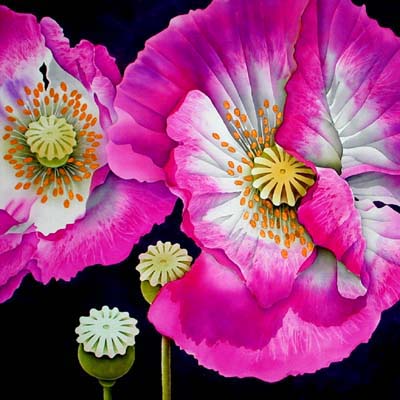
from http://www.silkartist.co.uk/poppies.jpg
I see the men in fatigues outside the Armory near my house. They are beautiful in the way that's inevitable for the young and strong, the disciplined, the fragile. Many have already served, will return to action.  Beautiful, equally, the women, at risk by virtue of gender but willing to strike a new path.
I admire the complexities of duty, bravery, ambition in today's soldiers and in soldiers who had no choice but to serve. 

There is little positive net result to the wars of my lifetime, and an infinitude of collateral damage, but I can hope for an end run around the phenomenal gain of the industries of war and corporations without conscience.

If we can love the now and tolerate the person next door, allow our intellects to be engaged in planning for cooperation and civility and not allow that small warp of willful ignorance which is rampant in the country, right now, grow and intensify, then there is hope and the wheel or spinning firmament of karma and grace will help our Memorial Day mean something tomorrow.

Today is a day of gratitude. Today is a day of love. Today the seeming strangeness of things unfamiliar is tolerated, seen for what it is, something new and untested. Something that won't be strange after proximity and acquaintanceship.

Peace.

Tuesday, May 15, 2012

Ha Jin's "Questions" of a "useless scarecrow" of a god

"Dragon" from the museum at RISD
Sunday, I stopped off at two parks, Madison Square and then Washington Square. Both stops I claimed bench space and read Wreckage by Ha Jin.

I could have finished the collection but found it so good, so interesting--I held off--did the old savor, as in I'm savoring these poems and don't want the collection to end.

Both narrative and historical, successfully imitative of a cultural voice (Ha Jin's country, true), Wreckage, by way of persona, relates an historical culture of Chinese emperors, with echoes in the present.

Mongol intrusion and coups, an everyday of history; stupidity of bureaucracies, another everyday; human folly. All play out.

Here, from the second-to-last section, Between Heaven and Earth, is "Questions."

Questions


                After lay Buddhist Aina

Lord of Heaven, how old are you?
Why have you no eye or ear
for our troubles?
Where's your forked grumble?

Those who kill, steal and bully others
bask in honor and security.
Those who follow your scriptures
are cold, starved, trampled.

Lord of Heaven, how can you govern
the earth like a fool
and let officials multiply
more than laborers and taxpayers?

Better if you were not there.
What a useless scarecrow you have
become, that rots in evil winds.
Why don't you topple down?
_____
Ha Jin, Wreckage (Hanging Loose Press), 2001.

Monday, May 14, 2012

Auden's :The Fall of Rome" ...fear the reindeer.

Beware the reindeer, the lurking north. Beware the unhappy worker, utterly universal in her discontent. 

It is unlikely that great Rome, or any stand-in for such a powerful, decaying empire, would fear animal or discontented worker. And in its oblivion to danger lies the seeds of trouble, or smouldering coals of, I don't know, conflagration, mongrel hordes, invasion.

Everything must end; those granted poetic hindsight, those who have lived through world wars, as did Auden, can gorgeously dally with reasons.  You can find a wonderful discussion of this poem at The Wondering Minstrels.

The Fall Of Rome

The piers are pummelled by the waves;
In a lonely field the rain
Lashes an abandoned train;
Outlaws fill the mountain caves.

Fantastic grow the evening gowns;
Agents of the Fisc pursue
Absconding tax-defaulters through
The sewers of provincial towns.

Private rites of magic send
The temple prostitutes to sleep;
All the literati keep
An imaginary friend.

Cerebrotonic Cato may
Extol the Ancient Disciplines,
But the muscle-bound Marines
Mutiny for food and pay.

Caesar's double-bed is warm
As an unimportant clerk
Writes I DO NOT LIKE MY WORK
On a pink official form.

Unendowed with wealth or pity,
Little birds with scarlet legs,
Sitting on their speckled eggs,
Eye each flu-infected city.

Altogether elsewhere, vast
Herds of reindeer move across
Miles and miles of golden moss,
Silently and very fast. 
_________
W. H. Auden, 1947

Tuesday, May 1, 2012

May Day / Poetry Assembles


If you are in New York City, come to Union Square at 3:00 p.m.  Look for the noble statue of George Washington and some noble poets.

Bring a poem, of course, and participate in the Poetry Assembly, 3-4. Merge into other rallies and events.

Wednesday, April 25, 2012

Ms. Magazine...I'm in a Q&A with Stonborough and Meriam

by Andrea Heimer
Please take a look at the Ms. Magazine blog posting of April 23, 2012. [Link below.]

Mary Meriam, poet and editor of Lavender Review, poses questions for Elaine Stonborough, poet, and me, poet et al.  I'll let you follow the links on the posting (links which reveal splendid insights into Stonborough, who is English and a scholar, and Meriam, who is tri-state-al, those states being New York, New Jersey, and somewhere in a forest region in the middle of this continent).

"A Woman, A Lesbian, A Poet" on the Ms. Magazine blog.  I'm honored to be part of this.

Sunday, April 22, 2012

Links to a few recent publications.

A Matisse print, included in
Folly.  She looks like a mermaid.

My three poems "Drink, Child," "Stop," and "Palace of the Blessed" are beautifully presented at Folly Magazine. The date of pub. is February 2012, but I didn't know they were out, so now is the time. Folly presents itself as a pdf. Don't hold back.  Your scrolling will reveal delights of performing arts posters, Matisse prints (Folly editors are geniuses to have permission to reproduce this artwork), poems of Stephanie Kaplan Cohen, and my poems. Note that the narrator of "Stop" works in advertising agencies.

(I have lots to say about the poems but why strip them down when you, the reader, can experience and question.)

Like "Stop," my poem "Long ago," published online by 200 New Mexico Poems (and, it is hoped, eventually in an anthology) draws on lived experience, my time (long ago) in Santa Fe.

Fiction (yay!)  Though it's not yet published, may I alert you to the imminent arrival of my short story, "Lillia," in the Spring issue of Devil's Lake, a journal from the University of Wisconsin-Madison. I'll post links when appropriate.

Saturday, April 21, 2012

By the way, David Bowie. The possibilities of sex made flesh.

This may seem rather random a post, an odd fit on a blog mostly about poetry and fiction (and politics, life, the sublime).

Let me assure you, however, this thought has come to me more than once, at a day's end that's seen me shopping at Trader Joe's, where the music's geared to baby boomers.  Sure and absolutely and with good reason, the entire market hums when Aretha, Otis, the Isleys, soul sisters, soul brothers play.

I'm there with the soul--way--but not with the Beatles when their music comes on. I once glued Life Magazine articles about them in my scrapbook (I was in junior high). Now, however, I am only glad to hear from the Beatles songbook when the song's covered by a contemporary singer. (Wikipedia has a long, long list of covers, Alvin and the Chipmunks being among the many celebrities to sing Beatlesian tunes.  To see the list of covers: click this sentence.)

The Stones are fine, but of only historical importance, to me, and while Neil Young is always appreciated, as are Laura Nyro (!), Buffalo Springfield, Janis, the seventies (and to this day) singer I love most (again, not counting soul, r&B) is Bowie.

I was a card carrying member of his fan club--and I was alive at that point, not in junior high but in my twenties. He was the angel sent by God to keep us music-ed up and open, charmed, savvy, impossibly hip; elevated to a psychedelic pedestal, enchanted, quasi-Euro, very sexy. Very.

I'm too demanding and too easily annoyed to fall back on baby boomer nostalgia, so don't figure that's behind my enthusiasm. Bowie's originality shines, his odd quiver of magic is a voice trait in the tradition of Billie Holiday's vocal timbre which immortalizes itself. He doesn't have Billie Holiday's eternal genius, but that's not the point. I am making a sort-of analogy.

He covered the Beatles "Across the Universe" (click to get to Youtube) on Young Americans. That's a very Beatles tune but there he is, owning it, vocally rewriting.

I wish I still had my membership card.  David Bowie. The possibilities of sex with any of many genders. Subtlety made flesh.

Saturday, April 14, 2012

She. A "She" in Kabbalah, thanks to Kay Ryan.

What began as a random read-and-run, a poem grabbed for a dip into the lovely before I started my day, transformed into a redefinition of my place in a history dominated by men (oh that sounds so cliched). (The domination of male scholars and male mystics remains but Madonna has indulged in, partaken of, some pop version of Kabbalah, so, sure there's that.)

Please note that in the eighties, before the questionable craze swept the pop-er-ati, I chose to explore Kabbalah. By which I mean I read Gersholm Scholem's Major Trends in Jewish Mysticism and Sabbati Sevi: The Mystical Messiah. I took a class to get an overview--not a college course but through a community center, and learned of and read or tried to read Abraham Abulafia, Isaac Luria, parts of the Zohar, some books about the mystical geography of Safed, and more.

Except for the Scholem, that was tough reading. I sincerely doubt the neo-kabbalists of Hollywood have read these volumes of ancient and complicated mysticism, but what do I know.

I know this. I didn't read anything Kabbalah-related that was written by any woman. Which brings me to this poem and pleasant surprise.  Imagine me, all unawares but focused on the work at hand while I slurp coffee, seeing "She" two lines after reading "kabbalist." You have, I hope, imagined a pleasant sensation, golden warmth easing through my limbs. Good title, too, because it takes some work to render meaning from those old texts which extrapolate the Talmud and Torah, extrapolate, reduce to numbers, juggle in the night air among the stars. 

Impersonal

The working kabbalist
resists the lure of
the personal. She
suspends interest
in the biblical list
of interdicted shellfish,
say, in order to
read the text another way.
It might seem to some
superficial to convert
letters to numerals
or in general to refuse plot
in favor of dots or half circles,
it might easily seem
comical, how she
ignores an obviously
erotic tale except for
every third word,
rising for her like braille
for something vivid
as only the impersonal
can be--a crescent
bright as the moon,
a glimpse of a symmetry,
a message so vast
in its passage that
she must be utterly open
to an alien idea of person.
___
Kay Ryan, from Flamingo Watching, from the anthology The Best of It (Grove)


Friday, April 13, 2012

A Quick Mea Culpa for the Typos & Co., All 3,000 Loving Ones

Emily Carr
A quick apology.  This morning I was alerted to a new comment to my blog posting on Marianne Moore's poem "A Jelly-fish."

The comment is interesting, a student's take on the poem, and after reading the insight, I reread my very short posting. And saw that I had misspelled a word IN SPITE OF SPELL CHECK.  Spell check sends little wavy lines under questionable spellings. And, yes, there they were, the little red warnings wavy as the Pacific. And yet, like the captain of the Titanic (to mix up my oceans) or that fool who sunk a ship off the coast of Italy, earlier this year, I ignored the signs.

And also, in terms of mistakes made: I had not used hyphens in a consistent manner in this remarkably short posting. The spacing between paragraphs was, furthermore, inconsistent.

As anyone who uses blogspot (a child of Google) knows, the blog has a mind of its own, and that willfulness can explain the occasional lack of breathable spacing or, conversely, huge blank crevices between paragraphs.  But only Sarah can make a typo.

Or mess up syntax or create other pretty darn egregious grammatical eyesores. My commitment to myself in creating this blog was to write quickly, not spend more than five minutes searching out an illustration / picture, and then get on with my day, a commitment which is understandable to anyone who has a day to get on with, i.e., all of you.  And yet, I was committing to writing a blog posting, which means communicating with some vague public by means of the tools at hand, which include spell check, native proofreading skills, and common sense.

Enough with the mea culpa. There's always that umbrella excuse, "Life happens." It's no justification but it is an excuse. I have, I hope, corrected the Marianne Moore mistakes and added a link to her bio on poets.org.

Wednesday, April 11, 2012

Ashley Judd and Carolyn Heilbrun Kick Ass

Asses are getting kicked.

So as you've heard, actress Ashley Judd is on a steroid medication which causes her fabulous cheeks to do a slight chipmunk thing. And because she's a fabulous looking actress and famous and a woman, the free world and probably the world-in-chains has been abuzz, not with concern about her health but with rumors about cosmetic surgery (not happening) and the like.

Being an IMDB addict I was predisposed to like Ashley Judd. I already knew she had a degree in French literature from the University of Kentucky where she also studied cultural anthropology art history, theater, and women's studies. I am not surprised by her feminism, but I am proud of it, especially of her calling out of women.  Women are major contributors to the problem.

(The problem is constant attention to women's bodies. The two major contributors to this debasing perspective are women and men.)

Lindy West, at Jezebel, is ready (as is any woman worth her vagina) to rename sports arenas and the entire Rose Parade--in spirit--in Ashly Judd's honor. West's is the best analysis and response I've read.

In further support of Judd and in further praise of her assessment of "patriarchy" I quote Caroline G. Heilbrun's essay, "Virginia Woolf in Her Fifties," from Hamlet's Mother and Other Women (Columbia University Press). Heilbrun left Columbia because she would not live with that level of arrogant sexism at work, day in, day out. "Woolf would have liked, one guesses, to have restored to all women what their talents deserved and their sex denied them."


A few sentences later, in a statement I have been trying, for a while now, to work into conversations with writers, women, friends, men, malefactors (hence I have bolded it), she calls out the patriarchy, stressing it ain't just men who are the problem.  Ashly Judd may have read this book and if not this book she has assuredly read other equally clear and subtly outraged statements.  Ms. Judd, you are one brainy, strong sister.

The moment one begins to criticize the destinies of women, even in a less than wholly serious way, the patriarchy (by no means composed entirely of men) feels that art is betrayed.

I  have health issues and find some women as judgmental (but more, fearful) as some men, and sometimes more so. So because I am a woman and an imperfect woman in a cutthroat competitive field (poetry), I gotta again thank the woman for speaking up. All a person can do is accept, and trust there is a vengeful a.k.a. merciful correcting influence in the universe.
 

Tuesday, April 10, 2012

Kay Ryan was once "Green Behind the Ears"

On her blog Bareback Alchemy, poet and fictioneer Melissa Studdard has called for us to memorize a poem a week—for us to slide rhythms, stops, breaks, bounties, eruption of passion and word into our share of The Collected Unconscious so we can hang out with poets wherever we are, on line at the grocery store or at our desks, watching the clock.

Week One, she choose a poem by Li-Young Lee, prompting me to post one of his poems, "From Blossoms," and write about poet Marilyn Koren who had once insisted I read Lee. (This was in my blog posting on Lee, a few days ago.)  Melissa also knew Marilyn.

You can scroll through Bareback Alchemy for the poems to date and in the future, but I'll give up the line-up so far. Week Two was Emily Dickinson, Three was Rilke, Four was Mary Oliver.  For Week Five, she choose a poem by Adrienne Rich, in memory of the poet's recent passing onto the heavenly dancing glinting weeping joyous spheres. Now on Week Six she has chosen Rumi (speaking of heavenly dancing glinting weeping joyous).

Melissa's urged us to suggest poems, and some of that challenge is intellectual. When I read I now consider whether or not the poem wants in. So much of the decision is weighed against my wee American memory, as so many more poems are worthy.

Nonetheless, Kay Ryan's work does have a way of skipping off the page, of suggesting it needs to be memorized, if only because of a slight occasional aphoristic hint, and more often because the work has that Emily Dickinson succinct universality.  Here, by Kay Ryan, is one such poem.


Green Behind the Ears

I was still slightly
fuzzy in shady spots
and the tenderest lime.
It was lovely, as I
look back, but not
at the time. For it is
hard to be green and
take your turn as flesh.
So much freshness
to unlearn.
_________
Kay Ryan. From The Niagara River (Grove Press), collected in The Best of It (Grove Press).

Thursday, April 5, 2012

I'm Still Just Waking Up to Art

Until I began writing poetry I didn't attend many readings. I was as oblivious to the aural beauty as any other citizen. I read it. I can't say I was a great explorer, but I always had a copy of Rilke, Stevens, Dickenson on hand. However, between the time I was an undergraduate, finishing up my education at Cal-State L.A., and the time I lived in Seattle and had begun writing, I didn't go to readings.

You have to understand. I'm still just waking up. I write this as I think about seeing poets Czeslaw Milosz, Adrienne Rich and many others read at Kane Hall at the University of Washington in Seattle. I wasn't a student. I was a poet.


The first college I attended never had such events. St. John's College in Santa Fe. Euripides and Dante were no shows. At Cal-State I heard (and still remember) Creeley.  Larry Leavis. Not sure if there were any women poets I saw but I was reading Diane Wakowski, whose work I adored, and others.


I was and continue to be a half-asleep consumer. There worlds around me, especially here in New York, I am unaware of, until I become aware of them. And sometimes I become aware of worlds and poets who'll have no part of me, who'll welcome me to their readings but never show up for mine. That's more often the case than not and, yes, I'm bitter.  


But also I'm curious about the next awakening, the next dawn, the next step towards a godhead. Because for me, if a poet doesn't move me in that direction (and I'm guilty of creating detours, too), I lose interest.


All over the place?  It's a good one, this place. As they say, I'm on it.

Wednesday, April 4, 2012

Jack Gilbert "The Abnormal Is Not Courage" (praise for "normal excellence")

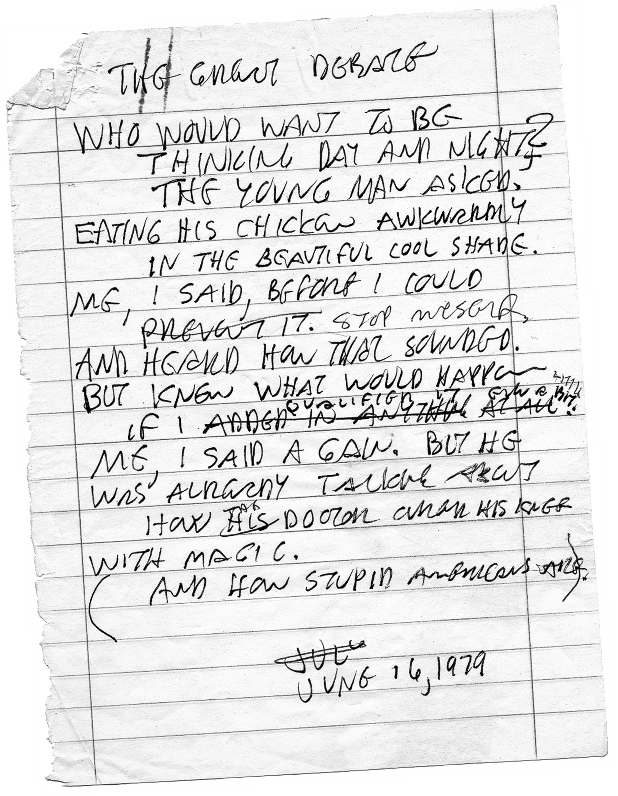
Jack Gilbert ms.
(The Paris Review)
A few minutes ago I was reading how some Russians still search for ways to praise Stalin (Stalin, responsible for 60 million deaths and an astonishing repercussion of collateral damage). That kind of impulse comes from a twisted understanding of bravery and greatness. It believes in the massive iron statute rather than the flesh and blood mere human.

And then I chanced on this poem by Jack Gilbert, whose poetry was often about just that, the daily effort, which he praised, or if not strictly praised (praise can be sentimental), acknowledged. Knowing we are witnessed and acknowledged helps us carry on. The evil demand tribute. The rest of us just want someone to notice we're alive and trying to do our best (a best that is hugely flawed).

Here's The Paris Review interview with Gilbert. And below is a poem of his offering a style of wry and honest praise of "normal excellence." Gilbert's Collected Poems has just been published by Alfred A. Knopf (link below).

The Abnormal Is Not Courage

The Poles rode out from Warsaw against the German
Tanks on horses. Rode knowing, in sunlight, with sabers,
A magnitude of beauty that allows me no peace.
And yet this poem would lessen that day. Question
The bravery. Say it's not courage. Call it a passion.
Would say courage isn't that. Not at its best.
It was impossib1e, and with form. They rode in sunlight,
Were mangled. But I say courage is not the abnormal.
Not the marvelous act. Not Macbeth with fine speeches.
The worthless can manage in public, or for the moment.
It is too near the whore's heart: the bounty of impulse,
And the failure to sustain even small kindness.
Not the marvelous act, but the evident conclusion of being.
Not strangeness, but a leap forward of the same quality.
Accomplishment. The even loyalty. But fresh.
Not the Prodigal Son, nor Faustus. But Penelope.
The thing steady and clear. Then the crescendo.
The real form. The culmination. And the exceeding.
Not the surprise. The amazed understanding. The marriage,
Not the month's rapture. Not the exception. The beauty
That is of many days. Steady and clear.
It is the normal excellence, of long accomplishment. 
_____________
Jack Gilbert, The Collected Poems, Knopf, 2012

Tuesday, April 3, 2012

Le-Young Lee, "From Blossoms" "...to take what we love inside..."

I was at a book table at the Geraldine Dodge poetry festival in New Jersey. This was a while back, six or seven, could be eight years ago.  My friend Marilyn Koren pointed to one of the hundreds of books stacked on tables and said, "You have to read him."

There was no equivocation in her voice, no hint she was suggesting a good poet I could check out some time. She'd driven me to New Jersey. She was driving me home. But it wasn't that. Her voice didn't tremble with a style of power but with moral conviction and surety. And I understood she wasn't insisting everyone should read Li-Young Lee (though they should). It was that Sarah Sarai should.

She was right and in a way I consider the finest compliment. She saw some golden cluster of butterflies struggling in my aura (let's say) and the gorgeous clusters in Lee's poetry. She matched poets. 

Marilyn and I lost track of each other. She spent at least half the year in Florida, where she ran poetry workshops (I learned about the workshops from her obituary).  So, yes, Marilyn has moved on. She was a good poet but I couldn't persuade her to submit her work to journals, a huge frustration. Who knows how and why we configure our journey to death.  

Li-Young Lee:

From Blossoms

From blossoms comes
this brown paper bag of peaches
we bought from the boy
at the bend in the road where we turned toward
signs painted Peaches.
From laden boughs, from hands,
from sweet fellowship in the bins,
comes nectar at the roadside, succulent
peaches we devour, dusty skin and all,
comes the familiar dust of summer, dust we eat.
O, to take what we love inside,
to carry within us an orchard, to eat
not only the skin, but the shade,
not only the sugar, but the days, to hold
the fruit in our hands, adore it, then bite into
the round jubilance of peach.
There are days we live
as if death were nowhere
in the background; from joy
to joy to joy, from wing to wing,
from blossom to blossom to
impossible blossom, to sweet impossible blossom.
__________________
Li-Young Lee

Monday, April 2, 2012

Fiction: "Stars." Cannibalism of fiction, rooftops in N.Y.C., book groups

Woolworth Building
One of my first New York friends, David, used to water plants of his friend who traveled lots and lived way downtown, near City Hall.  The friend's apartment had rooftop access, with views over the East River to Brooklyn and the red Watchtower sign; west across to the Woolworth Building, an architectural stunner. "Stars" takes place largely on that rooftop. I lifted the first draft from a novel I wrote that will never see the light of day. It works, I like to think. Cannibalism works.

Thanks to VerbSap's editor, so kind, intelligent and enthusiastic, and such a good writer herself. She published "Stars" in 2005. Here are the first paragraphs, followed by a link to the rest of the story. (I keep trying to keep my stories and poems in rotation.)


STARS


“O stars swirling swirling...”

“And swirling?” I suggest.

Because she snapped at our last book group Michelle is nervous and trying to divert us with this windmill-arm thing, as if memory worked like that. Let’s see, in June Michelle screamed she was dying of loneliness, but today she’s up here on the roof exhorting the firmament so no one remembers her outburst. Everyone does remember but we just factor it in.

Michelle is a bit stocky with biker calves and thighs and has that kind of short, straight hair that is never anything but straight and never held with a bow or clip. It is also never shimmery, but because it is nothing else—not red, not brown, not black—it’s blond. Her left eye is bigger than her right eye and sometimes looks frozen.

She chose this month’s reading, “The Burrow.” Kafka as a mole. And she’s hostessing, which she does periodically in this apartment with roof access and views. It’s not far from Wall Street. The tenant, her boss’s son, flies to Prague six times a year. We didn’t meet here for that whole awful year after, but we’re back.

“You know, I’m thinking we’ve read this tale of a mole...” Here’s Aaron, black curly hair, medium height, and prematurely stooped; a LAN guy at an advertising agency on 23rd. “Which means, if you will...”

Apparently we will.

“…we went underground with him for thirty or so pages, with his detailed account of false entrances and storerooms and tunnels. This is one paranoid and obsessive—”


“—He’s being a mole, Aaron,” I break in, “he’s not obsessive.” I am tall for a woman, 5’ 11”, and always wear boots with heels as if I didn’t care. You can bet I care in summer when my calves sweat beneath the suede. My hair is black, but with richer hues than Aaron’s; these days it’s short and Marceled. I have a pert face.


“So you’re telling me it’s in the nature of a mole to spend that much time touring Castle Keep as he calls it. Did he have a name anyway?” Aaron gives me a look and mouths a word.

Lester ? The minute Michelle looks his way, he desists.

She plants herself between LAN boy and me. “I don’t believe you completed your thought, Aaron.”

“You’re right...if I may continue.” He looks at me, without acknowledging Michelle’s support.

“Go on.” I glance away.

“Oh do.” Michelle’s voice is resonant, as if bouncing in a hollowed-out container.

I lift my hand; she slaps it. Hi, five.

“So us being on the roof is some kind of redemptive state.”

I nod, but can’t decide if Aaron’s self-important or just not sure of himself.

“We’re out of the muck, out of the subway, off the sidewalk, above the dirt. We see light.”

_______

by Sarah Sarai. Published in VerbSap.com, 2006. Read the rest on VerbSap, here.

Adrienne Rich's "Song"

Image from: lacymarschalk.blogspot.com
I haven't been able to express feelings about the loss of Adrienne Rich, maybe because for myself and any other reader of her poems, her work isn't lost. Or maybe because it will take a while to pull it together, to go back to "Diving Into the Wreck," to remember my discovery in "Split at the Root" that I wasn't the only one split at the root in the same way and in some other ways she was.

I saw her read, once, at Kane Hall, a huge auditorium at the University of Washington in Seattle. Yowza. The joint was jumping, the hall jam-packed, the rafters nearly squeezed up into and over the roof. I understood then that poetry could reach beyond a small audience of specialists to feed a greater body, to feed a spiritual hunger.

Here she is, feeding us.  Not to get maudlin, but being a woman can be a lonely endeavor if, like me, you strive to be original and not hide strength or intellect or opinion.

Song

You're wondering if I'm lonely:
OK then, yes, I'm lonely
as a plane rides lonely and level
on its radio beam, aiming
across the Rockies
for the blue-strung aisles
of an airfield on the ocean.

You want to ask, am I lonely?
Well, of course, lonely
as a woman driving across country
day after day, leaving behind
mile after mile
little towns she might have stopped
and lived and died in, lonely

If I'm lonely
it must be the loneliness
of waking first, of breathing
dawns' first cold breath on the city
of being the one awake
in a house wrapped in sleep


If I'm lonely
it's with the rowboat ice-fast on the shore
in the last red light of the year
that knows what it is, that knows it's neither
ice nor mud nor winter light
but wood, with a gift for burning

_____
Adrienne Rich, republished from Southern Cross Review.  Their biography of her:
Adrienne Rich (1929 - 2012 ) Adrienne Rich was first published as a poet in 1951, when she won the Yale Series of Younger Poets prize for A Change of World. Her poetry has reflected her own life changes and many roles. Adrienne Rich's feminism emerged in mid-career, and many of her later poems express a political rage and search for sisterhood and creative language. Her work includes nineteen volumes of poetry including The School Among the Ruins: Poems 2000-2004, which won the Book Critics Circle Award; Dark Fields of the Republic: Poems 1991-1995 (1995); Collected Early Poems: 1950-1970 (1993); The Dream of a Common Language (1978); and Diving into the Wreck (1973); three collections of essays, and a ground-breaking study of motherhood, Of Woman Born: Motherhood as Experience and Institution.

Friday, March 30, 2012

Foodstuff Friday (the Return of): Tricking the Tongue, Eating the Magic.

The game plan is to trick the tongue. The tongue wants smooth and sweet. The tongue anticipates a frisson of cold and the gradual transformation of that sensation into melting pleasure.

The game is fooling yourself to believing, "I'm eating ice cream."  The discovery eureka!-ed itself late one night when I was curious and desperate.

The contention, by way of a sidebar, is that I invented frozen yogurt. It is a false boast, but allow me my vanity, which is not the vanity of vanities, merely a vanity among vanities.  There are so many!

Required for this game are ingredients often on hand or at least almost always are in my fridge. The night I alchemized them into Sarah's Ice Cream, the time was late, I was resisting spending money, and my higher angel, like The State in Aristotle, was nudging me to The Good.

I opened the refrigerator doors, grabbed ingredient "a" from the freezer and "b" from the shelves, threw "a" into a giant mug, a.k.a. a bowl with a handle, plumped it with a glorious scoop of "b" and watched the magic happen.

Ingredient "a" is a bag of frozen fruit. Blueberries or raspberries are my favorites.

Ingredients "b" is Greek yogurt. I like Fage, all three versions (from no fat to some fat).  I buy whichever has the greatest promise of shelf life.

The magic is Newtonian, as in Rosicrucian, as in alchemical. It reminds me, this magic, of Magic Rocks, which fizzle and spark. The frozen fruit and the Greek yogurt freeze up as if accosted by a police detective with a gun.

And as they realize there is no danger, fruit and Fage relax to caress each other into bliss, a frozen pleasure-mystery. I suggest spooning it onto your waiting tongue at all levels of freeziness and mushiness, experimenting with stages of texture. I favor the slight meld, when raspberry juices make rivulets into the snowy peaks of yogurt.

Ingredient "c" is optional. Sometimes I sprinkle a packet of turbinado sugar over for crunch as well as for sweetness. They are available as some coffee houses. I don't like sugar in my coffee and so (I confess) sometimes pocket the packet (just one) for later use.

My shoddy ethics aside, this delight really is as good as ice cream. Trader Joe's sells inexpensive frozen fruits (use as much as as little of the bag as feels right) and Greek yogurt.

Eat the magic.

Thursday, March 29, 2012

Deactivation Report: I'm out of the Facebook box

April 2012 Update. Back on FB, but as a presence. Not roving, not posting (this blog posts automatically). More time for me. Less agonizing over lives of others.

This shouldn't be news but then a blogger shouldn't be compelled to be a news source. Now that that disclaimer is off my shoulders or mind or other part of my anatomy or portion of me which defines or signals me, here's the non-newsworthy news: I got off Facebook.

I deactivated my account. I can return. And, yes, it's not a monumental life event. Part of the reason I'm  mentioning this is in case one of my almost 2,000 Facebook friends, most of whom I haven't met but do have a connection with, through poetry or fiction, wonders if I unfriended them.

No!  No one is unfriended. Just, everyone.

Not much more to say than that it is a good move right now. Like many things, Facebook is a box, a specified delivery system. As an intimacy-avoiding mechanism, it rules. I, however, am human, and need intimacy.

As a poet and fiction writer, I need to stray. I am a cat, straying.  I am howling in the alley.

(p.s. Just did a spellcheck. Three words come up as questionable:  Facebook. unfriended. spellcheck.

Monday, March 26, 2012

Poem: Christina Hutchins

Ta da! My final posting of nominees for this year's Lambda Literary award for lesbian poetry collections is (and remember, I posted in random order, the order beloved by random bloggers everywhere) The Stranger Dissolves, by Christina Hutchins (Sixteen Rivers Press).

As is the case with the other nominees, Hutchins is a seasoned poet. On the list of Things You Can Tell Your Parents About Your New Girlfriend: she has won the Villa Montalvo Poetry Prize, received two Barbara Deming Awards, and is the first Poet Laureate of Albany, California. She teaches at the Pacific School of Religion in Berkeley.

Here, from Missouri Review is "Into your pocket."  You might wander over to Switchback for more beauty and elegance.

Into your pocket

I have slid a bright morning before rain.
Tonight’s concerto is folded into thousands
of paper cranes; their wings were trees, rollicking
restless in the sun. Here’s a loose,
black thread pulled from my hem, tangled

to a tiny bundle between my fingers & thumb.
Kelp strands roiled back & forth in the surf
& deposited at high tide, the lost chains
of underseas are knotted, left along the beach.
Here is the warmth of my stride, left in a heap

on a rug beside the bed, blue jeans shed
in the shapes of my legs. I, too, have held
the shape of an absence. Quiet in the auditorium.
Who is that, laughing at the back of the room?
Here we are again, leaning against the door,

my way to you disclosed by two tongues
spending a sweet moment. The self I become
& the self you become are celestial bodies
entered into, one by another. Tender
release, a wet palate tasting its small

flourishes, my love is for taking along.
Like you, I swim a rising, astral surge.
If we are anchored by every spent moment,
the anchors are already rusted to dust
& these chains no heavier than light.

by Christina Hutchins, from The Missouri Review, 2010

Sunday, March 25, 2012

Poem: Robin Becker (a poet in Milk and Honey: A Celebration of Jewish Lesbian Poetry)

The fourth nominee is an anthology, rather than a collection by one author.  (Not that you didn't know what an anthology was, but the distinction is noteworthy under the circumstances, those being the five nominees for the Lambda Literary Award for lesbian poets.)

As you are curious about the other nominees, you will want to look at the past three postings herein on My 3,000 Loving Arms and (furthermore) keep an eye tuned to tomorrow's posting which will have the final nomination (all posted in random order).

Milk and Honey: A Celebration of Jewish Lesbian Poetry, edited by Julie R. Enszer, published by Midsummer Night's Press, includes poems by a variety (duh) of poets and if you want more information, click here (there) to get to Midsummer's page. In the meantime, I post one poem by one of the poets, Robin Becker.

I'm thinking it's not included, but it's such a great poem, I want to read her and the other poets' twist on and insights. 

Angel Supporting St. Sebastian

Shot with arrows and left for dead,
against the angel's leg, Sebastian sinks.
In time, he'll become the patron

saint of athletes and bookbinders.
But for now, who wouldn't want to be
delivered into the sculpted arms

of this seraph, his heavenly
shoulders and biceps?
The artist understood the swoon

of doctrine, its fundamental
musculature, and the human need
to lean against the lusty form,

accept the discourse that assigns
to each of us a winged guardian
whispering into our ringing ears.
______________
by Robin Becker, pub. on Poets.org.


Saturday, March 24, 2012

Poem: Daphne Gottlieb

The third nominee (see yesterday and yesterday's yesterday) for a Lambda Literary Award for a best collection by a lesbiana poet . . . is Daphne Gottlieb.

Although the poem I selected is short, as in real short, four lines, it does seem to represent rare inventiveness and insight.

I saw one reference to Gottlieb was a "performance poet."  That phrase is limiting and also too strict in terms of codification. Few poets can resist at least a few plays to the audience these days, especially in our Youtube culture. And once a poet is called a performance poet, she is considered pegged. Since Gottlieb has over nine books out she's spent some time off the stage.

"ernie..." could be titled "the Serenity Prayer goes awry" except its real title is cool and wildly informative.

ernie, on the street, overhears lola, who has fallen off the wagon is walking home alone at 2:15 a.m. 

god grant me the heredity the hysterectomy god grant me to

excess to annex to invent the things I cannot 

exchange courage to claim or chain the things I 

clam and the wizard to know the defense.

______________________
Daphne Gottlieb, Homestead Review, Hartnell College


Link to Homestead Review