Monday, June 24, 2013

Stanzas Concerning An Ecstasy Experienced In High Contemplation -- Hippity Birthday to my 2nd Favorite Discalced Carmelite

His Converso father died young. His mother supported the family. As is often the case, education was the way out and up - he was given the basics through a church-run school, and promoted and then grandly and deeply educated, as one would expect of St. John of the Cross.  Trying to reform the Carmelites, as he and my favorite Discalced Carmelite, St. Teresa of Avila, did, was a bad move. He was imprisoned, but then again, lots suffering is good for maybe one in one million sufferers (the other 999,999 just suffer in torment and loneliness - no immortality as odd compensation). He was lashed in front of the community, weekly. (For instance.) There's lots more to him and the community and of course to St. Teresa. But let me not spoil birthday celebrations for this genius poet and enlightened theologian.

Stanzas Concerning An Ecstasy Experienced In High Contemplation

I entered into unknowing,
and there I remained unknowing
transcending all knowledge.

1. I entered into unknowing,
yet when I saw myself there,
without knowing where I was,
I understood great things;
I will not say what I felt
for I remained in unknowing
transcending all knowledge.

2. That perfect knowledge
was of peace and holiness
held at no remove
in profound solitude;
it was something so secret
that I was left stammering,
transcending all knowledge.

3. I was so ‘whelmed,
so absorbed and withdrawn,
that my senses were left
deprived of all their sensing,
and my spirit was given
an understanding while not understanding,
transcending all knowledge.

4. He who truly arrives there
cuts free from himself;
all that he knew before
now seems worthless,
and his knowledge so soars
that he is left in unknowing
transcending all knowledge.

5. The higher he ascends
the less he understands,
because the cloud is dark
which lit up the night;
whoever knows this
remains always in unknowing
transcending all knowledge.

6. This knowledge in unknowing
is so overwhelming
that wise men disputing
can never overthrow it,
for their knowledge does not reach
to the understanding of not
understanding,
transcending all knowledge.

7. And this supreme knowledge
is so exalted
that no power of man or learning
can grasp it;
he who masters himself
will, with knowledge in
unknowing,
always be transcending.

8. And if you should want to hear:
this highest knowledge lies
in the loftiest sense
of the essence of God;
this is a work of his mercy,
to leave one without
understanding,
transcending all knowledge.

by St. John of the Cross, from The Works of St. John of the Cross
Copyright ICS Publications. Permission is hereby granted for any non-commercial use, if this copyright notice is included.

Sunday, June 23, 2013

88 constellations - a Wondrous Way of Learning About Wittgenstein

Here's a particularly brilliant and imaginative, what, insight into? riff on? amplification of? next generationing of? the great, off-putting, daring, brave, lovable, not lovable, sad, distant Wittgenstein. Soldier, brother, bad teacher, philosopher, maybe lover but probably not, and European - brushing suede elbows with other post WW I Europeans of note. 88 Constellations. Created by David Clark.

It doesn't take long to learn to navigate the site. Even if you have never heard of Wittgenstein, the site itself is a plaything and learning tool. And since I was staring at the skies and fat-happy golden moon last night, more sky staring is in order.

Wednesday, June 19, 2013

The Arbour to Joyful Rain - though he's not so joyful - poem by Su Shi / Dong Po

That's him.

The Arbour to Joyful Rain

Should Heaven rain pearls, the cold cannot wear them as clothes;
Should Heaven rain jade, the hungry cannot use it as food.
It has rained without cease for three days -
Whose was the influence at work?
Should you say it was that of your Governor,
The Governor himself refers it to the Son of Heaven.
But the Son of Heaven says "No! It was God."
And God says "No! It was Nature."
And as Nature lies beyond the ken of man,
I christen this arbour instead.


by Su Shi / Dong Po (1037-1101) / translated by Herbert A. Giles

Monday, June 17, 2013

Era of the There: when dragons were mapped & Great Goddess had mercy (a poem)


Arhats (holy men) Ding Yunpeng. Ming dynasty, 1368 – 1644 B.C.E. Shanghai Museum
Era of the There

One day you stepped off an edge.
Dragons nipped your toes.
Which grew back.
Those were different times.
Your daughter sailed toward There.
She puzzled.
You know how it blushes at
end of light?
Feet flip flopped a cover-
let over turtle-back and loam.
Stilt birds strutted.
You serenaded valleys lying
long on their backs, hands
behind head making of clover-
arms foothills.
Those were different times.
As far as eye could see
greeny willow-leaning and
un-ladle-able soup of alligator-scale. 
Paddle too far and be — like that!
in an instant! all of you! in a gullet
gulped gone — gracefully — 
to not forever flail in the dark
coppery cauldron of mystery.
Oh, even then Great Goddess had
mercy on our miserable lives.

[by Sarah Sarai] [published in Ocellus Reseau: The OR Panthology, 2013] [thanks to Other Rooms Press]

Friday, June 14, 2013

A Little Bliss, a Little Enlightenment: a Meditation on Risk

There’s no loss in a reach for the sublime, still success rates vary.  Note fates of saints and philosophers, of mothers steady on the path:  A little bliss, a little enlightenment. Love. I paint a warning on the clouds: Don’t be hasty, ask only for what you reason to be true and may I suggest you don't assume symbols mean a thing or the thing that symbols are said to represent.  Symbology is creative guesswork born in none of the chakras. Don’t trust your eyes, practice patience, listen.  Bliss-filled, you will die and shed the body, what was it there for, anyway.  You can’t train one eye on sin the other on perfection.  Ah,  you perceive The One to be dual. This means you've turned apostate and a traitor in some folks’ minds but your confusion is sincere, which is more than can be said for many folks. For a time you’ve watched stars flare gasp and die. You’ve gauged risks. Let yourself be singed.

[Sarah Sarai, June 14, 2013] [written because you want to know if you can maintain a series of prose poems]
[beautiful artwork by Hayao Miyazaki]

Thursday, June 13, 2013

King Pellinore and King Vidor - Together at Last

My goblet is half full, my stomach overfloweth. The sword is stoned, Excalibur is just another butter knife. King Pellinore and King Vidor - together at last. My glass is one and three-quarters full, my fullness overfloweth. Vitality is derivative? Schopenhauer doesn't own a glass. Will Smith owns many. Keira Knightley requested an agent when she was 3. She begged for a publicist and a cookie the next day. Minute on the lips/month on the hips - Joan Crawford said that. Minutes turn into months, months turn in early. Discipline offers pleasure. Pleasure brings tears to my eyes. But where to store it? One day all this will be yours. One day a lawyer will object. Never you mind. Always are you lifted. You are already home.

[Sarah Sarai, June 13, 2013] [written because you're not quitting] [written because] [written written written, isn't that enough?]

Wednesday, June 12, 2013

You Are Given Second Chances and You Take Them


As you were crossing Lexington you thought about last night's dream - it wasn't a good one. You also considered red and yellow, the colors, how they work together, yet if you were designing the perfect outfit as you rose from your bed like the undead from a coffin, yet if you were to imagine a blouse awaiting on hanger at Macy's or the Good Will as you flip flopped on sidewalks tacky with phlegm and ambition, never - not once - would you imagine a blouse red and yellow. Not once, yet it could work. You've seen silk sheaths blending statement colors with more sophistication than the Chinese flag. Your dream had something to do with a volunteer gig and poetry. A distasteful gig you abandoned and as you did, you dropped a prop related to the gig, something big as fire extinguisher. But then you conscience-stricken love bundle, you turned back. The dropped prop was damaged but found. The guy organizing the gig shrugged. He knew and cared and didn't. No one wore red and yellow. You returned to the room of poets doing crafts but not good ones. The poets were hopeful. Hope being a fly to swat at.  You returned - it's not a nightmare.  You were given second chances and you took them. Take a chance, dear one, take a second chance. You can rise like steam or a flame or a shard seeking grace and holy love.

[Sarah Sarai, June 12, 2013] [written because you remembered colors] [written because the dream could be worse] [written because you need someone to talk to]

[Sorry I missed yesterday.]

Monday, June 10, 2013

Solids, Liquids, Spherical Shapes, and I Lost My Train of Thought

*
Apparently Titian didn't paint mockingbirds. It would seem Mary Cassatt couldn't be bothered. Titian's first name was Jordan. Mary Cassatt's first name was Camryn. I googled "mockingbird art" and discovered mockingbirds aren't artists. Why the mockingbird? I don't imagine that you, reader, inquires. I imagine I ask because it's what I expect: a question. The Question In Pre-Modernity. Solids, Liquids, Spherical Shapes, and I Lost My Train of Thought. Camryn Mary Cassatt: couldn't be bothered or wouldn't be bothered? The heart has wings so why the fuck not the suckling child? Tell you the truth, I dread work today. But I love getting paid now and then, the now and then I get paid. Even $25 for reviewing a book is a thrill but Christ it's a lot of work. The end.

[Sarah Sarai, June 10, 2013] [written because blame habit] [written because I watched a show] [written]

[That's a royalty-free stock photo of a northern mockingbird. In 3-D.]

Sunday, June 9, 2013

Spinoza to Simon De Vries: No Experience Necessary


from Spinoza in Cartoons*
Respected Friend,—You ask me if we have need of experience, in order to know whether the definition of a given attribute is true. To this I answer, that we never need experience, except in cases when the existence of the thing cannot be inferred from its definition, as, for instance, the existence of modes (which cannot be inferred from their definition); experience is not needed, when the existence of the things in question is not distinguished from their essence, and is therefore inferred from their definition. This can never be taught us by any experience, for experience does not teach us any essences of things; the utmost it can do is to set our mind thinking about definite essences only. Wherefore, when the existence of attributes does not differ from their essence, no experience is capable of attaining it for us. ...[Italics mine, more info below]**
Letter XXVIII, courtesy of Online Library of Liberty.

To which I, Sarah Sarai, say, what?  Experience doesn't teach us a thing's essence? Okay, then. I vote for intuition and a holy flash of understanding. Experience can be a first step, but if something is what it is, well, then, that's that, and it can stay on the top shelf in a Chinese pagoda while I know it, just know it, from afar. My oldest sister experienced Europe. She came back and said, "It's just old." Living in New York City after having lived in Seattle for ten years and Los Angeles for over twenty-five years, I got it, believed her, understand the essence of her critique. It's old here in Manhattan, too. The infrastructure is weak and every tall building is on a sinkhole of mildew resulting from poor caulking. Trust me. Without experiencing the absolute collapse of European culture I nonetheless tell you it's inevitable. Move west. West.

[Sarah Sarai, June 9, 2013] [written because I was blown away] [written because Spinoza's torments were worse than mine and he got a grip] [written because I ain't kidding anyone anyway] [written because yowza writing's fun ((not sure if all these are prose poems but they are definitely probably paragraphs))]

*** Spinoza, pg. 316-317 of Benedict de Spinoza's On the Improvement of Understanding/The Ethics/Correspondence tr. by R.H.M. Elwes, Dover Books. BUY IT! [Italics, mine] [He continues a few more lines to talk of eternal truths.]

Spinoza in cartoons. I'd like to see him in Khartoum.

Saturday, June 8, 2013

How Mel-Mel's Mind Works: I Had Fun With This One!

Not Tarzana but an echo of.
Okay. So here's the deal. Mel-Mel doesn't like sharing, not ongoings of her life, not with strangers, i.e., occasional workmates. Not unless the ongoings are stored in a pink plastic folder she can pull from her purse, ta dah. Not unless they are her ice skates and she can tell her pudgy, finger-in-the nose classmates about the rink in Tarzana. Which abuts Encino. Which whistles to Sherman Oaks. And there's North Hollywood going cheek-to-cheek with Burbank. This train of thought is going loop-de-loop, a description of a thought's rotation in the heavenly spheres of the conscious-ish mind. She likes pictures in frames. Narratives are pictures. But the personal is not framed. It romps wild in dreams and echoes in chambers of the heart of a judge. So now Mel-Mel is in trouble because this workmate has hurt feelings. Mel-Mel is nervous because there are always consequences in her awkward life. Every inaction rates an action in her life. Mel-Mel has too logical a mind to understand her workmate's locker of hurt feelings.

[Sarah Sarai, June 8, 2013] [written because she wishes she were different but she's not] [written because so what iimperfection is revealed] [written because she likes feeling relieved] [written because writing is the best]

Friday, June 7, 2013

Look on Me, Lady. Sever Decisions of Justice From Institutions White and Be-penised.

Quito, Ecuador
A Friday morning prayer. Lady. Let me accept the low-key and blazing divinity of my art. Let me accept my nature of dualities. Give me the wisdom to know it reaches You. Teach me trust and don't let me get too huffy puffy. Let me be here and wherever I am now. Protect me at the cocktail party with the department head who ends affairs when he's bored or his wife complains. Nuzzle my useless resentments in your shawl of great colors. Let them be loved so they grow healthy and through the beauty of bosoms of wisdom and flesh, no longer angry. The street urchin of bitterness now on a feather bed. No longer resenting. Look on me, Lady. Sever decisions of justice from the egos of men and institutions white and be-penised. The flamboyant whimper in department meetings until they are tenured. But look at me, Lady. I do need a little attention. Yes, the billboard of hope is wiser than a cat at peace with the feathers dangling from her ears. I do need some attention, Lady, but mainly friendships and love. But mainly, I need to write.

[Sarah Sarai, June 7, 2013] [written because why not be honest] [written because so what if my grossly imperfect soul is revealed] []written because I ain't kidding anyone anyway] [written because writing is a pleasure]

*Street art courtesty of http://www.tooflynyc.com/life/category/ecuador/

Thursday, June 6, 2013

Today You're an Angel in Space {the Third Planet Being Angel-Free}

from Lubinetski’s 1667 treatise Theatrum Cometicum (Du-uh)
Being in exile gives a girl away-time. Today I'm no saint, but an angel in space. The Third Planet is angel-free and don't we know it. Oh my hair gets frizzy in morning mist. See, motion could be stasis captured by art, still motion, my kind of motion, motion with a mug of steaming coffee - a steaming mug. When coffee's in cool-down, add ice cubes for a thick swirl of gold melting, a transit of Venus toward your heart. Those "stupid Cartesians" believe their threadbare existence proves their threadbare existence. If we are only what we are, we might as well throw ourselves onto the tracks. Whooo Whooo! The end, and if so, make it on the Q. Everything Spinoza conjectured teed off the burghers. Liberal Holland? There's no accounting except by Price Waterhouse, which must be Dutch, look at the name. I am in solidarity with his adeptness with annoying, not a thing to be changed, as innate as the heart in his breast. Sure he could have stopped writing and conversing, but theories and awarenesses like his are visitations. They emanate. All the fuel burned over quelling emotion. One quietude is enough. I wish I were brilliant.

a to wit: Hence certain theologians, perhaps the authors of the rumour, took occasion to complain of me before the prince and the magistrates; moreover, the stupid Cartesians, being suspected of favouring me, endeavoured to remove the aspersion by abusing everywhere my opinions and writings, a course which they still pursue. [from a letter Spinoza wrote to Oldenberg {who saw the rings of Saturn}]

[Sarah Sarai, June 6, 2013] [written because she sat in a chair and read D's Meditations, long ago] [written because Spinoza understood emotion] [written because Descartes didn't, that's a problem handed down] [written because it's becoming a pleasure]

Wednesday, June 5, 2013

The Wise Woman Senses a Friend Is Watching

Andes, Peru. Amber Frances O'Hara (photographer)
Are you seeking? If you find, were you then lost, or, different, insatiable? To be insatiable is to be scrambling or a delicate oddity or a searcher on her odyssey and finder of strange and new lands? The judgment of value faintly waivers. To be insatiable is your royal line. Insane hungers. Impossibilities. Hey, things go wrong. Mountainous doesn't define that hoist of a natural will. Beauty is deafening. Phospherize for clarification. The final peace is terror. The joyous know the path. The smug will tell you how to climb. The wise woman senses a friend is watching. You are far away, always arriving. You are not the messenger. You are not the message. You are the king, you are the queen, you are willing to receive.

[Sarah Sarai, June 5, 2013] [written because we should worship the range] [written to aggravate depression] [written] [breathless]

Amber Frances O'Hara: For more information on this photographer, please visit her website.

Tuesday, June 4, 2013

She Will Admit As Much Wisdom As Awe

/ Rita Angus / New Zealand / Fog, Hawkes Bay /

Not clear how all this thissed. The ball of mud suspended in a wind chamber, the creak fart fissure of geology, layering, waters parted by gradual inclination and gradual inclination of peaks and hills, one sparked life enabled by circumstance and habit, and all subsequent lives engineering and architectural wonders, works in progress but slow-progress and not "progress" but change to mock the trap of the naked eye baffling a fact of flux. As things are thissed others are issed. Thissing and issings, grim devilish patience though why it's not loving and nurturing, is behohlden to the beholder who herself was thissed and issed though limits she thissing and issing to observation and wisdom. She will admit as much wisdom as awe and with wisdom the ripped-aliveness, the daily eagle, friends turning to daphne and stone, cedar the harmonious mystery, and the only flaw is the flawed for which the eagle pecking into our live guts serves as the ecological balance of taunt.

[Sarah Sarai, June 4, 2013] [written because tidy house does not explain anything] [written to thumb wrestle depression] [written because of that well]  [written because those roads stake illegal claims]

Monday, June 3, 2013

A Loose & Sluttish Interpretation of Malory

Dear Sirs...

Perhaps you did not receive my letter sent yesteryear on the glorious manifestation of serpents' souls. Good masters and mistresses know the coil and slither, the hiss and dry-throat rattle of the underfoot.

Dear Madam...

Knowest thou the ungentle and less-than-affectionate heart of all mankind?  Do not trust, my loved one. The smug are reptiles wrapt around your tender robin throat.

Good Christians...

Knowest thou revelry and the sainthood of a joyous home?  Kindness is an illuminated archway and the creak thou thinkest your conflicted foulness is a gate opening to allow you enter.

Parfit Ladies and Gentle Knights...

Knowest thou sluttish imperfections of everyday admission into the final chamber? If thee beat down your most mean and useless self-seekings you will be and are now there.

With affections and lamentations,
Sarah

[Sarah Sarai, June 3, 2013] [written because this Malory ms. page inspires with its penship] [written because writing baffles depression] [written because yesterday and tomorrow are here always]

Sunday, June 2, 2013

Yet There Is Not Enough Kindness to Match its Luminous Gift

Beautiful calligraphy, isn't it. A book cover, I believe. It means life is flow and confusion, it means all four suits in the deck are neutral and your cunning only will win the day, it means there is no winning and yet there are losses, it means new is old, it means the sword will out the heart, it means two brothers united are humbled by the mighty but not defeated, it means no defeat, it means the sky is bigger than you conceive it and still there is not enough kindness in the world to match its luminous gift, it means you'll never know what it means unless you read Arabic and even then four wise women in the desert night have mapped out your path. Do you know it? Can you find them. Can you walk your mapped-out path?
[Sarah Sarai] [written to keep me sane] [written to fool jinns of depression] [written to celebrate this book cover found on the web]

Friday, May 24, 2013

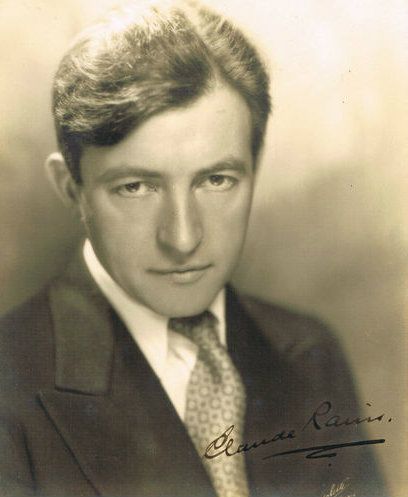
Claude Rains: a book report

I just read An Actor's Voice: Claude Rains (University Press of Kentucky) by David J. Skal with Jessica Rains.

Claude Rains was destined to rebel and did so, becoming a truant when he was ten or so. He was born in 1898 to a testy, i.e., alcoholic and belt-wielding father who overpowered his mother. And who was a braggart unable to feed the family. They lived in poor, as opposed to gentrified, London.

He quit school, worked here and there, ending up (a story in itself) in theaters where he assisted the great great actors of the day, like Sir Herbert Beerbohn Tree. Long, long days, and most of his pay went to help his family, but eventually, the great, great actors began to mentor Rains, coaching him to lose his stammer, and with diction in general. He was given novels and plays to read and assigned parts to memorize to help as a prompter. This led to that and Rains developed into a great stage actor, who went on tour, and also taught at the Royal Academy. Gielgud was a student, as was Charles Laughton.

Difficult marriages, service in the British military in wartime, this that, and he moved to the U.S. where he also toured and acted on Broadway. Then Hollywood, with The Invisible Man.

Gielgud was always kind, Laughton became a mean prick. G.B. Shaw sly but generous. Bette Davis very dear and warm, but wanted to run the show. And on and on, with the studios being their usual off-again on-again using lying entities, at least some of the time. Rains was not a temperamental actor. So there's that. He was married six times. So there's that. And there's greatness. That.

Monday, May 20, 2013

Sibyl James' "October Lambs" "in suburban Carthage" {a prose poem}


October Lambs


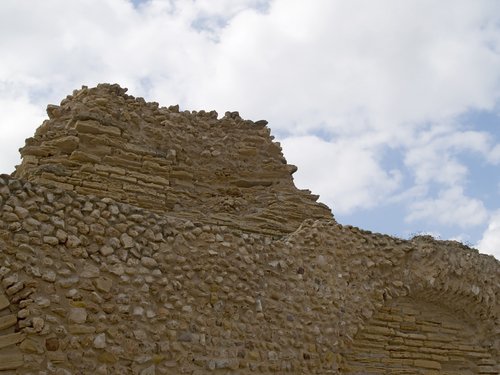
The tenth of October, the sky overcast, sultry with the storms that leave the palm-lined street strewn with huge fronds, the pale green Mediterranean roaring almost like a proper ocean, its usual gentle swell lost in the winds that stir these nights with thunderless heat lightning. Everywhere, the fall's the time for raking. Only here it's unripe dates and fat fig leaves, brown and curled like fists--not the red and golden blaze of maples, sycamore. The rake looks strange beside my swim suit, flesh I cover when I haul stuffed bags outside the gates, careful not to shock the families headed for the beach, girls with their hair wrapped in Muslim scarves, the maids from the richer houses with their white safsaris draped on heads, knotted across a work dress. Some herder's descending Byrsa Hill with his sheep and goats cropping whatever grows outside the walls surrounding villas, in suburban Carthage, where the ruins of Dido's city and the Romans who sowed her streets with salt still sprout between the Arab homes. I see lambs with the ewes, new-born size, still suckling. Lamps in October, the seasons confusing as Arabic books printed back to front, in this country I have never learned to read.

Sibyl James from The Prose Poem, on Web Del Sol.

Bio: Sibyl James has published nine books, including The Adventures of Stout Mama (fiction),China Beats (poetry) and, most recently, The Last Woro Woro to Treichville: A West African Memoir. She has taught in the US, China, Mexico, and–as Fulbright professor–Tunisia and Cote d’Ivoire.

Tuesday, May 14, 2013

Camille Martin's LOOMS: strolling down a parallel road

At first I was confused. Shaken. Oh yes, I was adrift.

Overly dramatic? Not when it's about poetry, in this case, Camille Martin's Looms, which like Penelope's famous twenty-year woven prevarication while Odysseus is out and about, begins each day anew with each poem, each poem begun without fanfare and needing none.

What it is: there are no titles and without titles, I initially was unmoored and a little ashamed I needed the perfunctory "To a Skylark" or "Homage to My Hips" to orient me. But then I got with the agenda gloriously so - allowed myself to float, to be shuttled (but not shuttlecocked) from perspective to image and on, each sonnet a frame and yet an embrace, a scene and invitation.

Martin launches the collection with a quotation from Barbara Guest:  Its remoteness from the center of things is what is endearing about a Tale and it doesn't tell the truth about itself. It tells us what it dreams about. Ah!

I recommend you get hold of Looms (published by Shearsman Books, publisher of Mervyn Taylor, Janet Holmes, Tom Clark, and a long, long list of other terrific poets).  Here's why (from page 36):

Between grass and vacuum, standing on faded
tapestry in a low cloud, the odd pine cone skittering down
a roof. Some burgeoning belief poses-index finger raised-
and then that becomes life strolling down a parallel road
beneath a gentle sky, a cruel sky, Consoling
to think of burning ballast for light, brewing letters from ashes
moistened with a little fog. If all weather reports of one life
redeemed emptiness, maybe the ordinary could re-emerge,
inert, forgettable, except for the part where it juts and struts
and sobs. Worth a try to con it with words of practiced
lust settling like dead metaphors on scrap. Easy to love
indelible ink, gliding down opaque roads. But to ponder it
is to falter and to falter is to reawaken standing on faded tapestry
now different somehow. If I could sugar-coat one tiny historical
diva of a moment as the last rose on earth withers  Then that
becomes the reigning prophecy. No way to grasp unique
blades, so they vanish with or without exegesis
into static. With no motive but moving limbs, pedestrians
absorb bland gravity and step on soft signals.
____
Camille Martin, Looms, Shearsman, 2012.

Friday, May 10, 2013

Flame, Flower, Kahlo, Tagore

Flower of Flame (1943) by Frieda Kahlo (b. 1910)

Poem from Rabindranath Tagore (b. 1861)
               who wrote the Bengali version (not here) and the English version below.

Accept me, my lord, accept me for this while.
Let those orphaned days that passed without thee be forgotten.
Only spread this little moment wide across thy lap, holding it under thy light.
I have wandered in pursuit of voices that drew me yet led me nowhere.
Now let me sit in peace and listen to thy words in the soul of my silence.
Do not turn away thy face from my heart's dark secrets, but burn them till they are alight with thy fire.

Saturday, April 20, 2013

Why call water my sister if water isn't my sister? PESSOA v ST. FRANCIS

Don't get carried away, St. Francis. Pessoa has some words for you.

Today someone read me St. Francis of Assisi.
I listened and couldn’t believe my ears.
How could a man who was so fond of things
Never have looked at them or understood what they were?

Why call water my sister if water isn’t my sister?
To feel it better?
I feel it better by drinking it than by calling it something –
Sister, or mother, or daughter.
Water is beautiful because it’s water.
If I call it my sister,
I can see, even as I call it that, that it’s not my sister
And that it’s best to call it water, since that’s what it is,
Or, better yet, not to call it anything
But to drink it, to feel it on my wrists, and to look at it,
Without any names.
 

Translation: 2006, Richard Zenith
From: A Little Larger Than the Entire Universe: Selected PoemsPublisher: Penguin, New York, 2006, 0-14-303955-5

Photo from: Rivanna Writer Blogspot

Monday, April 15, 2013

an incendiary sweetness . . . scheduler of passions . . . 2 poems


I had a great time on Saturday at the Rainbow Book Fair, in its eighth year.

In its seventh year was Come Hear ! -- the marathon reading organized by Nathaniel Siegal and Regie Cabico, and this year hosted by Nathaniel. As did most of the others in the line-up, I read three poems; am posting two of them below. (The third's a soon-to-be-published.)
 

Confused Words 


Woman, you show your lover your worst 
girlish passivity, an incendiary sweetness
teasing her libido each time you approach.  
And your petulance at boyish bumbling -
where the  evenness and patience offered 
those of us who ramble of our importance?
You have such good insights - friends 
admire your well-spoken depths - they do.
For her you show no depth and would she
spot it as she flexes a loud brash rendition 
of the woman she becomes seated across
a table where you pause for caffeine before
a rayon jacket-sheltered run to the place
you two tumble.  You are a couple –
you lapping at cream - her filling the
          chipped saucer as it overflows.

by Sarah Sarai / from Emily Dickinson’s Coconut Face (my Dusie Kollektiv chapbook, distributed at AWP)

Pillow Book

A train steaming out from between your thighs,
the locomotive intensity of its
exit and expressively oriental loss of your forested regions.

We pray for a layover, schedulers of passions:
hear us.

Oh, grant me a boarding pass for where
I want to visit so I can be a passenger,
a tourist in your underground,
eager for an infinity of pinks.

by Sarah Sarai / published in Gobshite Quarterly, Issue 12, 2012

Image from http://www.etsy.com/listing/104765868/leather-sketchbook-journal-pride-rainbow

Thursday, April 4, 2013

From Ms. Rukeyser: "Song for Dead Children" {a poem}


It turns out I could learn to love the word poignant. Enough said.  This unrelated image, by the way, is from an article in The Daily Mail about the "new face of grief" in England and how politicians are trying to eliminate it.  So, two offerings.  The article's url follows the poem. I hope I'm not confusing with independent yet related things.


SONG FOR DEAD CHILDREN
We set great wreaths of brightness on the graves of the passionate
who required tribute of hot July flowers—
for you, O brittle-hearted, we bring offering
remembering how your wrists were thin and your delicate bones
not yet braced for conquering.

The sharp cries of ghost-boys are keen above the meadows,
and little girls continue graceful and wondering.
Flickering evening on the lakes recalls those young
heirs whose developing years have sunk to earth,
their strength not tested, their praise unsung.

Weave grasses for their childhood—who will never see
love or disaster or take sides against decay
balancing the choices of maturity.
Silent and coffined in silence while we pass
loud in defiance of death, the helpless lie.
 October 1935

BY Muriel Rukeyser, from The Collected Poems of Muriel Rukesyer. 

The Daily Mail article is here: "Modern face of mourning: The colourful 'poundland' shrines across Britain that councils are trying to wipe out"

Sunday, March 31, 2013

Sopheap Pich at the Met...Don't Miss this Exhibit

 
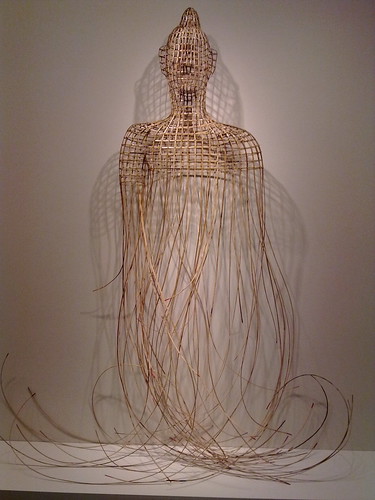
Quite an exhibit, in several of the Asian galleries, including up a staircase to an elevated gallery. An exploration, a winding revelation.  Sopheap Pich at the Met until July 7. When the Khmer Rouge was in power, morning glories (above) were sometimes all that were available for food, or at least for filling of the stomach.


I haven't found a photo showing the blush of red at the tips of the rattan, the faint riveting reminder of the Khmer Rouge's stranglehold on Cambodia. No matter.  "Budda 2." A sculpture of rattan, wire, and dye.

An excerpt from the artist's statement:
Buddha 2 was born out of a short journey my family took on foot from a Khmer Rouge village to the center of Battambang, the province of my birth. The Buddha was to symbolize a temple called Wat Ta Mim. My family built a hut across the street. I used to go past the temple ground everyday with a buffalo to the rice field several hundred meters away. I would occasionally walk inside the temple hall to see bloodstains on the floor, ceiling, and walls—bloodstains that looked like they had been sprayed with a toy gun. Where there used to be the normal Buddha sculptures, there were just piles of broken things I couldn’t see. . . . I was afraid to look in the dark. [Sophea Pich]
 
Sopheap Pich at the Metropolitan Mueum of Art.

Sunday, March 10, 2013

My AWP Takeaway

Family Dog Presents Buffalo Springfield
My AWP Takeaway

1.  Google runs buses from "the Valley" into San Francisco.
2.  There is, was, and will be gorgeous poetry in Turkey.
3.  Google runs buses from San Francisco into "the Valley."
4.  Nazim Hikmet, 1902 to 1963, is a joy to read.
5.  Those Google people are sure tight with their money when it comes to charitable giving.
6.  Lewis Hyde's exploration of The Gift presents us writers with models of being.
7.  San Francisco has a decent poetry scene, but who wants to live there.
8.  Boston breeds poets and venues.
9.  No good music has come out of San Francisco since Buffalo Springfield.
10.  There are, in fact, countless wonderful poets in Boston and everywhere.
11.  Jefferson Starship?  You kidding me?
13.  Writers of fiction, nonfiction, creative abstracts & co. abound, are enthusiastic, convivial, and of course all too human.
14.  Did Hot Tuna come out of S.F.? 
15.  Approaches to and manifestations of persona poems are varied.
16.  Now, L.A., is a great place to live.
17.  Uses of letters (epistles) in writing range from highly creative to usefully functional and (most) always interesting.
18.  Google is in search of something or other. God help us all when Google finds it.
19.  Hearing poetry in a bar with warm colors and brass fixtures is a necessary antidote to convention center readings.
20.  Soft hands are, for some, genetic.

Basically, heard and saw and met many n-a-m-e-s and wondrous people. The Dusie Kollektiv chapbook swap was a highpoint, partly because it facilitated putting faces to names, mainly because the poets were fun and generous. 

Suggestion for another AWP:  Read all material in advance. Make lists of people I want to catach up with. Plan.  Get phone numbers in advance.  Stay closer to the convention center so offsite readings in the eventuality of snow or other weather are easier to negotiate than they were this time around.